Targu Mures
The castle of Târgu Mureș, located in the heart of Târgu Mureș, Romania, is a remarkable example of a Renaissance bastioned fortress with a complex history spanning several centuries. Originally established around a Franciscan church and monastery, the fortress evolved through periods of conflict, reconstruction, and military use, reflecting the turbulent history of Transylvania and the broader region.
The earliest historical records mention Târgu Mureș in 1322 as a market settlement along the Mureș River valley. The area likely hosted a Dominican church destroyed during the 1241-1242 Tatar invasion. By 1405, King Sigismund of Luxembourg granted the town market privileges, and in 1470, King Matthias Corvinus elevated it to royal city status. A Franciscan monastery, one of four in Transylvania, is documented from 1332. After a fire destroyed the wooden church in 1360, the Franciscans began building a stone church, completed by 1490. Two years later, István Báthory, the voivode of Transylvania and father of the future Polish king Stephen Báthory, ordered defensive walls to enclose the church and monastery.
Early fortress and turbulent 16th century
The initial fortress was strategically important as a stronghold to control the Székely population. It witnessed significant historical events, including the imprisonment of the Hungarian Renaissance poet Bálint Balassi in 1575 and the torture of Székely rebels in 1596. However, the original fortress was destroyed in 1601 during military conflicts involving Giorgio Basta and Mihai Viteazul.
Construction of the renaissance bastioned fortress (1602–1652)
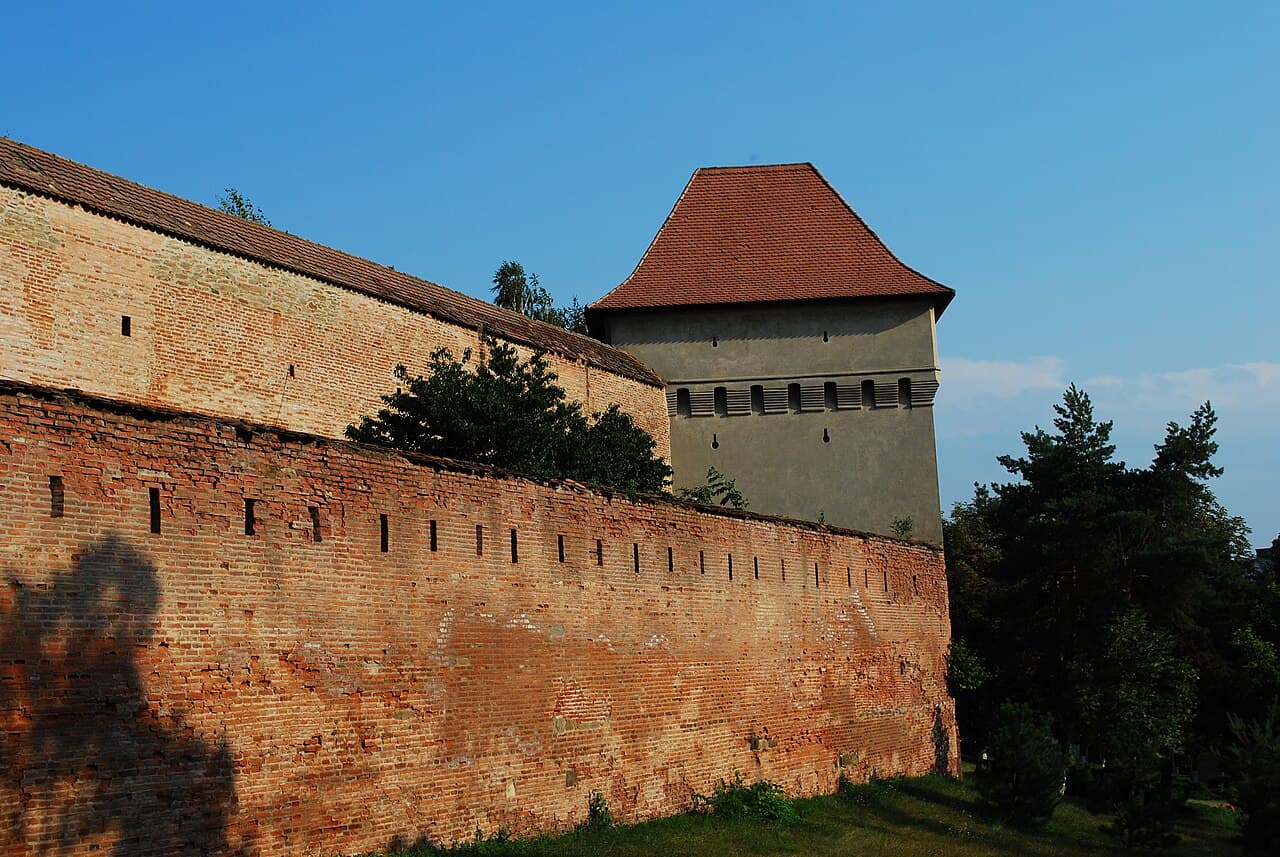
Following the destruction, reconstruction began in 1602 and lasted until 1652, resulting in the fortress visible today. The new design featured a roughly pentagonal plan with seven bastions, each named after the local craft guilds that financed their construction: the Shoemakers', Furriers', Coopers', Tailors', and Butchers' bastions. Two additional bastions included the Gate Bastion with the main entrance and the Bathory Tower Bastion, named after the fortress's builder. The walls connecting these bastions were built from brick and stone, reaching 10 meters in height, and the bastions were equipped with artillery positions on the lower levels and firing positions for handheld firearms on the upper floors.
The fortress was surrounded by a moat approximately 9 meters wide and 2.5 meters deep, fed by water from the nearby Mureș River. Inside the walls, several buildings were constructed to serve the fortress's military and administrative functions.
Military history and later transformations
In 1661, the fortress was captured by Ottoman forces, and it suffered damage during subsequent wars with the Turks and the Kuruc uprisings. After Transylvania's integration into the Habsburg Empire, the fortress lost its military significance. Around 1775, the Austrians demolished many internal buildings and replaced them with barracks, ammunition depots, and other military facilities. The moat was filled in 1910 to accommodate urban development. In 1962, plans to build an amusement park on the site were abandoned due to lack of funding, preserving the fortress ruins.
Architectural features and surviving structures
The fortress covers an area of approximately 4.3 hectares, enclosed by fortified walls connecting the seven bastions. The bastions are artillery towers rising three to four levels, connected internally by wooden staircases. Unusually, these bastions were not filled with earth, and their embrasures are shaped for smaller caliber firearms and cannons. Defensive features from medieval fortifications, such as "pitch holes" for vertical defense, remain visible on some bastions, highlighting the fortress's unique regional characteristics.
Within the fortress walls stands the Reformed Church, the oldest surviving building in Târgu Mureș. Originally a Franciscan church completed by the late 15th century, it features a striking 55-meter-high Gothic tower with four levels and corner turrets. The church complex includes a Gothic annex, a Gothic facade marking the main entrance, a Baroque nave added later, and a Gothic presbytery.
Another notable building is the former Habsburg command building, now housing the Museum of Archaeology and History. This structure consists of two 17th-century houses connected by a central wing, remodeled in the 18th century into a U-shaped layout. Historically, it served as the city hall in the 17th century.
The courtyard between the church and the command building features a Baroque-style artesian fountain, a replica of an early 19th-century original, reflecting the artistic heritage of the period.
Restoration and cultural significance
Recent decades have seen extensive restoration efforts funded by the European Union and other sources. These projects have repaired fortress walls and roofs, refurbished internal buildings, and landscaped the grounds. A geodesic dome inspired by mathematician János Bolyai was constructed within the complex, symbolizing the fortress's cultural connection to regional heritage. Accessibility improvements include a bronze tactile model with Braille inscriptions for visually impaired visitors.
Archaeological excavations have revealed evidence of early industrial activities within the fortress, including workshops for brick manufacturing and bronze processing, as well as a cellar with furnaces. A 15th-century fresco depicting King Ladislaus I of Hungary was discovered during church restoration, linking the site to medieval artistic traditions.
The castle of Târgu Mureș stands today as a testament to the region's layered history, architectural evolution, and cultural resilience. It offers visitors a unique glimpse into the Renaissance military architecture and the historical narratives of Transylvania's diverse communities.
Frequently asked questions (FAQ)
- What is the historical significance of Targu Mures Castle?
- Targu Mures Castle, also known as the Fortress of Târgu Mureș, is a symbol of medieval architecture in Transylvania. Built in the 15th century, it served as a defensive structure and reflects the rich history of the region, including various influences from different cultures over the centuries.
- When was Targu Mures Castle built?
- The construction of Targu Mures Castle began in the late 15th century, specifically around 1492, and was completed in the early 16th century. It was designed to withstand attacks and played a vital role in the defense of the town during its early years.
- What are the opening hours for Targu Mures Castle?
- Targu Mures Castle is typically open to visitors from 10 AM to 6 PM, but it’s recommended to check for seasonal variations or holidays that may affect these hours. Guided tours are often available, providing visitors with insights into the castle's history and architecture.
- Can I take photographs inside Targu Mures Castle?
- Yes, visitors are generally allowed to take photographs inside Targu Mures Castle, although some areas may have restrictions. Be sure to respect any signage regarding photography to ensure a pleasant experience for everyone.
- Is it possible to access Targu Mures Castle with a wheelchair?
- While Targu Mures Castle has made efforts to improve accessibility, some areas may be challenging for wheelchair users due to the castle's historical architecture. It is advisable to contact the castle ahead of your visit to inquire about specific accessibility options available.
- What are the ticket prices for Targu Mures Castle?
- Ticket prices for Targu Mures Castle are quite affordable, typically ranging from 10 to 20 Romanian Lei for adults, with discounts available for students and seniors. Special family tickets and guided tour options may also be available at different rates.
- When is the best time to visit Targu Mures Castle?
- The best time to visit Targu Mures Castle is during the spring and early autumn months when the weather is mild and pleasant. Additionally, these seasons often feature fewer crowds, allowing for a more enjoyable exploration of the castle and its surroundings.
- What nearby attractions can I visit after Targu Mures Castle?
- After visiting Targu Mures Castle, you can explore the nearby Cultural Palace, which showcases stunning architecture and houses various museums. The city also offers beautiful parks and the Mureș River, providing opportunities for leisurely strolls and scenic views.
Photo gallery

Information
Loading map...
Visitor reviews
No reviews yet. Been here? Write the first review and help other travelers!
Write the first reviewVisited this castle? Share your experience
Your review helps other travelers and adds first-hand knowledge to our encyclopedia.