
Tarascon Castle
Tarascon Castle, located on the banks of the Rhone River in the Bouches-du-Rhône department of Provence-Alpes-Côte d'Azur, France, stands as one of the most remarkable and well-preserved medieval fortresses in Europe. This imposing castle, built primarily in the early 15th century between 1400 and 1435, was commissioned by the Counts of Provence-Barcelona and the Dukes of Anjou, who were influential noble patrons with ties to the castles of Angers and Saumur. Its strategic location on a rocky islet overlooking the Rhone made it a monumental sentinel guarding the political border and controlling river traffic.
The site originally hosted an earlier castle, likely constructed by Roubaud II, Marquis of Provence, sometime between 994 and 1010. This early fortress was partially destroyed and rebuilt over the centuries. By the mid-13th century, it was occupied by Charles d'Anjou, Count of Provence and brother to King Louis IX of France. His son, Charles II "the Boiteux", expanded the castle further. The fortress played a significant role during the turbulent 14th century, notably during the siege led by the famed military commander Bertrand Du Guesclin in 1368, acting on behalf of Duke Louis d'Anjou. This siege marked a crucial episode in the French ambitions to assert control over Provence.
Architectural evolution and construction
The current structure of Tarascon Castle was largely rebuilt beginning on November 27, 1400, by Louis II of Anjou, Count of Provence, after his return from Italy. The construction proceeded swiftly but was interrupted, resuming from 1428 to 1435 under the direction of his son, Louis III of Anjou. The castle was designed by the architect Jean Robert, who collaborated with sculptors Simon de Beaujeu and Jacques Morel. The stone materials were quarried from Beaucaire, ensuring the fortress's robust and enduring construction.
The castle is composed of two distinct parts: to the north lies the farmyard, which was dedicated to the staff and soldiers, and to the south, the residential dwelling. The fortress features massive towers, thick curtain walls, and a moat that historically added to its defensive capabilities. The castle's drawbridge was replaced with a fixed bridge in the late 15th century, under the reign of King René I, who also made modifications to improve the castle's habitability between 1447 and 1449. During this period, overseen by Jean de Serocourt and Regnault de Serocourt, the captain and lieutenant of Tarascon, a niche was created in the main courtyard displaying busts of King René and Queen Jeanne de Laval, symbolizing their patronage and presence.
Historical significance and notable events
Tarascon Castle was not only a military stronghold but also a cultural hub during the reign of King René I, who hosted prestigious gatherings and courtly events within its walls. After his death, the castle's use as a royal residence diminished, and it transitioned into a place of detention early on. By 1480, it was already serving as a prison, notably incarcerating a Catalan prisoner who left engraved motifs on the dungeon walls depicting warships and religious symbols.
The castle's prison function intensified from the 17th century until 1926, when the prison was definitively closed. During the French Revolution, supporters of Robespierre were executed here, marking the castle's dark chapter in revolutionary history. The transformation into a prison led to structural changes, including the partitioning of rooms into collective and individual dungeons, which caused damage to the original medieval architecture.
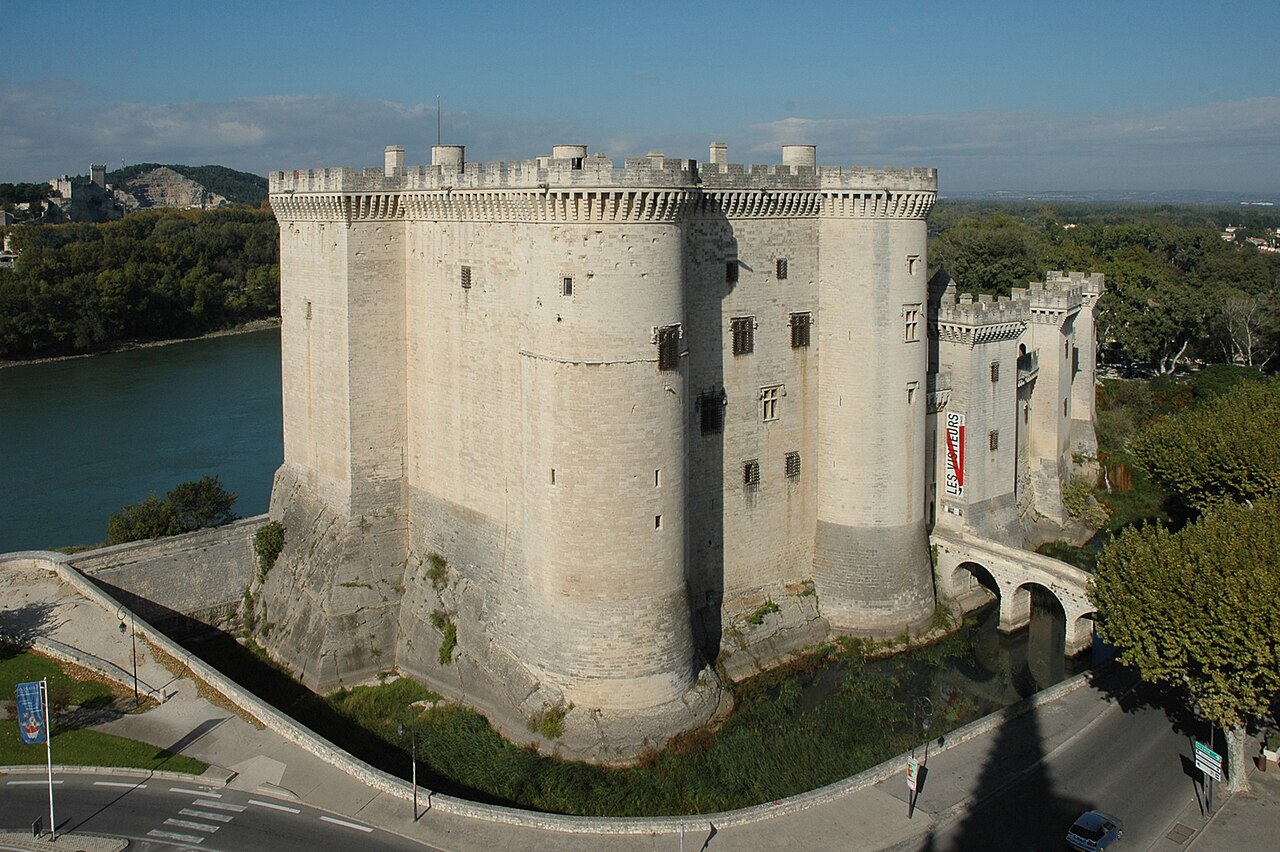
Photo by Gérard MARIN • CC BY 2.5
Restoration and preservation efforts
Recognizing the castle's historical and architectural value, restoration efforts began in 1932 under the guidance of architects Henri Antoine Révoil and Jean Camille Formigé, specialists in historical monuments. These restorations aimed to repair the damage inflicted by its prison use, removing partitions, reopening windows, and restoring the castle's medieval appearance. Further extensive restoration work continued from 1940 to 1980, allowing Tarascon Castle to regain much of its original grandeur and structural integrity.
Today, the castle remains well preserved and is a prominent cultural landmark in the region. Its terrace offers panoramic views of the Rhone River, the Alpilles mountain range, and the Montagnette hills, attracting visitors interested in medieval architecture, history, and scenic landscapes.
Architectural features and layout
The castle exemplifies high medieval military architecture with features designed for both defense and residence. Its massive stone walls and towers provided formidable protection against sieges. The layout includes a central courtyard surrounded by living quarters, defensive battlements, and service buildings. The northern farmyard area supported the castle's garrison and staff, while the southern residential section housed the noble family and their guests.
The castle's design reflects the transition from purely defensive fortresses to more habitable noble residences, incorporating comfort and aesthetic elements alongside military functionality. The presence of sculptural decorations by Simon de Beaujeu and Jacques Morel adds artistic value to the fortress, blending utility with Renaissance influences emerging in the 15th century.
Visiting tarascon castle today
Visitors to Tarascon Castle can explore its well-maintained halls, towers, and courtyards, gaining insight into the medieval lifestyle of the Anjou counts and the castle's role in regional history. The site often hosts cultural events and exhibitions that highlight its rich heritage. Its accessibility and preservation make it a key destination for those interested in medieval architecture and French history.
Frequently asked questions (FAQ)
- How do I get to Tarascon Castle?
- Tarascon Castle is located in the town of Tarascon in the south of France. You can easily reach it by car, with parking available nearby, or by taking a train to Tarascon station followed by a short walk to the castle.
- What is the historical significance of Tarascon Castle?
- Tarascon Castle, built in the 15th century, is a remarkable example of medieval military architecture. It played a crucial role in defending the region against invasions and has been a symbol of local power for centuries.
- When was Tarascon Castle built?
- Construction of Tarascon Castle began in 1400 and was completed in 1430. The castle was commissioned by King René of Anjou as a fortress to protect the strategic route along the Rhône River.
- Can I visit Tarascon Castle year-round?
- Yes, Tarascon Castle is open to visitors throughout the year, although opening hours may vary seasonally. It’s best to check the official website for the most accurate and updated information before planning your visit.
- Why is Tarascon Castle considered an architectural marvel?
- The castle is celebrated for its impressive fortifications, including massive towers and thick walls, which were designed to withstand sieges. Its well-preserved structure offers a glimpse into medieval military design and reflects the historical importance of the region.
- Is it possible to take guided tours of the castle?
- Yes, guided tours are available at Tarascon Castle, providing visitors with in-depth information about its history and architecture. These tours enhance the experience by offering insights that self-guided visits might miss.
- What are the ticket prices for Tarascon Castle?
- Ticket prices for Tarascon Castle are generally affordable, with discounts available for students and seniors. Children under a certain age may enter for free, making it a great outing for families.
- What is the best time to visit Tarascon Castle?
- The best time to visit Tarascon Castle is during the spring and fall when the weather is mild, and the crowds are smaller. Visiting during these seasons allows you to enjoy the beautiful surroundings and the historical ambiance of the castle.
- Are there any nearby attractions to explore?
- Yes, nearby attractions include the charming town of Tarascon itself, with its quaint streets and local shops, as well as the historic Saint-Michel Chapel. Additionally, the region offers beautiful natural landscapes and other castles to explore.
Photo gallery

Information
Website
Visit websiteSources & official resources
Verify the information above using these authoritative references.
Loading map...
Visitor reviews
No reviews yet. Been here? Write the first review and help other travelers!
Write the first reviewVisited this castle? Share your experience
Your review helps other travelers and adds first-hand knowledge to our encyclopedia.