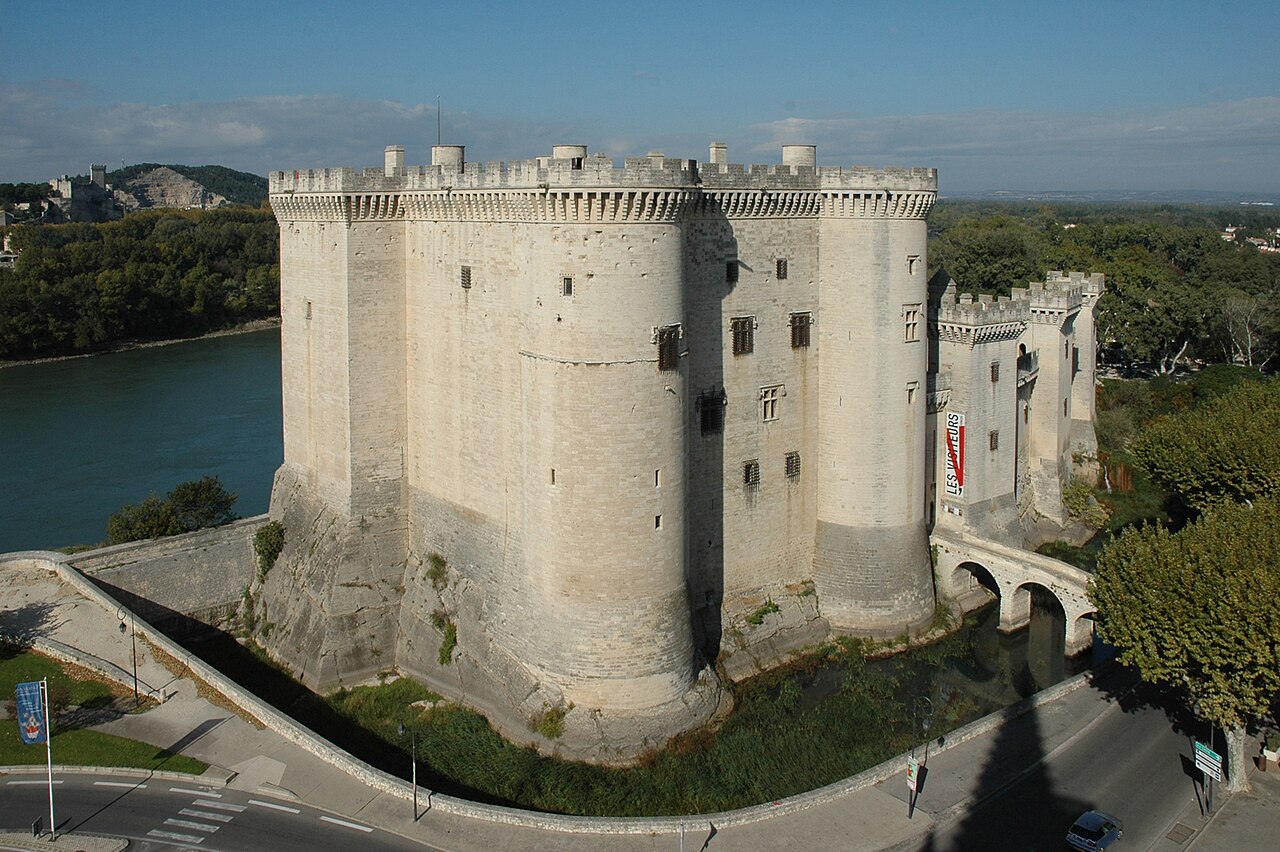
Château de Boulbon
Château de Boulbon stands as a remarkable example of a medieval hill castle strategically perched on a rocky promontory overlooking the Rhône valley in southern France. Its origins trace back to the early 11th century, with the first documented mention in 1003. The castle's location was of great military and political importance, marking the border between the County of Provence and the Kingdom of France. This position enabled control over vital trade routes and regional power dynamics during the High Medieval period.
The castle's current remains primarily date from the 13th to 15th centuries, reflecting successive phases of construction and fortification. Although today it lies in ruins, the site retains significant architectural and historical features that illustrate its evolution through centuries of conflict, ownership changes, and adaptation to emerging military technologies.
Historical significance and ownership
The Château de Boulbon was initially built by local powers in the 11th century to establish a stronghold on this commanding site. Its early importance is evidenced by its mention in documents from 1003. Over the centuries, the castle passed through the hands of notable figures, including Raymond de Turenne, a prominent nobleman known for his military campaigns in Provence, and King René, ruler in the 15th century who contributed to the castle's development.
In 1608, the lordship associated with the castle was elevated to a county, underscoring its administrative and territorial significance. This title was later acquired by the Raousset-Boulbon family in 1784, who maintained possession until the 19th century. The castle ceased to function as a residence during the 19th century, falling into disuse and eventual ruin.
The last notable family member, Gaston de Raousset-Boulbon, left the castle to pursue colonial and revolutionary activities abroad, dying in 1854. The final count of the lineage died without heirs in 1956, after which the property passed to the La Vaissière de Lavergne family. Recognizing its cultural and historical value, the site has been protected as a historic monument since 1976, with ongoing preservation and archaeological efforts.
Architectural layout and defensive features
The castle's design is closely adapted to the natural contours of the rock on which it stands. Its enclosure forms a long, narrow courtyard approximately 45 meters in length and varying between 9 and 15 meters wide. The perimeter is fortified by thick curtain walls, about 1.6 meters thick, which notably lack foundational bases, a factor that has contributed to their vulnerability to erosion and structural instability over time.
At the core of the fortress lies the oldest surviving structure: a rectangular keep (donjon) dating back to the 11th century. This keep originally rose to four stories, with one level partially embedded into the rock beneath, enhancing its defensibility. Attached to its southern side is a small watchtower, primarily intended for observation rather than habitation, emphasizing the castle's focus on surveillance and defense.
The curtain walls surrounding the keep were constructed mainly during the 13th century, with significant enhancements in the 14th century. Among these are machicolations—defensive openings in the battlements allowing defenders to drop projectiles or boiling substances on attackers below. These machicolations are decorated with distinctive trilobed motifs, a stylistic feature also found at the nearby Château de Tarascon, indicating regional architectural influences.
Lordly residence and internal structures
By the late 14th century, the castle saw the construction of its logis seigneurial, or lordly residence, positioned along the western side of the courtyard with an adjoining expansive terrace. This two-story building, topped by an attic, comprises approximately thirty rooms, reflecting the castle's role not only as a military fortress but also as a noble residence.
Central to the internal layout is the remains of a double spiral staircase, accessible from a southern garden area, which would have facilitated movement between floors. Decorative elements such as a water buffet—a basin or fountain feature—and sculpted rock formations integrated into the architecture highlight the blend of functionality and aesthetic consideration in the castle's design.
Innovations in water management
One of the castle's most advanced features is its 15th-century water supply system. Fed by a natural spring, this system employed glazed terracotta pipes to channel fresh water directly into the living quarters. The water was first directed into small settling basins designed to remove impurities, before overflowing into wash basins located beneath terraces.
Excess water was carefully drained away to maintain hygiene and prevent damage to the structure. Traces of these conduits remain visible in the walls of the lordly residence, providing valuable insight into medieval engineering and the importance of sustainable water management in castle life.
Later modifications and current condition
During the 17th century, the castle's surroundings were enhanced with the addition of terraced gardens and a carriage road leading to the northern gate. These modifications reflect a shift towards more comfortable and aesthetic considerations, as well as improved access for transportation.
Despite these improvements, the castle was eventually abandoned and suffered from pillaging and neglect, leading to its current state as a ruined fortress. Conservation efforts have been underway since its designation as a historic monument, aiming to stabilize the remaining structures and preserve the site's archaeological significance.
Today, visitors to Château de Boulbon can explore the evocative ruins that tell a story of medieval military strategy, noble residence life, and innovative engineering. The castle remains a significant cultural landmark in the region, offering insights into the complex history of Provence and the medieval borderlands between powerful realms.
Information
Website
Visit websiteSources & official resources
Verify the information above using these authoritative references.
Loading map...
Visitor reviews
No reviews yet. Been here? Write the first review and help other travelers!
Write the first reviewVisited this castle? Share your experience
Your review helps other travelers and adds first-hand knowledge to our encyclopedia.