
Takeda Castle
Takeda Castle stands as a remarkable example of a late medieval hill castle in Japan, renowned for its breathtaking ruins perched atop a mountain in Asago, Hyogo Prefecture. Built in 1441 by Ohtagaki Mitsukage, a retainer of the powerful Yamana clan, the castle was strategically positioned to guard the border between the Harima/Tanba and Tajima regions. Its location atop a mountain ridge provided a natural defensive advantage, overseeing the surrounding valleys and controlling vital routes between these feudal domains.
Historical context and strategic significance
The castle was constructed during a period of intense regional conflict in Japan's late medieval era, serving as a stronghold for the Izushi domain. Ohtagaki Mitsukage, who commanded the military forces of the Yamana clan for five generations, became the lord of Takeda Castle, solidifying its role as a critical military and administrative center. The castle's primary function was to defend against incursions and maintain control over the contested borderlands.
In 1577, Takeda Castle was seized by Toyotomi Hideyoshi during his campaign to unify the region. Hideyoshi entrusted the castle to his younger brother, Hidenaga, although Hidenaga relocated to Izushi within two years, reflecting the shifting political landscape of the time. Subsequently, in 1585, the castle came under the lordship of Akamatsu Hirohide, who undertook significant renovations to strengthen its defenses, especially to secure the nearby Ikuno silver mines, an important economic asset.
Architectural features and construction
Takeda Castle is celebrated for its extensive and well-preserved stone walls, which date primarily from Akamatsu Hirohide's renovations in the late 16th century. These walls are remarkable for their size and the skill required to build them on the rugged mountain terrain. The castle's layout includes multiple baileys, terraces, and defensive structures that take full advantage of the natural topography.
The castle's design incorporates traditional Japanese fortification elements such as curved stone walls, watchtowers, and gates strategically placed to control access and provide vantage points for surveillance. The ruins reveal the castle's former complexity, with remnants of residential quarters, administrative buildings, and defensive works.
Defensive landscape and surrounding features
The castle's elevated position offers commanding views over the surrounding valleys, which was essential for early warning and defense. At the foot of the mountain, several temples and shrines were established, serving dual roles as spiritual centers and part of the castle's defensive network. These religious complexes feature walls resembling castle fortifications, further enhancing the site's security.
Across the valley lies Ritsuunkyo Park, a popular vantage point offering panoramic views of the castle ruins, famously known as the "castle in the clouds" due to the frequent mist that envelops the mountain. This scenic beauty has contributed to the castle's popularity among visitors and photographers.
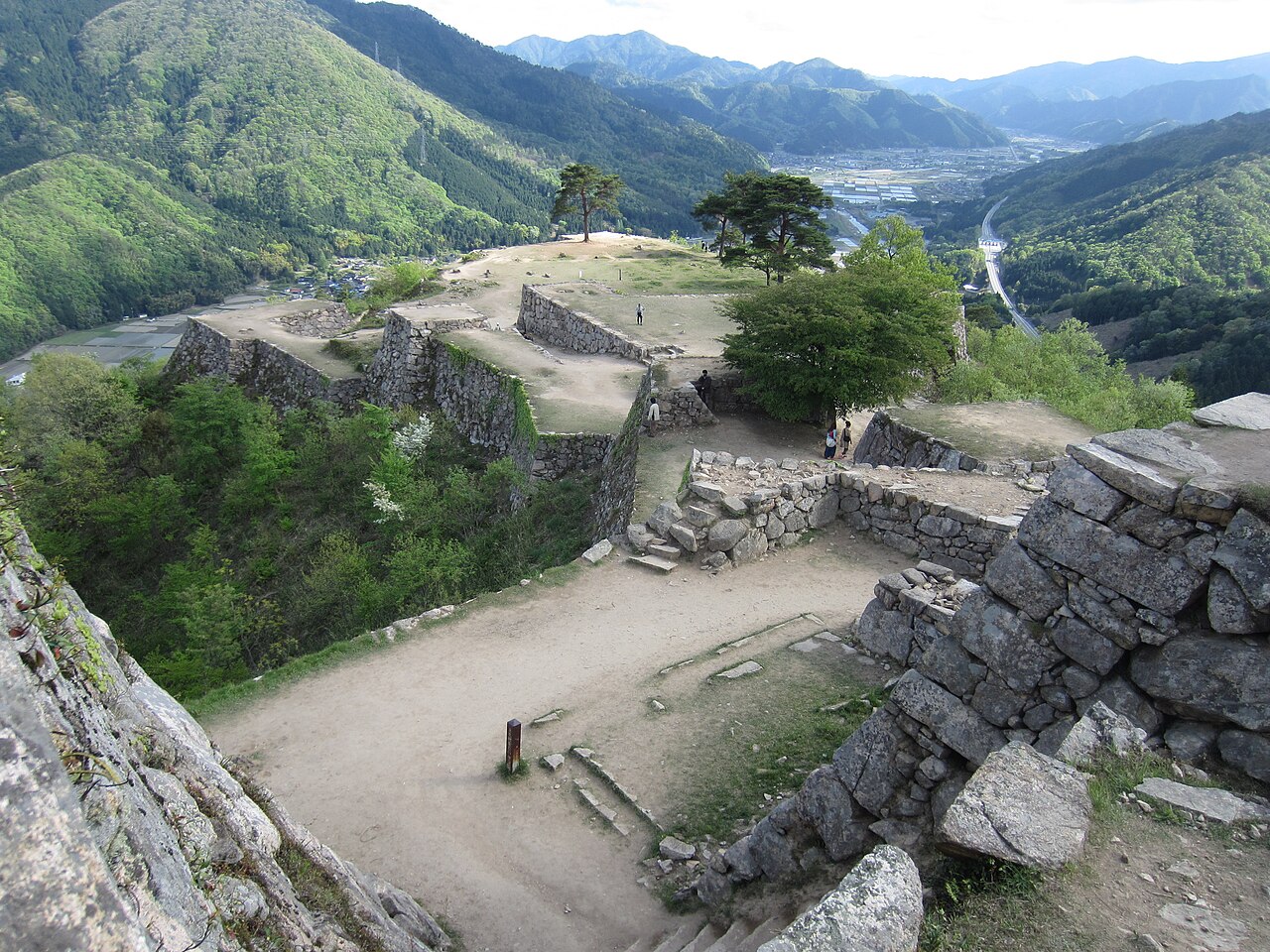
Photo by Baku13 • CC BY-SA 3.0
Decline and preservation challenges
Following Akamatsu Hirohide's participation in the Battle of Sekigahara in 1600, where he fought for the Western Forces, he was accused of setting fire to the castle town. Subsequently, Hirohide committed seppuku, and Takeda Castle was abandoned, marking the end of its active military use.
Today, Takeda Castle remains in a state of ruins, yet it is one of Japan's most celebrated historic sites. The extensive stone walls and the castle's dramatic mountaintop setting continue to attract visitors. However, the site has faced significant preservation challenges due to increased tourism. The surge in visitors, especially after media exposure highlighting its ethereal "castle in the clouds" appearance, has led to soil erosion and damage to the stone walls.
To mitigate these effects, authorities have restricted access to certain trails and areas within the castle grounds. Some original hiking paths have been closed or limited to protect the fragile environment. Visitors are now required to stay on designated paths, and some sections such as the Hanayashiki Bailey remain closed to prevent further deterioration.
Visitor experience and access
Visitors to Takeda Castle are encouraged to allocate at least 90 minutes to explore the ruins and take in the spectacular views. The site is accessible via limited train services to nearby stations, followed by a hike up the mountain. The experience is enhanced by the presence of nearby temples and the scenic Ritsuunkyo Park, which offers alternative perspectives of the castle.
The castle is particularly popular during late autumn and winter when the foliage and weather conditions enhance visibility of the stonework and the surrounding landscape. Due to its popularity and conservation measures, visitors should plan their trips carefully and respect the site's preservation rules.
Cultural significance and legacy
Takeda Castle holds a unique place in Japanese cultural heritage as a symbol of feudal military architecture and regional history. Its ruins evoke the turbulent era of Japan's Sengoku period and the strategic importance of mountain castles in controlling territory and resources.
The castle's evocative ruins and stunning natural setting have inspired numerous photographers and artists, contributing to its reputation as the "Machu Picchu of Japan." Its preservation efforts reflect a broader commitment to protecting Japan's historic sites while balancing the demands of tourism and conservation.
Frequently asked questions (FAQ)
- How do I get to Takeda Castle?
- Takeda Castle is accessible by train to Asago city, followed by a hike up the mountain. Limited train services operate, so plan accordingly and wear comfortable shoes for the ascent.
- When is the best time to visit Takeda Castle?
- The best time to visit is during late autumn and winter, when the foliage is colorful and the weather conditions allow clear views of the stone walls and surrounding landscape.
- Can I explore all areas of Takeda Castle ruins?
- Access to some areas of Takeda Castle ruins is restricted to protect the site from erosion and damage. Visitors must stay on designated paths, and some sections like the Hanayashiki Bailey are closed.
- What is the historical significance of Takeda Castle?
- Takeda Castle was a strategic stronghold during Japan's late medieval period, built to guard regional borders and control important resources like the Ikuno silver mines.
- Are there facilities near Takeda Castle for visitors?
- At the foot of the mountain, there are temples and shrines that visitors can explore. Nearby Ritsuunkyo Park offers excellent views of the castle and is a popular spot for photography.
Photo gallery

Information
Opening hours
Some areas currently blocked off for repairs.
Current owner
Municipality
Website
Visit websiteSources & official resources
Verify the information above using these authoritative references.
Loading map...
Visitor reviews
No reviews yet. Been here? Write the first review and help other travelers!
Write the first reviewVisited this castle? Share your experience
Your review helps other travelers and adds first-hand knowledge to our encyclopedia.