Szczerba Castle
Szczerba Castle stands as a significant medieval hill fortress located in the municipality of Gniewoszów, Poland. Established by Polish knights in the late 13th century, this stronghold occupies a strategic position atop a gneiss hill at 520 meters elevation, overlooking important trade routes and guarding the Poręba Pass toward Bohemia. The castle's history reflects the turbulent political landscape of the region, marked by shifting control between Polish and Czech rulers.
The site of Szczerba Castle likely hosted a fortification as early as the 11th century, during the military conflicts between Polish ruler Bolesław Chrobry and the Czechs over the Kłodzko territory. The extant stone castle was constructed by the end of the 13th century, embodying the medieval defensive architectural principles of the time. Shortly after its completion, the fortress was transferred by Czech King Wenceslaus II to the Cistercian abbey of Kamieniec Ząbkowicki, indicating its importance within regional power structures.
Historical evolution and ownership
The first verified written record of the castle dates to 1358, naming Otto Schuler, son of Otto von Glaubitz from Lusatia, as its owner. The Glaubitz family likely acquired the castle in the early 14th century when John of Luxembourg gained authority over the Kłodzko region. Ownership remained with the Glaubitz lineage, with Bernhard Glaubitz serving as the starost (royal governor) until 1428.
In 1428, the castle was captured and effectively destroyed by Hussite forces during their military campaigns. The use of artillery in this siege marked a turning point in medieval warfare, rendering many traditional fortresses vulnerable. Following this destruction, Szczerba Castle was never rebuilt as a defensive stronghold. Instead, it transitioned into a titular seat managing the nearby Międzylesie estates.
Over subsequent centuries, the castle passed through the hands of various owners, including local village administrators and noble families such as Paul Prebir, the von Tschirnhaus family, counts von Althann, barons von Stillfried, count von Magnis, and Princess Marianna Orańska. Its function evolved from military fortress to an administrative center overseeing feudal properties.
Strategic importance and naming history
Szczerba Castle was strategically positioned to guard a vital trade route crossing the Poręba Pass, facilitating commerce between Poland and Bohemia. It also served as the administrative hub for the territory known historically as the Śnielin state. The castle’s name evolved over time, originally known as Śnielin or Śnielinek, later adopting the German name Burg Schnallenstein, before becoming known as Szczerba Castle.
Architectural features and layout
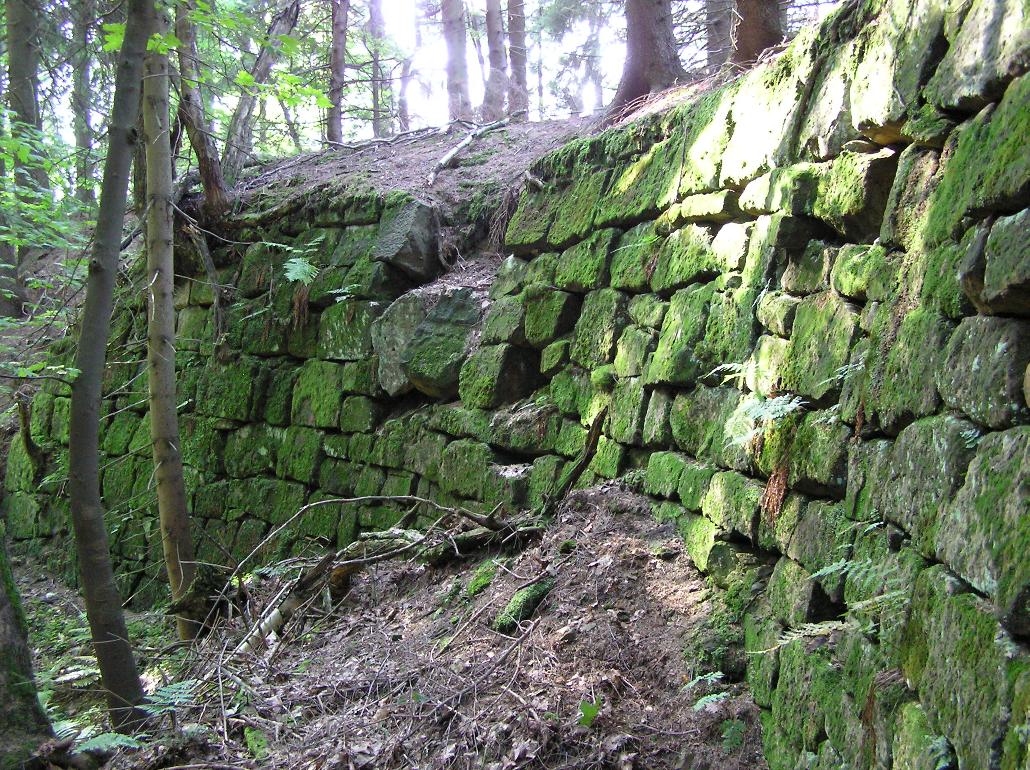
The castle was constructed on an irregular, oval-shaped plan resembling a horseshoe, with a straight western side and a projecting northern section. Its defensive perimeter consisted of thick walls over 100 meters long, reaching heights up to 9 meters and approximately 1.5 meters wide. These walls enclosed a courtyard about 40 meters long from east to west, and between 10 and 18 meters wide.
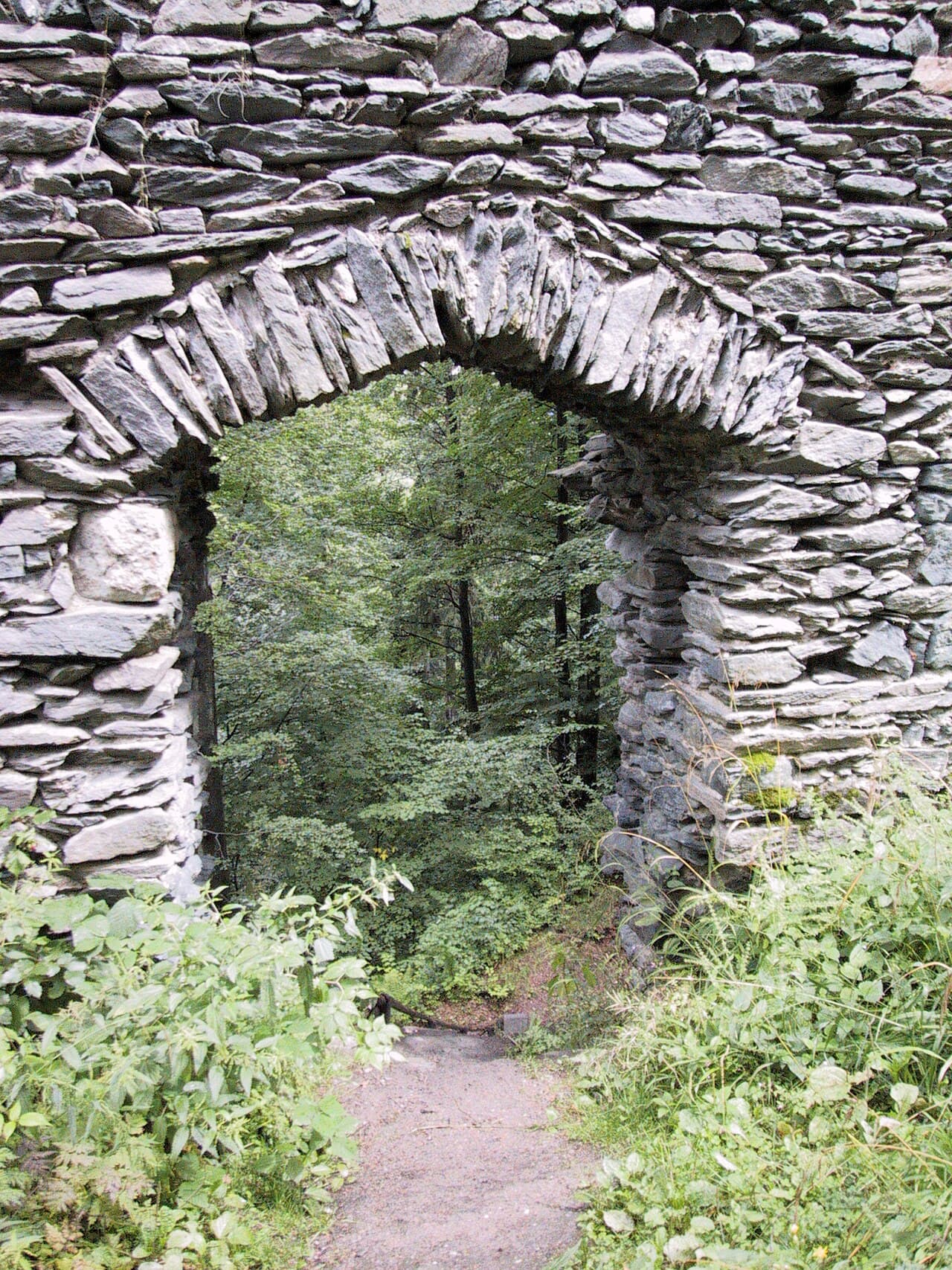
Defenses were enhanced by a deep dry moat cut directly into the rock on the south, southwest, and west sides. Originally, access to the castle was via a drawbridge spanning this moat, leading to a narrow main gate about 3 meters wide. A smaller gate was located on the northern part of the western wall.
Residential buildings were situated against the northern enclosure wall facing the Głownia valley. These two-story stone buildings had a nearly rectangular base measuring approximately 9.5 by 19.5 meters, containing four living quarters and a basement. Opposite the main entrance, a small castle chapel likely stood on a rocky outcrop, serving the spiritual needs of the inhabitants.
The courtyard, though limited in space, accommodated a tower at the northeast corner, along with essential service buildings such as stables, garrison barracks, and other quarters lining the inner faces of the curtain walls. The use of uncut stones in construction reflects the regional building materials and techniques of the medieval period.
Decline and current state
From the 16th century onward, stones from the castle ruins were quarried and repurposed for other construction projects. This activity exposed previously buried architectural elements, including lower vaulted floors and staircases, providing valuable insights into the castle’s original structure.
Today, the ruins of Szczerba Castle remain a striking testament to its medieval past. Significant segments of the thick defensive walls survive, some still reaching their original height of about 9 meters. The tower, remnants of the courtyard, portions of the residential buildings, the gate complex, and traces of the dry moat are clearly visible. These ruins are surrounded by natural deciduous and mixed forests, with two mountain streams flowing nearby, enhancing the site’s scenic and historical appeal.
Szczerba Castle’s remains offer a rich archaeological and cultural heritage site that reflects the complex history of borderland fortifications in Central Europe. Its story encapsulates the evolution from a strategic military fortress to a feudal administrative center, mirroring broader historical shifts in the region.
Frequently asked questions (FAQ)
- When was Szczerba Castle originally built and by whom?
- Szczerba Castle was originally built in the late 13th century by Polish knights, establishing a strategic stronghold in the region.
- What is the current condition of Szczerba Castle and what remains can visitors see?
- The castle is currently in ruins, with substantial segments of defensive walls, a tower, gate complex, and remnants of residential buildings still visible.
- Why was Szczerba Castle never rebuilt after its destruction in 1428?
- After its destruction by Hussite forces in 1428, the castle was not rebuilt as a fortress but instead served as an administrative center for nearby estates.
- What historical significance does Szczerba Castle hold in the region?
- Szczerba Castle guarded a vital trade route through the Poręba Pass and served as a feudal administrative hub, reflecting the region's medieval political and military history.
- Can visitors access the castle ruins year-round and are there any entrance fees?
- Information about visiting hours and entrance fees for Szczerba Castle is not widely published, so visitors should check local sources before planning a visit.
Photo gallery

Information
Website
Visit websiteSources & official resources
Verify the information above using these authoritative references.
Loading map...
Visitor reviews
No reviews yet. Been here? Write the first review and help other travelers!
Write the first reviewVisited this castle? Share your experience
Your review helps other travelers and adds first-hand knowledge to our encyclopedia.