Szczecinek
Szczecinek Castle stands as a remarkable example of a medieval hill castle located in the town of Szczecinek, Poland. Its origins date back to the late 13th century, rooted in a strategic Slavic settlement on an island in Lake Trzesieka. This early fortified settlement guarded an important trade route known as the "salt route," connecting Kołobrzeg to Kujawy and Wielkopolska. The castle's location was chosen for its natural defensive advantages and to counter the expansionist threats posed by Brandenburg and the Teutonic Order during the High Medieval period.
The initial fortifications were established around 1310 by Duke Warcisław IV of the Duchy of Wołogoszcz, who sought to strengthen the southeastern borders of his realm. Early structures included a residential building on the island, which was connected to the mainland by a wooden bridge. The nearby town of Nowy Szczecin was founded on Lübeck law on the isthmus between two lakes, further emphasizing the area's regional importance.
Medieval origins and early development
The first stone castle in Szczecinek was constructed around 1356 by Warcisław IV's successors, replacing earlier wooden fortifications. The castle was built on a roughly 70-meter diameter island, approximately 60 meters from the shore, linked by a wooden causeway. The earliest surviving part of the castle is the Gothic brick south wing, a rectangular building measuring approximately 13.6 by 35.5 meters. Initially, this wing featured a high ground floor and shallow cellars, later raised by an additional storey in the late 14th century, becoming known as the "knight's house."
While little is known about the original defensive walls, the castle's layout was typical of the period, with buildings arranged around a courtyard enclosed by curtain walls. The northern gatehouse wing, added in the 15th century under Duke Eric II of Pomerania, featured three storeys and a distinctive cylindrical tower on the eastern corner. Access to the castle was via a drawbridge over a moat that divided the island, highlighting its defensive design.
Renaissance transformations and later history
In the early 17th century, the castle underwent significant transformation under the rule of Dukes Philip II and Ulrich. The southern wing was rebuilt in a Renaissance architectural style between 1606 and 1610, reflecting contemporary tastes and the castle's shift from a fortress to a noble residence. Ulrich replaced the northern gatehouse wing between 1618 and 1622, further modernizing the complex. These renovations reduced the castle's military character, turning it into a comfortable residence for widowed duchesses of the Griffin dynasty, including Duchess Anna Maria and Duchess Jadwiga Brunszwicka.
Following the extinction of the Griffin dynasty, the castle's importance declined. It was repurposed as a courthouse and later housed a manufactory from 1780 to 1793. The northern gatehouse wing was demolished in 1801, and the southern wing experienced numerous alterations that diminished its original stylistic coherence. In the 19th century, the lowering of Lake Trzesieka's water level transformed the castle's island into a peninsula, altering its defensive setting.
20th century preservation and modern use
During the 20th century, Szczecinek Castle saw various uses, including a youth hostel after conservation efforts in the 1960s. The castle suffered neglect until a private investor acquired it in 1996 with plans for a hotel and restaurant, which were not realized beyond roof repairs and stabilization. In 2007, the city of Szczecinek repurchased the property and undertook extensive renovations funded by the European Regional Development Fund.
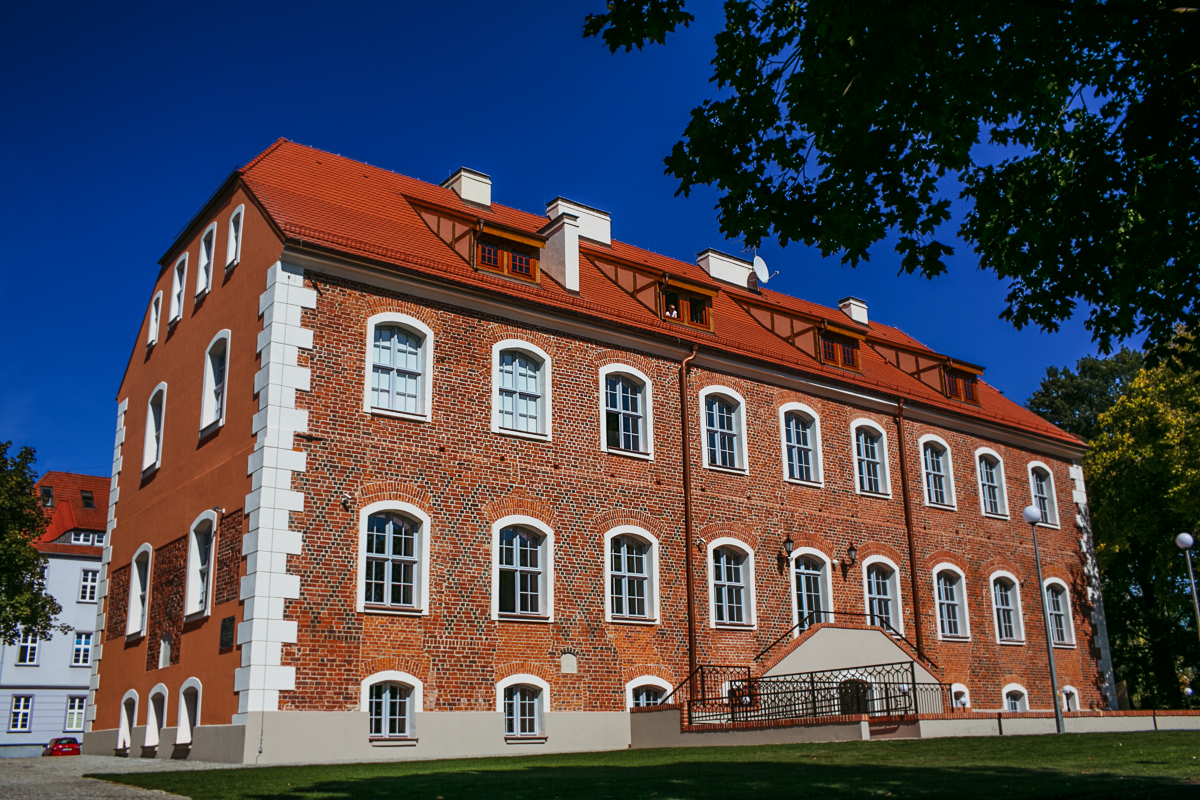
Restoration work uncovered medieval brick decorations known as "zendrówka" bricks, revealing the castle's historical fabric. Today, the castle's well-preserved south wing serves as the Center for Conferences ZAMEK, blending its rich heritage with modern functionality. The castle remains a significant cultural landmark, embodying centuries of architectural evolution from Gothic fortifications to Renaissance residence in the heart of Pomerania.
Architectural features and layout
Szczecinek Castle's surviving south wing is a two-storey rectangular building topped with a steep, dual-pitched roof. The lower walls retain Gothic masonry, while Renaissance modifications are evident in window and door treatments. The castle originally featured a courtyard enclosed by curtain walls, with a moat dividing the island and a drawbridge providing access from the north. The north wing, no longer extant, once included a gatehouse with a cylindrical tower, a typical defensive element of late medieval castles in the region.
Defensive and residential elements
- Curtain walls enclosed the courtyard, providing protection and a controlled internal space.
- The drawbridge and moat enhanced the castle's defensive capabilities by restricting access.
- The knight's house or south wing served as the main residential and administrative building.
- The north gatehouse wing included a tower for defense and observation.
Historical significance and legacy
Szczecinek Castle played a crucial role in the defense and administration of the Duchy of Wołogoszcz and later the Duchy of Pomerania. It was strategically located to resist the expansion of Brandenburg and the Teutonic Knights, two powerful forces in the region during the Middle Ages. The castle also served as a residence for the Griffin dynasty's widowed duchesses, reflecting its evolution from military fortress to noble estate.
Its architectural transformations mirror broader European trends, transitioning from Gothic military architecture to Renaissance residential style. Despite periods of decline and repurposing, the castle's preservation and recent restoration efforts have secured its place as a cultural and historical monument in Poland.
Cultural and tourism aspects
Today, Szczecinek Castle is an important tourist attraction and cultural venue. Its use as a conference center allows visitors to engage with the castle's history while enjoying modern amenities. The castle's location in the picturesque setting of Lake Trzesieka and its proximity to the town of Szczecinek make it accessible and appealing for cultural tourism.
Visitors can appreciate the blend of medieval and Renaissance architectural elements, the castle's historical context, and the ongoing preservation efforts that maintain its structural and aesthetic integrity. Szczecinek Castle stands as a testament to the region's rich heritage and architectural evolution over more than seven centuries.
Frequently asked questions (FAQ)
- What are the visiting hours of Szczecinek Castle?
- Szczecinek Castle is typically open to visitors during regular business hours, especially when hosting conferences and cultural events. It is advisable to check the official website or contact the Municipality of Szczecinek for the most current visiting hours.
- What is the historical significance of Szczecinek Castle?
- Szczecinek Castle was a strategic fortress guarding important trade routes and resisting expansion by Brandenburg and the Teutonic Order. It later became a Renaissance residence for the Griffin dynasty's widowed duchesses, reflecting its evolving role in regional history.
- Can I see original medieval architectural features at Szczecinek Castle?
- Yes, the castle's south wing retains original Gothic masonry in the lower walls, including medieval brick decorations known as zendrówka. Renaissance modifications are also visible, showcasing the castle's architectural evolution.
- Is Szczecinek Castle accessible for tourists with disabilities?
- Accessibility may be limited due to the castle's historic structure, but efforts have been made to accommodate visitors. It is recommended to contact the site in advance to inquire about specific accessibility arrangements.
- When was the major restoration of Szczecinek Castle completed?
- A comprehensive restoration was completed after 2007, funded by the European Regional Development Fund, which uncovered medieval brickwork and stabilized the structure for modern use as a conference center.
Information
Current owner
Municipality of Szczecinek
Loading map...
Visitor reviews
No reviews yet. Been here? Write the first review and help other travelers!
Write the first reviewVisited this castle? Share your experience
Your review helps other travelers and adds first-hand knowledge to our encyclopedia.