Swobnica
Swobnica Castle stands as a significant example of a late-medieval hill castle in Poland, embodying centuries of architectural evolution, military history, and noble residence. Located on a peninsula surrounded by water on three sides, the castle's strategic position on the Grodziskie Lake peninsula enhanced its defensive capabilities and made it a vital stronghold for the Knights Hospitaller, also known as the Joannites.
Originally constructed beginning in 1345, the castle was established after the dissolution of the Knights Templar in the region, with the Joannites inheriting their properties, including the commandery and castle in Rurka. Following a violent conflict with the Wedel family and the destruction of the Rurka castle in 1373, the order secured permission from the Pomeranian dukes to found a new commandery at Swobnica in 1377. This marked the beginning of the castle's construction as a fortified square complex with sides approximately 50 meters long, surrounded by walls reaching 15 meters in height, topped with crenellations for defense.
Architectural design and medieval fortifications
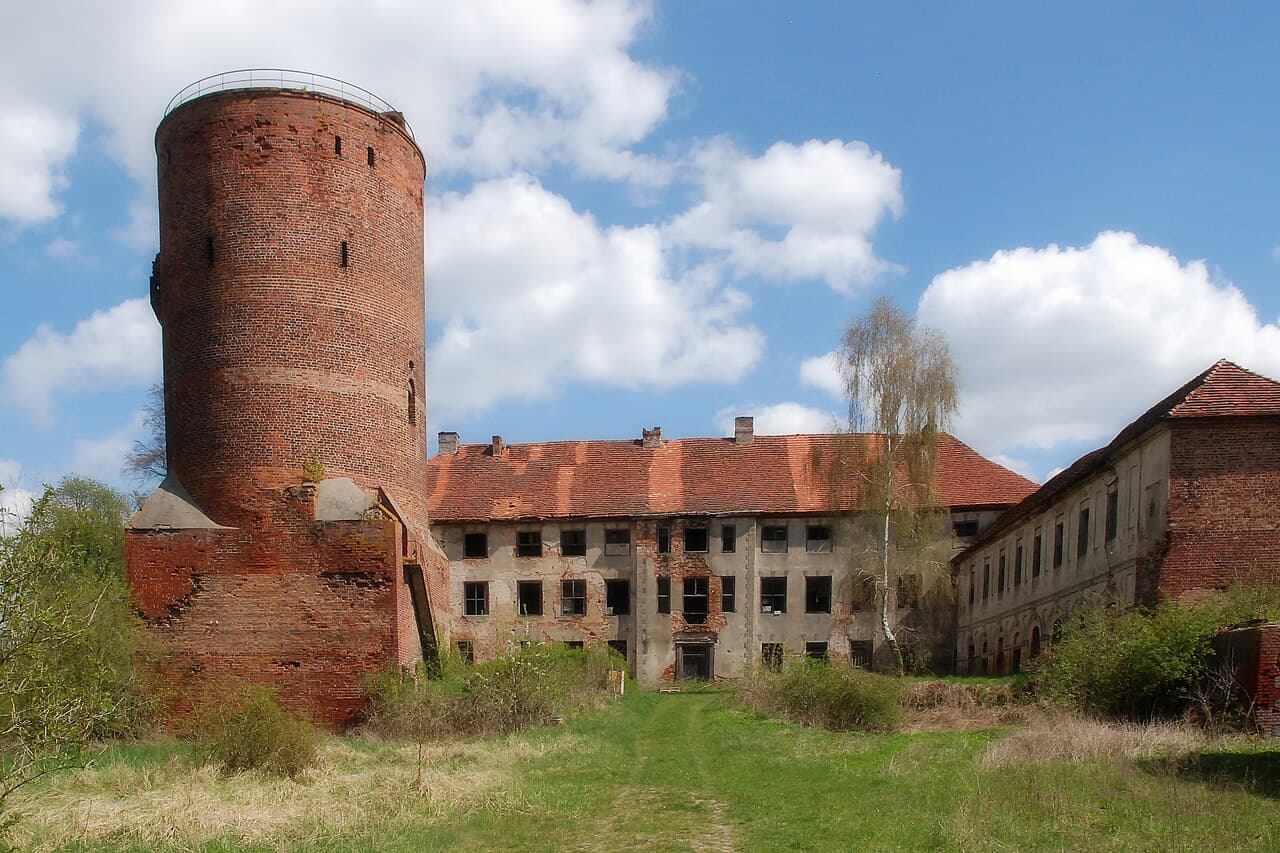
The original castle featured a distinctive 30-meter high tower in the northwest corner, notable for its unique shape: the lower third was square, transitioning into a cylindrical upper section. The tower's entrance was elevated at 16 meters above ground, accessible only by a wooden bridge connecting to a guard walkway along the western wall, emphasizing its defensive purpose. The castle walls enclosed a central courtyard and were complemented by a deep moat separating the castle from the outer bailey (vorburg), which housed economic buildings and was accessed via a fortified gatehouse on the western wall.
The northern curtain wall contained a residential building with a chapel and armory, while the eastern wall was later expanded in the 15th century to include a large residence for the commander and treasury rooms. The southern wing, added between the 15th and late 16th centuries, served primarily agricultural and service functions, reflecting the castle's growing role as a noble residence as well as a fortress.
Historical developments and ownership changes
In the mid-15th century, the castle underwent significant expansions, including the elevation of the eastern wing around 1600, which marked a shift towards enhanced residential comfort over purely military functions. The castle's ownership changed hands multiple times, notably passing to Philip I the Pious in 1544, who appointed a new commander and oversaw further modifications.
The Thirty Years' War and the Peace of Westphalia in 1648 led to the expulsion of the Knights Hospitaller from Swobnica. Subsequently, the castle became property of the Hohenzollern family from Schwedt in 1690. Under their stewardship, the castle was transformed in the early 18th century into a Baroque residence, with the demolition of the medieval northern and southern wings and the construction of new buildings to create a three-winged palace complex. This renovation included richly decorated interiors featuring stucco work, ornate fireplaces, and elegant staircases.
Decline, damage, and modern restoration efforts
World War II inflicted damage on the castle, including its use as storage for the monument of Frederick II. Postwar, the castle was repurposed for agricultural administration and storage by the local state enterprise, leading to neglect and deterioration. By the late 20th century, the castle had fallen into ruin, exacerbated by unauthorized scavenging and vandalism.
In 2011, ownership transferred to the municipality of Banie, which initiated restoration efforts. The roof of the eastern wing was repaired in 2012, and the medieval tower was restored and opened as a viewing platform in 2013. Despite these efforts, much of the castle remains in a state of ruin, with only the tower and some walls and foundations well preserved.
Architectural significance and cultural heritage
Swobnica Castle exemplifies the architectural transition from a fortified medieval stronghold to a Baroque noble residence. Its Gothic origins are evident in the defensive walls, crenellations, and tower design, while the Baroque renovations reflect changing tastes and functions in the early modern period. The castle's location on a lake peninsula with a moat and outer bailey is typical of hill castles adapted to water defenses.
The castle's history is intertwined with regional political and religious shifts, including the transition from the Knights Templar to the Knights Hospitaller, the Protestant Reformation, and the territorial changes following the Thirty Years' War. Today, Swobnica Castle remains an important cultural monument and a testament to Poland's medieval and early modern heritage.
Visitor experience and current condition
Visitors to Swobnica Castle can explore the restored tower, which offers panoramic views of the surrounding lake and countryside. The ruins of the castle walls and foundations provide insight into the original layout and defensive features. While much of the castle is in ruins, ongoing preservation efforts aim to stabilize and protect this historic site for future generations.
The castle's picturesque setting near the Polish-German border and its rich history make it a compelling destination for those interested in medieval architecture, military history, and noble residences.
Frequently asked questions (FAQ)
- How do I get to Swobnica Castle?
- Swobnica Castle is located in the village of Swobnica in the West Pomeranian Voivodeship of Poland. It is accessible by car via local roads, with parking available near the site. Public transportation options are limited, so driving is recommended.
- What is the historical significance of Swobnica Castle?
- Swobnica Castle was originally built by the Knights Hospitaller in the 14th century and served as a military and administrative center. It reflects the transition from medieval fortifications to Baroque noble residences, highlighting regional political and religious shifts.
- Can I visit the tower at Swobnica Castle?
- Yes, the castle's medieval tower has been restored and is open to visitors as a viewing platform. It offers panoramic views of the surrounding lake and countryside, providing a unique perspective on the castle's strategic location.
- When is the best time to visit Swobnica Castle?
- The best time to visit Swobnica Castle is during the late spring to early autumn months when the weather is favorable for exploring the ruins and enjoying the surrounding natural scenery.
- Are there guided tours available at Swobnica Castle?
- Currently, guided tours are not regularly offered at Swobnica Castle. Visitors can explore the site independently, with informational signage available to provide historical context.
Photo gallery

Information
Sources & official resources
Verify the information above using these authoritative references.
Loading map...
Visitor reviews
No reviews yet. Been here? Write the first review and help other travelers!
Write the first reviewVisited this castle? Share your experience
Your review helps other travelers and adds first-hand knowledge to our encyclopedia.


