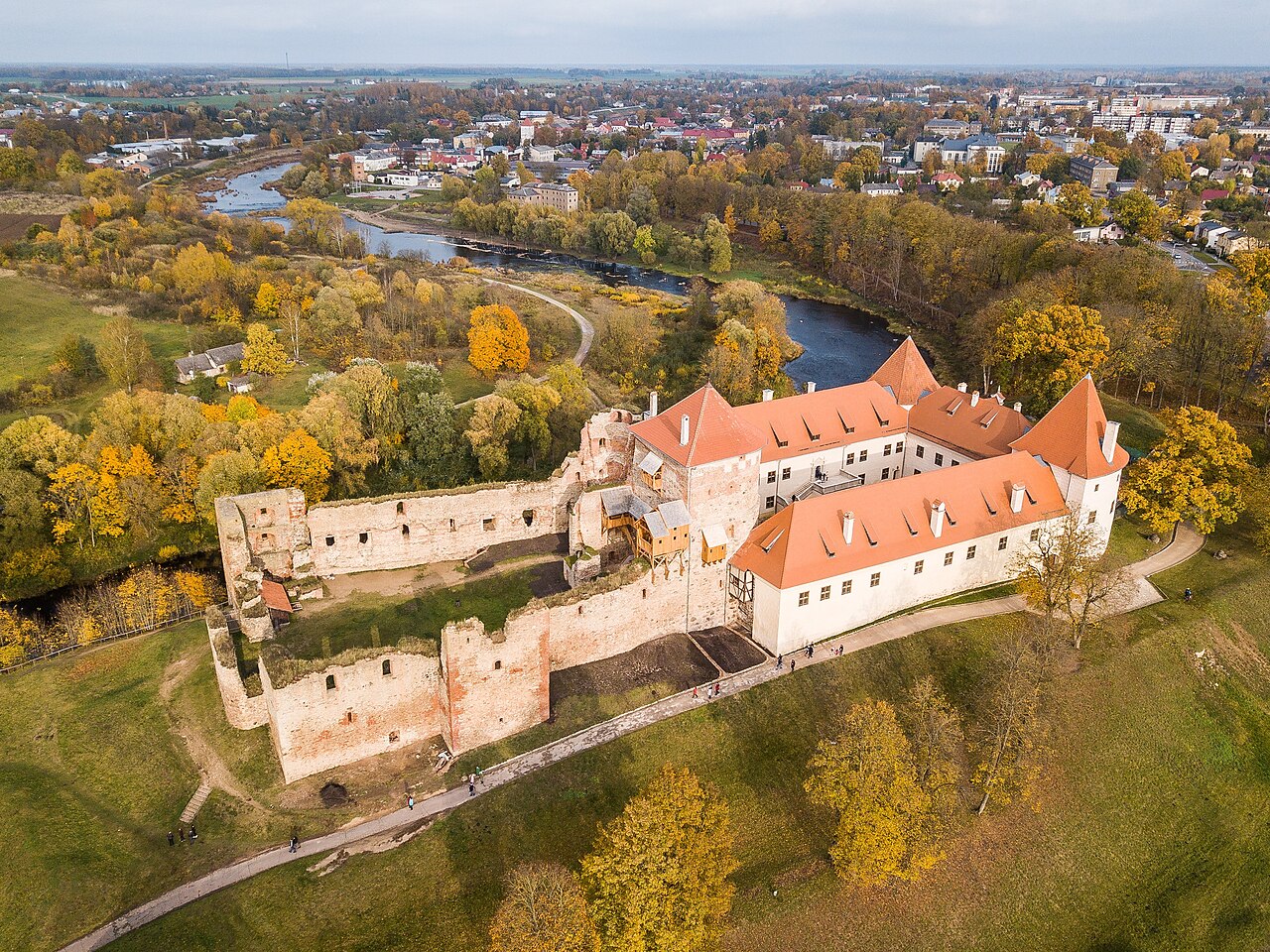
Svitene Palace Castle in Latvia is a remarkable example of architectural evolution from a fortified manor house to a classical palace. Originally constructed in the 16th century, this castle reflects the changing needs and styles across centuries, blending defensive features with later aesthetic transformations.
The estate was first granted in 1505 by Master Walter von Plettenberg of the Livonian Order to knight Otto von Grothus. The Grothus family held the property for over three centuries, during which the manor underwent significant development. After Otto's death, his sons divided the estate into three branches, with the middle share, Svitene, going to Thomas. His son Georg constructed a substantial stone manor house in the late 16th century, measuring approximately 42 by 11 meters.
Architectural features of the original manor
The manor built by Georg von Grothus was designed with defensive characteristics typical of the period. The walls were over one meter thick, incorporating hidden staircases within their mass. The building was rectangular with a gable roof that formed triangular pediments at the edges, a feature that added both structural stability and aesthetic appeal. Strategically located in a bend of the Virsite River, the manor was naturally protected on the south and east sides by water, while the remaining sides were secured by a sturdy stone wall.
Additional defensive elements included a drawbar gate at the entrance and barred windows on the ground floor, emphasizing security. These features highlight the manor's dual role as a residence and a fortress during a turbulent historical period.
Transformation into a classical palace
In 1788, the estate passed to Russian Field Marshal Count Johann Martin von Elmpt. His son, Lieutenant General Philip Elmpt, undertook a major reconstruction in the early 19th century, converting the fortified manor into a classical palace. This transformation included extending the building southeastward and enlarging the rear by nearly 9 meters, resulting in new dimensions of approximately 51.8 by 18.9 meters.
The renovation embraced the Neoclassical architectural style, characterized by symmetry, clean lines, and grandeur, replacing the medieval defensive purpose with an emphasis on comfort and representation. Although the work was not completed during Philip Elmpt's lifetime, his heirs continued the project, further refining the palace's appearance.
Modern history and current use
By 1893, the estate was acquired and leased by Prince Antoni Lieven of Mezotne. Following World War I and the establishment of an independent Latvia, the property was nationalized. The palace, having suffered damage and neglect, was repurposed as a school. Despite the changes, the original manor's thick walls remain incorporated into the palace's interior structure, preserving a tangible link to its fortified past.
Today, the restored classical palace no longer resembles its defensive origins but stands as an important cultural and educational site. Since 2011, it has housed a music and arts school, continuing its legacy as a place of community and learning.
Historical significance and cultural heritage
Svitene Palace Castle exemplifies the architectural and historical layers typical of Latvian noble estates. Its transition from a fortified manor to a classical palace mirrors broader European trends in castle and manor house design, reflecting shifts in social structure, military technology, and aesthetic preferences from the Renaissance through the Neoclassical period.
The castle's location along the Virsite River highlights the importance of natural defenses in medieval architecture, while its later modifications demonstrate adaptation to peaceful times and changing ownership. The preservation and restoration efforts have ensured that Svitene remains a valuable heritage site, offering insights into Latvian history and architecture.
Architectural details and layout
The original manor's elongated rectangular plan and thick masonry walls were typical of fortified residences designed to withstand sieges. The hidden staircases within the walls allowed discreet movement between floors, a defensive advantage. The gable roof with triangular pediments added a distinctive Renaissance character to the building's silhouette.
The later Neoclassical expansion introduced larger windows, more refined facades, and expanded interior spaces suitable for a noble residence rather than a fortress. The palace's current appearance is dominated by these classical elements, with little visible of the original defensive features except for the internal walls.
Visiting and educational role today
As a functioning music and arts school, Svitene Palace Castle serves an active role in the local community. Visitors interested in Latvian history and architecture can appreciate the blend of Renaissance defensive architecture and Neoclassical elegance. The castle's preservation allows for educational programs and cultural events that celebrate its rich heritage.
Frequently asked questions (FAQ)
- How do I visit Svitene Palace Castle?
- Svitene Palace Castle is accessible to visitors, especially during school open days and cultural events. It is advisable to check local schedules or contact the municipality for visiting hours and guided tours.
- What is the historical significance of Svitene Palace Castle?
- Svitene Palace Castle reflects the architectural evolution from a fortified manor of the 16th century to a Neoclassical palace, illustrating Latvia's noble estate history and cultural heritage.
- When was the original manor at Svitene constructed?
- The original manor house was built in the late 16th century by Georg von Grothus, featuring defensive walls over one meter thick and strategic river protection.
- Can I see the original defensive features at Svitene Palace Castle?
- Some of the original thick walls from the fortified manor remain within the palace interior, although the exterior now reflects its classical palace transformation.
- Is the castle currently used for any purpose?
- Yes, since 2011, the restored palace has housed a music and arts school, serving both educational and cultural functions in the community.
Information
Current owner
Municipality
Loading map...
Visitor reviews
No reviews yet. Been here? Write the first review and help other travelers!
Write the first reviewVisited this castle? Share your experience
Your review helps other travelers and adds first-hand knowledge to our encyclopedia.