Bauska
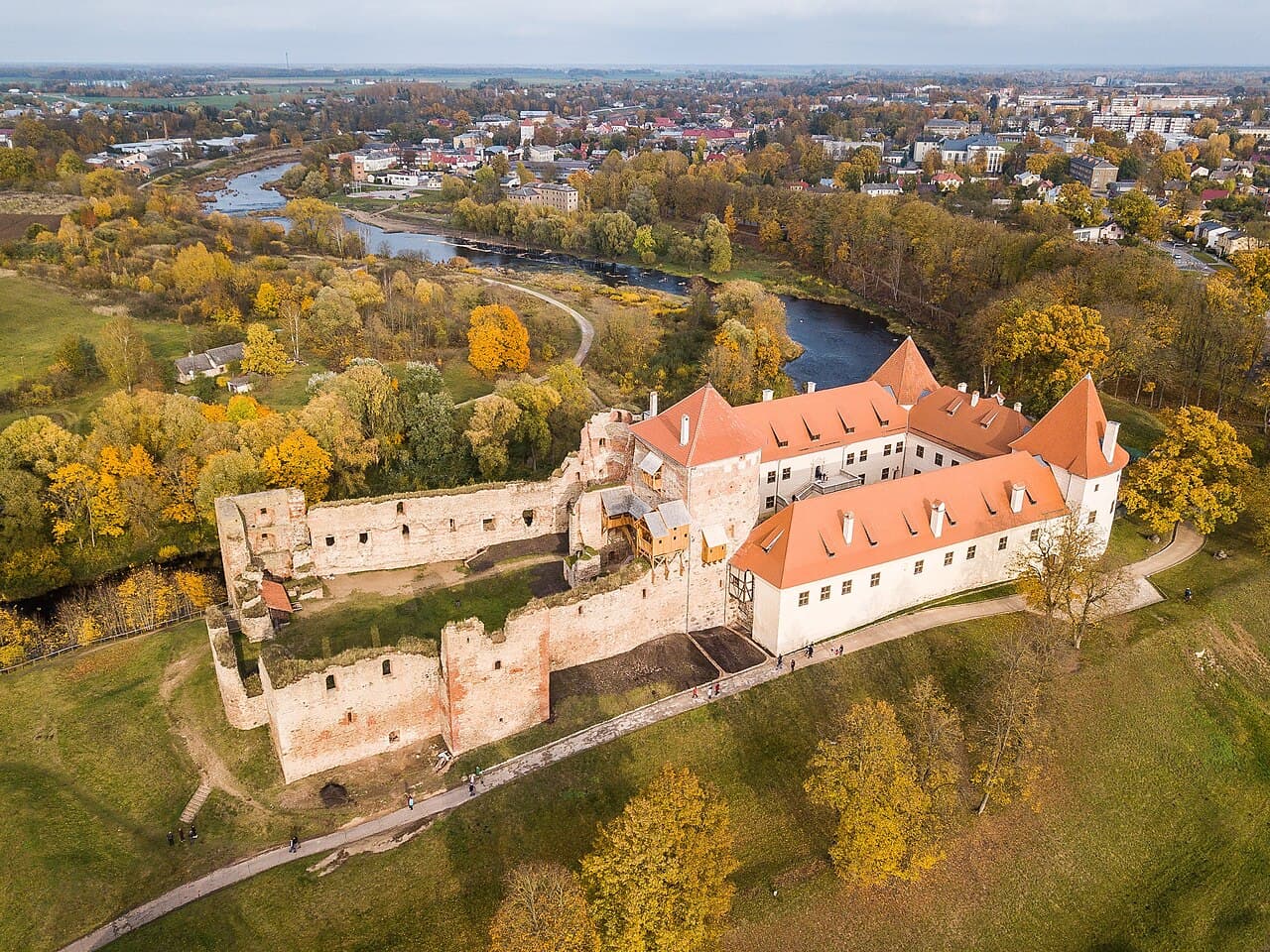
Bauska Castle is a remarkable historic site located in Bauska, Latvia, known for its unique combination of a medieval fortress and a Renaissance palace. Situated on a narrow peninsula at the confluence of the Mūsa and Mēmele rivers, which form the Lielupe River, the castle occupies a naturally defensible position with steep slopes protecting it from the north and south. This strategic location was originally the site of an ancient Semigallian fortress and a late Bronze Age Baltic settlement, underscoring its long-standing military and cultural significance.
The castle's origins trace back to the mid-15th century, built by the Livonian branch of the Teutonic Knights. Construction began around 1443 and was completed by 1451 under the initiative of the Livonian master Heidenreich Vincke von Overberg. Its primary purpose was to guard the border with the Grand Duchy of Lithuania and control the important trade route from Riga to Vilnius. The fortress was the seat of the local vogt, an official subordinate to the commanders of Ascheraden, charged with judicial, military, and administrative duties in the region of Semigallia.
Medieval fortress architecture and defenses
The castle was designed as a quadrilateral fortress measuring approximately 56 by 31 meters, with walls expanding westwards. It was constructed primarily of red brick, a common material in Baltic medieval fortifications, with walls up to 3.5 meters thick in critical defensive areas. The fortress was enhanced to withstand the evolving threats of the time, including the use of firearms, which was reflected in its artillery towers and features for flanking fire.
Key architectural features include two main defensive towers guarding the eastern gate: a smaller tower at the northeast corner and a larger semicylindrical tower at the southeast corner. The larger tower, with a diameter of 16 meters and walls 3.5 meters thick, contained five floors connected by internal staircases. Its first floor housed the castle's most prestigious chamber, measuring 9 by 9.4 meters, featuring a star-shaped vaulted ceiling, a fireplace, and a latrine bay window, indicative of the castle's residential as well as military functions.
The castle was further protected by a moat on the eastern side and a fortified outer bailey. The natural topography, with steep slopes on the north and south, provided additional defense. The inclusion of embrasures and artillery platforms reflected the adaptation of the fortress to the use of gunpowder weapons, an important evolution in military architecture during the late medieval period.
Renaissance palace and later modifications
Following the secularization of the Livonian Order in 1561 and the political shifts in the region, Bauska Castle became part of the newly formed Duchy of Courland and Semigallia. Between 1561 and 1596, a Renaissance-style palace was constructed adjacent to the medieval fortress on the site of the eastern bailey. This palace expanded the complex significantly, incorporating two medieval towers and adding three new wings around an inner courtyard.
The palace is notable for its Mannerist architectural style, characterized by decorative sgraffito plasterwork creating illusionistic square patterns on the facade. This artistic detail highlights the transition from purely military architecture to a residence reflecting the cultural aspirations of the ducal court. The palace's construction was completed in 1596, marking a key phase in the castle's evolution from fortress to noble residence.
Significant historical events and ownership changes
Bauska Castle has witnessed numerous military conflicts and political changes throughout its history. It served as a prison for Protestant dissidents in the early 16th century, including the notable incarceration of the German dramatist and Lutheran propagandist Burkard Waldis from 1536 to 1538.
In 1557, the castle came under the control of the Polish Crown, and after the secularization of the Livonian Order in 1561, it became the residence of the last Archbishop of Riga, Wilhelm von Brandenburg, before passing to Gotthard Kettler, the first Duke of Courland and Semigallia. The castle hosted several important regional assemblies, known as landtags, during the late 16th and early 17th centuries.
The fortress endured sieges and occupations during the Livonian War, the Polish-Swedish conflicts, and the Great Northern War. Swedish forces occupied the castle in 1625 and again in 1701, while Russian troops captured it in 1704. The Russian army deliberately destroyed the fortifications in 1706 during their retreat, leaving the castle in ruins.
Ruination and restoration efforts
After the castle's destruction, it was not rebuilt as a fortress. Instead, the ruins were repurposed for various practical uses, including storage, stables, and a prison. Local inhabitants also quarried the site for building materials, accelerating its decay. The castle remained largely in ruins until the 1970s when restoration efforts began, focusing primarily on the Renaissance palace section.
Today, the restored palace and the ruins of the medieval fortress form a significant cultural heritage site in Latvia. The castle complex includes a museum, a café, and a viewing platform atop the main tower, offering panoramic views of the town of Bauska and the surrounding countryside. The site hosts an annual international festival of medieval music, attracting visitors interested in history, architecture, and cultural events.
Architectural highlights and visitor experience
Visitors to Bauska Castle can explore the extensive ruins of the medieval fortress, including the thick defensive walls, remnants of residential wings, and the main semicylindrical tower. The tower remains the best-preserved part of the Gothic section and provides insight into medieval defensive architecture.
The Renaissance palace, by contrast, is well-preserved and showcases the elegant Mannerist style with its sgraffito decoration and harmonious courtyard layout. The palace's artillery towers are also accessible, illustrating the blend of residential comfort and military preparedness characteristic of the period.
The castle's museum offers detailed exhibitions on the site's history, the Livonian Order, and the Duchy of Courland and Semigallia. The combination of ruins and restored buildings provides a comprehensive narrative of the castle's transformation over centuries.
Frequently asked questions (FAQ)
- How do I get to Bauska Castle?
- Bauska Castle is easily accessible by car or public transport from major Latvian cities. If you're traveling from Riga, you can take a bus that runs regularly to Bauska, and the castle is a short walk from the bus station.
- What is the historical significance of Bauska Castle?
- Bauska Castle, built in the 15th century, played a crucial role in the defense of the region and served as a residence for the Livonian Order. Its historical importance is highlighted by its strategic location at the confluence of the Mūsa and Daugava rivers, making it a vital military stronghold in medieval times.
- When was Bauska Castle constructed?
- Construction of Bauska Castle began in 1443 and continued over several decades. It was completed in the 17th century, with various architectural styles reflecting the periods of its development.
- Can I take guided tours of Bauska Castle?
- Yes, guided tours are available at Bauska Castle, providing visitors with in-depth knowledge about its history and architecture. These tours are often conducted in both Latvian and English, ensuring a comprehensive experience for all visitors.
- Why is Bauska Castle considered an architectural gem?
- Bauska Castle is known for its unique blend of Gothic and Renaissance architectural styles, showcasing the evolution of military architecture in the region. Its well-preserved ruins, towers, and walls offer a fascinating glimpse into the past and attract architecture enthusiasts from around the world.
- Is it possible to visit Bauska Castle year-round?
- Yes, Bauska Castle is open to visitors year-round, although opening hours may vary by season. It's advisable to check the official website for the latest information on visiting hours and any seasonal events.
- What are the ticket prices for Bauska Castle?
- Ticket prices for Bauska Castle are generally affordable, with discounts available for students and seniors. Children under a certain age may enter for free, making it a budget-friendly attraction for families.
- What is the best time to visit Bauska Castle?
- The best time to visit Bauska Castle is during the late spring and summer months when the weather is pleasant and outdoor activities are abundant. Additionally, various festivals and events are often held in the summer, enhancing the visitor experience.
- Are there any nearby attractions to explore?
- Yes, Bauska is home to several nearby attractions, including the beautiful Bauska Town Hall and the historical Rundāle Palace. Visitors can easily spend a day exploring the castle and the surrounding cultural sites.
Photo gallery

Information
Website
Visit websiteSources & official resources
Verify the information above using these authoritative references.
Loading map...
Visitor reviews
No reviews yet. Been here? Write the first review and help other travelers!
Write the first reviewVisited this castle? Share your experience
Your review helps other travelers and adds first-hand knowledge to our encyclopedia.



