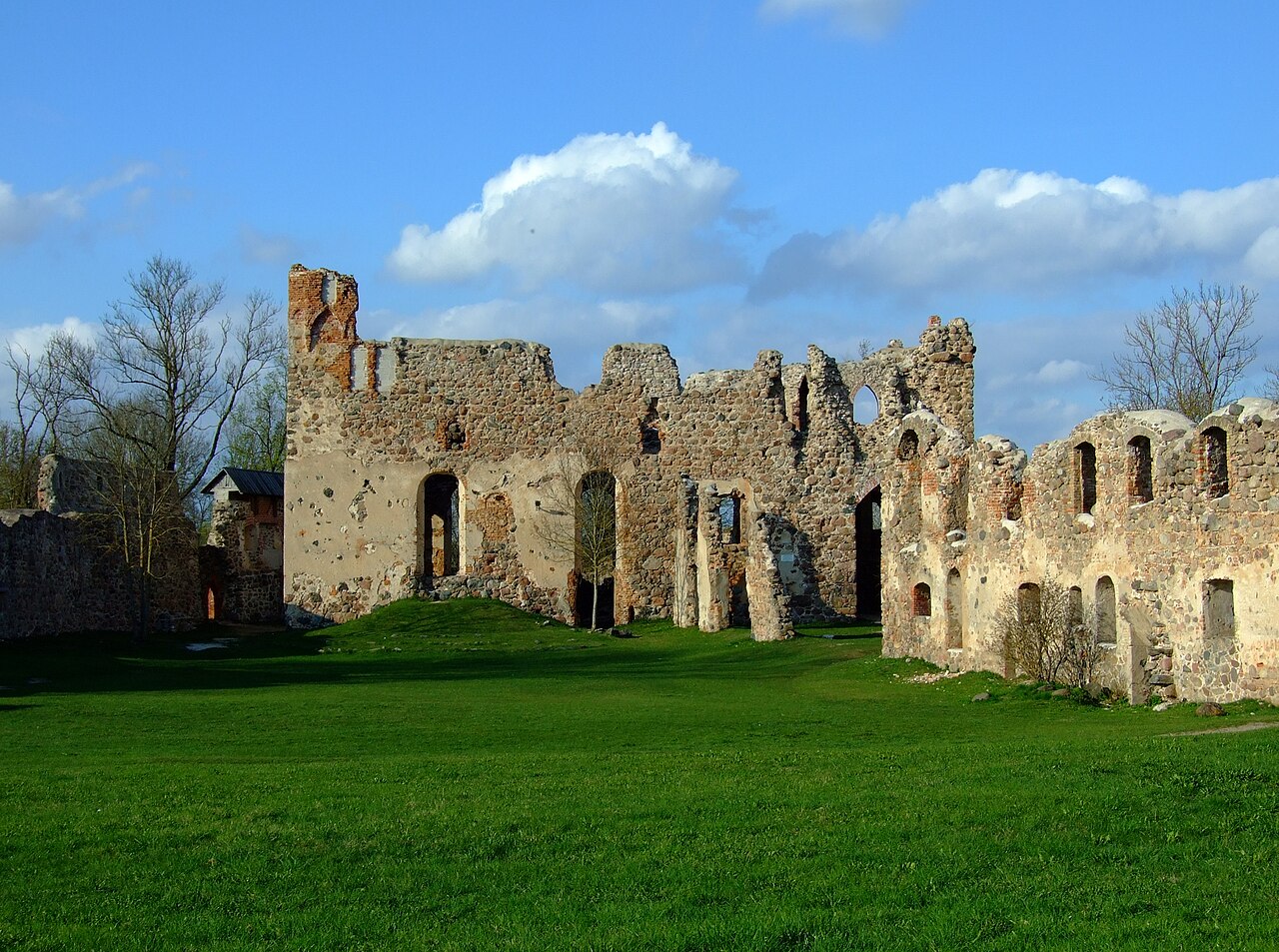
Jelgava Palace
Jelgava Palace stands as a monumental testament to Latvia's rich historical tapestry and architectural grandeur. Located in the city of Jelgava, the palace occupies a strategic flat island formed by the confluence of the Lielupe River and its tributary, the Driksa. This site has been pivotal since medieval times, initially hosting a fortress of the Livonian Order in 1265. The original wooden structure succumbed to fire in 1345, leading to the erection of a more durable stone castle that became the residence of the Ketler dukes, rulers of the Duchy of Courland and Semigallia.
Medieval origins and the duchy era
The early fortress at Jelgava was a key military and administrative center during the medieval period, reflecting the strategic importance of the region. The transition from a wooden fortress to a stone stronghold marked a significant evolution in defensive architecture, aligning with broader trends across Europe in the 14th century. The stone castle served as the seat of the Ketler family, who governed the duchy from the mid-16th century onwards, establishing Jelgava as a political and cultural hub.
Baroque transformation under duke ernst johann von biron
The most defining chapter in Jelgava Palace's history began in the 18th century, when Duke Ernst Johann von Biron assumed control following the end of the Ketler dynasty. Biron, a prominent figure in the Russian imperial court, sought to manifest his power and prestige through architecture. Starting in 1738, he commissioned the celebrated architect Bartolomeo Rastrelli, famed for his work on the Winter Palace in St. Petersburg, to design an opulent Baroque palace that would serve as the duchy's capital residence, then known as Mitava.
The construction unfolded in two main phases: the initial build from 1738 to 1740 and a later resumption between 1763 and 1771. The interruption was due to Biron's political downfall and exile in 1740. Upon his return, the architect Severin Jensen contributed classical elements to the design, blending Baroque exuberance with emerging neoclassical restraint. The resulting structure is a three-winged U-shaped palace, later expanded with a fourth wing in 1937, enclosing a central courtyard.
Architectural features and artistic embellishments
Jelgava Palace's architecture is characterized by its grand scale and refined craftsmanship. Built primarily from stone, dolomite, and brick, the palace features carved wooden doors, parquet flooring, and tiled stoves crafted by Austrian artisans, underscoring the international influences in its construction. The facade, while more restrained than Rastrelli's other works, exhibits elegant Baroque details softened by Jensen's classical touches.
The interior was once lavishly decorated with artworks by notable artists such as Latvian painter F.H. Barizien, Berlin sculptor Johann Michael Graff, and Italian artist D’Angeli. These contributions created a rich artistic environment that reflected the cultural ambitions of the duchy, although much of this interior decoration was lost due to fires in the 20th century.
Historical significance and notable residents
After its completion in 1772, Jelgava Palace became the residence of Duke Biron until his death. His successor, Duke Peter Biron, eventually ceded the duchy to the Russian Empire in 1795, ending its independent rule. Subsequently, the palace served as the residence for Russian governors overseeing the region until 1915.
The palace hosted several historically significant figures, including King Louis XVIII of France, who sought refuge there intermittently between 1798 and 1807 during his exile. Additionally, the enigmatic Count Alessandro Cagliostro, an occultist, visited the palace in 1779. During the Napoleonic Wars of 1812, the palace was repurposed as a hospital for the French army's Prussian corps, highlighting its strategic importance beyond a noble residence.
Destruction, restoration, and modern use
The 20th century brought significant challenges to Jelgava Palace. It suffered severe damage from an arson attack by the West Russian Volunteer Army in 1919 and again during intense combat in World War II in 1944. Despite these devastations, restoration efforts began in the late 1930s and resumed after 1956. Unfortunately, the original interiors were irretrievably lost, but the palace's external grandeur was preserved.
Since 1939, Jelgava Palace has been home to the Latvian University of Life Sciences and Technologies. This adaptive reuse has ensured the building's continued maintenance and relevance, with ongoing preservation efforts celebrating its historical and architectural legacy, particularly its role during the duchy period.
The ducal crypt and funerary art
Beneath the palace lies a significant historical feature: the ducal crypt, established in 1820 in the southeastern basement. It contains 30 coffins, including 24 metal and 6 wooden sarcophagi, dating from 1569 to 1743. These belong to members of the Ketler and Biron families and are notable examples of Baroque and Mannerist funerary art. The crypt provides invaluable insight into the duchy's burial customs and artistic traditions.
Landscape and archaeological heritage
The palace is surrounded by an expansive park developed from 1817 onwards on the former fortifications of the Livonian Order. This landscape incorporates romantic elements such as canals, bridges, and an island habitat for wild horses. The park is home to mature trees, including centuries-old horse chestnuts, oaks, and poplars, enhancing the site's natural beauty and historical atmosphere.
Archaeological excavations at Jelgava Palace have uncovered a wealth of artifacts spanning its long history. Finds include coins, fragments of Dutch clay pipes, cooking pottery, and cast-iron columns. A particularly striking discovery in 2003 was a human skull embedded within a wall, a poignant reminder of the complex human narratives intertwined with the palace's past.
Architectural classification and significance
Jelgava Palace is classified as a hill castle due to its original strategic position on an island formed by river branches, offering natural defensive advantages. Its architectural style is primarily Baroque, with later classical influences introduced by Severin Jensen. The palace's construction and subsequent modifications reflect the evolving tastes and political circumstances of the duchy and its rulers.
The palace's scale, with 669 rooms, 674 windows, and 615 doors, along with its intricate drainage system of 25 roof pipes, underscores the sophistication of 18th-century palace design. Despite the loss of much of its original interior decoration, Jelgava Palace remains a key cultural and historical landmark in Latvia.
Frequently asked questions (FAQ)
- When was Jelgava Palace originally built and by whom?
- Jelgava Palace was originally constructed starting in 1738 under Duke Ernst Johann von Biron, with architect Bartolomeo Rastrelli leading the design. The construction spanned until 1772, with later contributions by Severin Jensen.
- What architectural styles are evident in Jelgava Palace?
- The palace primarily exhibits Baroque architectural style with classical elements added later by Severin Jensen, reflecting a blend of exuberance and neoclassical restraint.
- What historical events affected Jelgava Palace in the 20th century?
- Jelgava Palace suffered significant damage due to an arson attack in 1919 by the West Russian Volunteer Army and heavy fighting during World War II in 1944, leading to extensive restoration efforts.
- Can visitors see the ducal crypt at Jelgava Palace?
- Yes, the ducal crypt located in the southeastern basement holds 30 coffins from the Ketler and Biron families, showcasing Baroque and Mannerist funerary art, and is accessible during certain tours.
- What is the current use of Jelgava Palace?
- Since 1939, Jelgava Palace has housed the Latvian University of Life Sciences and Technologies, combining educational functions with preservation of its historical heritage.
Information
Sources & official resources
Verify the information above using these authoritative references.
Loading map...
Visitor reviews
No reviews yet. Been here? Write the first review and help other travelers!
Write the first reviewVisited this castle? Share your experience
Your review helps other travelers and adds first-hand knowledge to our encyclopedia.