Sutton Valence Castle
Sutton Valence Castle stands as a remarkable example of a medieval hill castle situated in the village of Sutton Valence, Kent, England. Constructed in the late 12th century, this fortress was strategically positioned on a raised spur of the Chart Hills to command key inland routes, particularly the vital road connecting Maidstone with Rye and Old Winchelsea. Its location underscores its historical importance in controlling trade and military movements across the region during the High Medieval period.
Historical origins and ownership lineage
The initial construction of Sutton Valence Castle is attributed to Baldwin of Bethune, Count of Aumale, or possibly his father-in-law William le Gros. This early phase focused on establishing a fortified site to oversee and secure the surrounding territory. Around 1200, a significant architectural enhancement was made with the erection of a stone keep on the southern side, marking a transition to more durable and defensible structures.
Ownership of the castle passed through several prominent medieval figures. In 1203, it became part of the dowry of Baldwin’s daughter Alicia upon her marriage to William Marshal, Earl of Pembroke. After Marshal's death, his widow Eleanor inherited the castle and subsequently married Simon de Montfort, a key leader in the Second Barons’ War against King Henry III. Following de Montfort’s death in battle in 1265, the castle was granted by the king to his half-brother William de Valence, whose family name gave the castle its current designation.
The castle later passed to Aymer de Valence in 1307, who gradually neglected it in favor of other estates. Upon his death in 1324, Sutton Valence Castle entered the possession of the Hastings family through marriage, remaining with them until 1390 when it was acquired by Reginald Lord Grey de Ruthin. By the early 14th century, the castle was largely abandoned and fell into disrepair over the following centuries. By the late 18th century, historian Edward Hasted documented the castle as overgrown with ivy and trees growing from its ruined walls.
Architectural features and layout
Defensive earthworks and baileys
The castle’s design included an inner and outer bailey, both enclosed courtyards fortified by substantial earthworks. These earthworks, along with an eastern barbican guarding the main entrance, formed the primary defensive perimeter. Today, these features survive mainly as landscape contours marking the castle’s original boundaries.
The inner bailey was the core defensive enclosure, protected by a dry ditch approximately 300 meters long and 34 meters wide. This ditch functioned as a formidable barrier despite lacking water, a common defensive strategy in medieval fortifications. The inner bailey likely contained essential buildings such as a great hall for gatherings, a chapel for religious observance, and kitchen facilities. However, no visible remains of these timber or stone structures survive today.
The stone keep
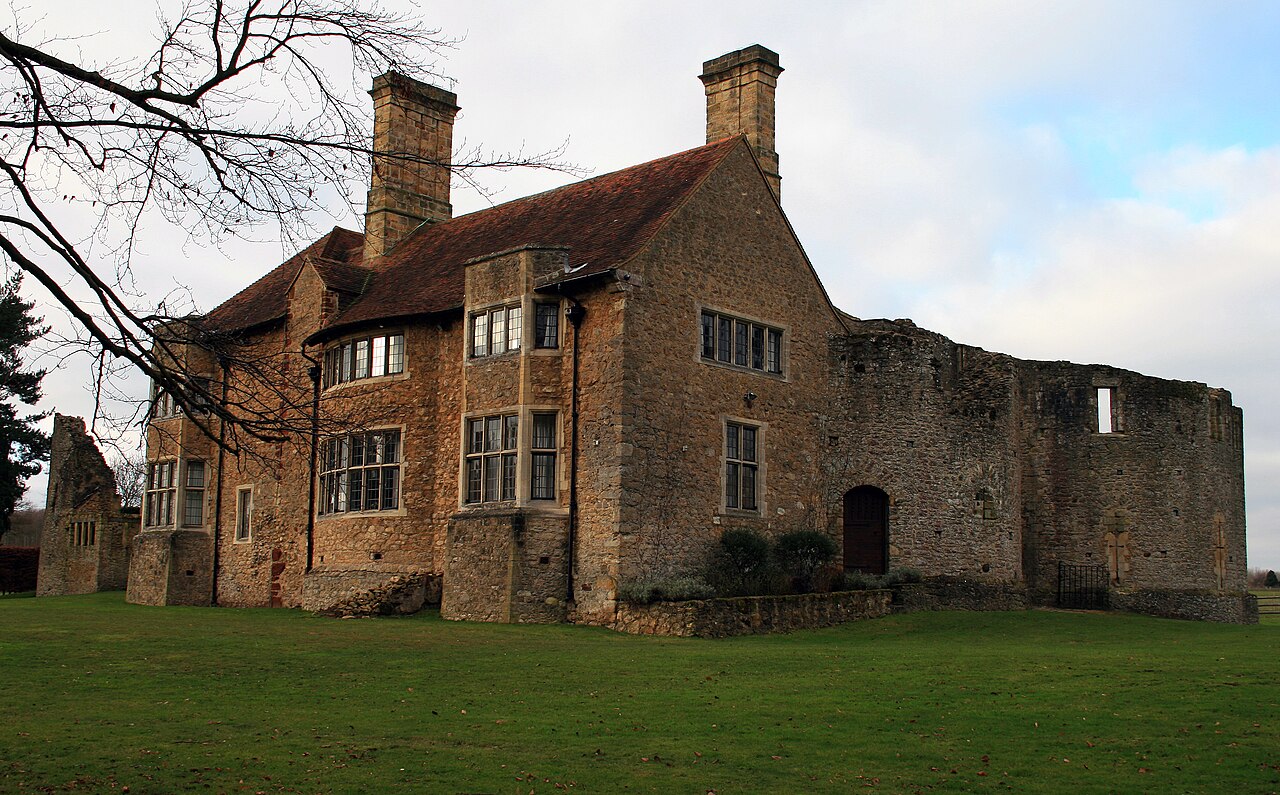
The most prominent surviving feature is the stone keep located on the southern edge of the castle grounds. Constructed from ragstone and flint rubble, the keep stands approximately 7 meters tall today, though originally it rose to nearly 20 meters over at least three floors. Its square footprint measures roughly 11 meters on each side, with walls about 2.4 meters thick, reflecting its role as the strongest and most defensible structure on the site.
Entry to the keep was through a door on the first floor, accessible via an external staircase, a typical medieval defensive design to reduce vulnerability. A distinctive corner tower houses a spiral staircase providing internal vertical circulation between floors. Each corner of the keep is reinforced with clasping buttresses, architectural elements that strengthen the walls and corners against attack and structural stress.
No decorative stonework or inscriptions have been found on the surviving masonry, emphasizing the keep’s purely military function rather than aesthetic embellishment.
Decline, archaeology, and preservation
Following its abandonment in the early 14th century, Sutton Valence Castle fell into ruin. By the 18th century, it was described as overgrown with ivy and trees, indicative of long-term neglect. Archaeological investigations in the mid-20th century focused primarily on the keep, revealing important insights into the castle’s construction techniques and layout.
Since 1976, the site has been under state protection, with conservation efforts aimed at stabilizing and preserving the remaining structures and earthworks. Sutton Valence Castle is now recognized as a Grade II listed building and a Scheduled Monument, underscoring its cultural and historical significance as a protected heritage site.
Historical significance and cultural heritage
Sutton Valence Castle offers valuable insight into the evolution of medieval military architecture in England, particularly the transition from timber fortifications to stone keeps in the High Medieval period. Its association with notable historical figures such as William Marshal, Simon de Montfort, and the de Valence family highlights its role in the complex political and military history of 12th and 13th-century England.
The castle’s strategic location and design reflect the importance of controlling trade routes and regional power during a turbulent era marked by feudal conflicts and baronial rebellions. Today, the site serves as a tangible link to England’s medieval past, attracting historians, archaeologists, and visitors interested in castle architecture and medieval history.
Frequently asked questions (FAQ)
- How do I get to Sutton Valence Castle?
- Sutton Valence Castle is located in the village of Sutton Valence in Kent, England. It is accessible by local roads, with parking available nearby. Visitors can reach the site by car or local bus services from Maidstone and surrounding towns.
- What are the opening hours for Sutton Valence Castle?
- The castle grounds are generally open to the public during daylight hours, but there are no formal visitor facilities or set opening times. It is advisable to visit during daylight for safety and to fully appreciate the site.
- Is there an admission fee to visit Sutton Valence Castle?
- There is no admission fee to visit Sutton Valence Castle as it is an open heritage site managed by the state. Visitors can explore the ruins and earthworks freely.
- What remains can I see at Sutton Valence Castle?
- Visitors can see the substantial remains of the stone keep, defensive earthworks, dry ditch, and the outlines of the inner and outer baileys. While no buildings remain intact, the layout of the castle is clearly visible in the landscape.
- What is the historical significance of Sutton Valence Castle?
- Sutton Valence Castle played a key role in controlling important medieval trade and military routes in Kent. Its association with prominent figures such as William Marshal and Simon de Montfort highlights its importance during the High Medieval period and the Second Barons’ War.
Information
Sources & official resources
Verify the information above using these authoritative references.
Loading map...
Visitor reviews
No reviews yet. Been here? Write the first review and help other travelers!
Write the first reviewVisited this castle? Share your experience
Your review helps other travelers and adds first-hand knowledge to our encyclopedia.