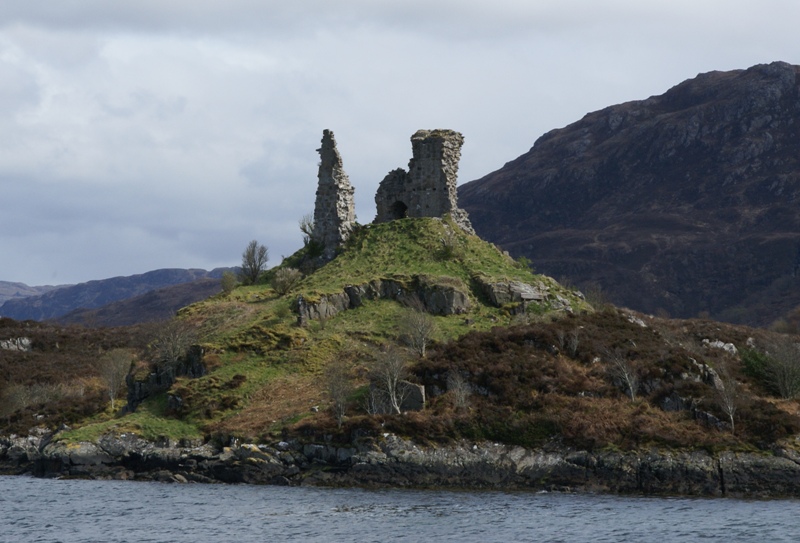
Strome Castle Ruins
Strome Castle stands as a significant historical ruin located near Lochcarron in the Scottish Highlands. Originally constructed in the 15th century, this castle was a formidable hill castle that played a crucial role in the power struggles of the Scottish clans during the late medieval period. Its strategic position on a headland between Loch Carron and Loch Kishorn afforded commanding views and control over the surrounding waterways and lands, making it an important military and political site for the Gaelic nobility.
Built by the Macdonald Earls of Ross, Strome Castle was initially a symbol of the MacDonald clan's influence in the region. The castle's architecture reflected the typical defensive needs of the time, featuring a courtyard and a square tower that served as the main stronghold. The use of local stone in its construction provided robustness against siege warfare, which was frequent in the turbulent clan conflicts of the Highlands.
Historical background and clan associations
The castle's history is deeply intertwined with the shifting allegiances and rivalries among Scottish clans. By 1472, ownership had passed to the Clan MacDonald of Lochalsh, with Alan MacDonald Dubh, the 12th Chief of Clan Cameron, appointed as constable. This role underscored the alliances formed between clans, as constables were responsible for the defense and administration of the castle on behalf of its owners.
In 1539, the castle was granted by King James V of Scotland to the Clan MacDonnell of Glengarry, marking another shift in control. During this period, Hector Munro, chief of the Clan Munro, served as constable, highlighting the complex network of clan relationships and the importance of trusted leaders in maintaining strongholds.
Siege and destruction in 1602
The castle's military significance culminated in the early 17th century. In 1602, after the Battle of Morar, Kenneth Mackenzie, 1st Lord Mackenzie of Kintail, chief of Clan Mackenzie, laid siege to Strome Castle. He was supported by allies from Clan Matheson and Andrew Munro of Novar. The siege ended with the surrender of the MacDonnells of Glengarry. To prevent the castle from being used again, it was deliberately demolished and blown up. This act of destruction was a common practice in clan warfare to eliminate strategic strongholds.
Following the castle's destruction, the MacDonnells of Glengarry relocated their seat to the more secure Invergarry Castle, constructed further inland to avoid coastal vulnerabilities.
Architectural features and surviving remains
Today, Strome Castle exists as ruins that offer valuable insights into late medieval Scottish castle architecture and clan history. The remains include a courtyard and the vestiges of a square tower, which was once the central defensive structure. The tower's ruins bear marks of the 1602 explosion, with scattered stone fragments evidencing the violent end of the fortress.
Castle layout and defensive elements
The castle's layout was typical of hill castles of the period, designed to maximize defensive capabilities. The courtyard would have served as a protected area for daily activities, while the tower provided a vantage point for surveillance and defense against attackers. The use of thick stone walls and limited entry points would have made it difficult for enemies to capture the site.
Interior structures and facilities
Archaeological studies reveal that the castle included a large hall adjacent to the tower, which functioned as a central gathering and living space. The hall featured doors facing north and west and had a wooden floor supported by beams. The absence of chimneys suggests heating was provided by a central open fire, a common feature in medieval Scottish halls.
Within the eastern part of the hall was a stone-lined well, an essential feature ensuring a reliable water supply within the castle walls. Its construction from stone highlights the practical considerations of sustaining life during sieges or isolation.
Cultural significance and preservation
Strome Castle is recognized as a Scheduled Monument, reflecting its importance in Scottish heritage and history. The site is managed by the National Trust for Scotland, which received the property in 1939. Preservation efforts focus on maintaining the ruins' structural integrity while allowing visitors to explore and appreciate the castle's historical context.
The castle's ruins serve as a tangible link to the turbulent clan history of the Scottish Highlands, illustrating the strategic importance of fortifications in Gaelic Scotland. Visitors can witness the remnants of a once-powerful stronghold that witnessed centuries of conflict, alliances, and cultural change.
Visitor experience and accessibility
Though in ruins, Strome Castle offers a compelling destination for history enthusiasts and those interested in medieval architecture. The site’s location on a scenic headland provides stunning views of Loch Carron and the surrounding landscape. Interpretive signage and guided tours help contextualize the castle’s history and architectural features.
Visitors should be prepared for uneven terrain typical of hill castles and ruins. The site is accessible year-round, but weather conditions in the Highlands can vary, so appropriate clothing and footwear are recommended.
Frequently asked questions (FAQ)
- How do I get to Strome Castle ruins?
- Strome Castle ruins are located near Lochcarron in the Scottish Highlands. Visitors can reach the site by car via the A896 road, with parking available nearby. Public transport options are limited, so driving is recommended for convenience.
- What is the historical significance of Strome Castle?
- Strome Castle was a key stronghold for the MacDonald clans during the late medieval period. It played a strategic role in clan conflicts and was destroyed in 1602 to prevent its further military use. The ruins reflect the turbulent history of the Scottish Highlands.
- Can I explore the ruins of Strome Castle?
- Yes, visitors can explore the ruins, including the courtyard and remains of the square tower. The site is managed by the National Trust for Scotland and is open year-round. Visitors should take care on uneven ground and wear suitable footwear.
- When is the best time to visit Strome Castle?
- The best time to visit Strome Castle is during the late spring to early autumn months when weather conditions in the Highlands are milder. This period offers clearer views and more comfortable walking conditions around the ruins.
- Is there an entrance fee to visit Strome Castle?
- There is no entrance fee to visit the ruins of Strome Castle. The site is freely accessible to the public, supported by the National Trust for Scotland's conservation efforts.
Information
Sources & official resources
Verify the information above using these authoritative references.
Loading map...
Visitor reviews
No reviews yet. Been here? Write the first review and help other travelers!
Write the first reviewVisited this castle? Share your experience
Your review helps other travelers and adds first-hand knowledge to our encyclopedia.