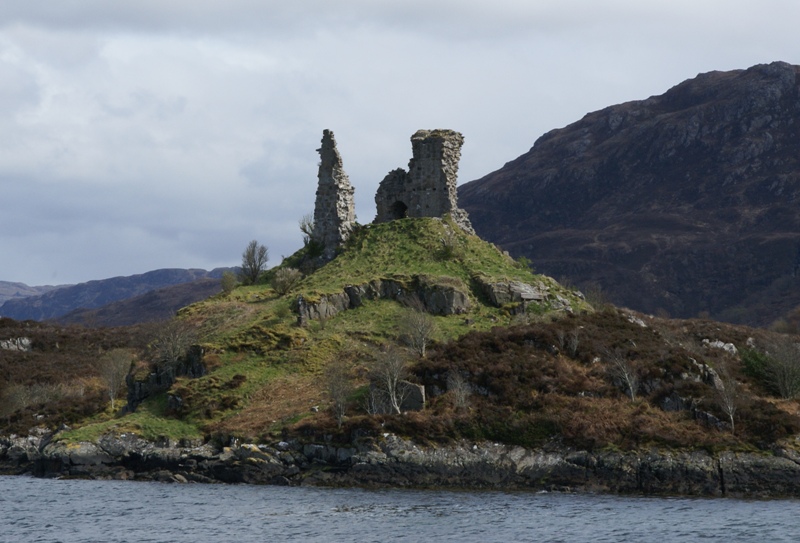
Brochel Castle Ruins
Brochel Castle, located on the Isle of Raasay in Scotland, was constructed in the late 15th or early 16th century, around c. 1500. It is believed to have been built by Calum Macleod, the first Macleod chief of Raasay, marking the castle as a significant seat of power during the Renaissance period. Although now in ruins, the castle's remains vividly illustrate the strategic and architectural ingenuity of its era.
Strategic location and defensive features
The castle is perched on a steep ridge that rises sharply from the east, providing natural defense with sheer drops on multiple sides. This positioning made Brochel Castle a formidable stronghold, difficult to assault. The entrance was accessible only via a narrow cleft between rocky projections and masonry, emphasizing its defensive design. Such a location is typical of hill castles that utilize natural terrain to enhance fortification.
Architectural layout and surviving structures
Today, only the footings of the tallest tower survive, but remnants of three other towers remain visible on different levels of the rocky outcrop. The best preserved tower is located on the northwest side, shaped like a prow, and retains traces of its original internal subdivisions. Within this tower, one can still observe recesses and a garderobe (a medieval toilet), which provide insights into the living conditions and architectural details of the castle.
Additional evidence of the castle's complex internal structure includes small windows and fragments of stairways, indicating multiple floors and varied access routes within the towers. These features reflect the castle's role not only as a fortress but also as a residence adapted to the needs of its occupants.
Historical context and ownership
Brochel Castle was occupied until approximately 1671. It served as the stronghold of the Macleod clan on Raasay, a prominent family in the Scottish Highlands. The castle's construction during the Renaissance period places it in a time of significant social and political change in Scotland, where fortified residences were evolving to combine defense with domestic comfort.
Currently, the ruins are owned by the Highland Council. Despite this, the site has not undergone significant consolidation or restoration, and much of the structure has deteriorated over time. Debris from the crumbling ruins has fallen to the base of the rocky pinnacle, highlighting the need for preservation efforts to protect this historic site.
Visiting Brochel Castle ruins
Visitors to Brochel Castle can experience a dramatic landscape where natural rock formations integrate with the castle's remains. The steep approach and rugged terrain require careful navigation, but the site offers a unique glimpse into Scotland's Renaissance-era fortifications. The castle's evocative ruins inspire imagination, often described as reminiscent of a fantastical realm due to their striking silhouette against the surrounding landscape.
Architectural significance
Brochel Castle exemplifies the transitional architecture of Scottish castles from purely defensive structures to more complex residences. The presence of multiple towers at varying levels, the use of natural rock formations in its design, and features like the garderobe and subdivided chambers underscore the castle's dual role as a fortress and home.
Preservation challenges
The site faces ongoing preservation challenges due to its exposed location and the fragility of the remaining masonry. Without active consolidation, the ruins continue to degrade, risking the loss of valuable historical fabric. Efforts to stabilize the towers and protect the site would be vital to maintaining Brochel Castle as a cultural landmark on Raasay.
Frequently asked questions (FAQ)
- How do I get to Brochel Castle Ruins?
- Brochel Castle Ruins are located on the Isle of Raasay, which can be accessed by ferry from Skye. Once on the island, follow the marked trails or local maps to reach the ruins, which are approximately a 30-minute walk from the ferry terminal.
- What is the historical significance of Brochel Castle?
- Brochel Castle, built in the 15th century, was a stronghold for the MacLeod clan. Its ruins tell the story of the turbulent history of the Highlands and the feudal structures that dominated Scotland during that period.
- When was Brochel Castle constructed?
- Brochel Castle was constructed in the 15th century, likely around the 1460s. It was used as a defensive structure and played a role in the clan conflicts of the time.
- Can I explore the castle ruins freely?
- Yes, visitors can explore the ruins of Brochel Castle freely. However, please be cautious as some areas may be unstable, and it is advised to wear appropriate footwear for the uneven terrain.
- Why is Brochel Castle a popular destination for visitors?
- Brochel Castle is popular due to its stunning scenic views of the surrounding landscape and its rich historical background. The combination of natural beauty and intriguing history makes it a must-visit for those exploring Raasay.
- Is it possible to visit Brochel Castle year-round?
- Yes, Brochel Castle is accessible year-round, but it's best to visit during the spring and summer months when the weather is milder. This allows for a more enjoyable experience while hiking to the castle.
- What are the opening hours for visiting Brochel Castle?
- Brochel Castle Ruins do not have formal opening hours, as they are open to the public year-round. However, it's advisable to visit during daylight hours for safety reasons.
- Are there any nearby attractions to visit after Brochel Castle?
- Yes, after visiting Brochel Castle, you can explore the nearby Raasay Distillery or take a scenic walk along the coastal paths. The island offers a range of natural beauty and cultural experiences for visitors.
- What are the ticket prices for visiting Brochel Castle?
- There is no admission fee to visit Brochel Castle Ruins, making it an accessible destination for all. Visitors are encouraged to support local businesses on the island during their trip.
Information
Current owner
Highland Council
Loading map...
Visitor reviews
No reviews yet. Been here? Write the first review and help other travelers!
Write the first reviewVisited this castle? Share your experience
Your review helps other travelers and adds first-hand knowledge to our encyclopedia.