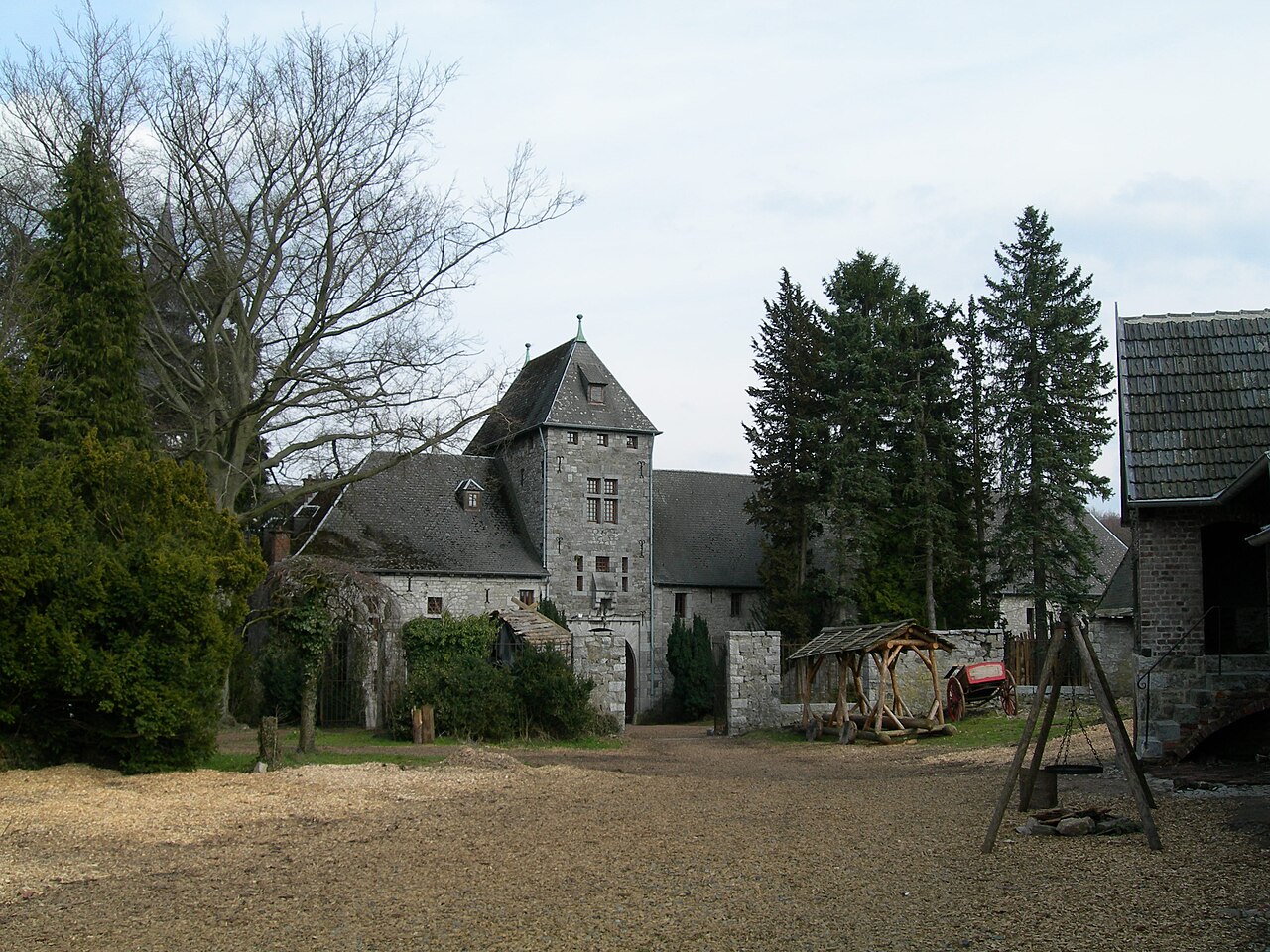
Streversdorp Castle
Streversdorp Castle, also known as Château de Graaf or Burg Streversdorp, is a historic hill castle located southwest of the village of Montzen in the province of Liège, within Belgium's Wallonia region. This castle stands as a significant example of medieval and early modern noble architecture, reflecting centuries of architectural evolution, noble lineage, and regional history.
Constructed originally in the 13th century by the noble Treversdorp family, the castle began as a fortified residence featuring a simple rectangular keep. This central keep, built primarily of sandstone rubble with walls up to 1.5 meters thick, remains a dominant feature of the eastern side of the castle. The keep rises three stories high and contains rare late Gothic mural paintings from the early 1500s on its vaulted ceilings and window recesses, illustrating the transition from medieval to Renaissance artistic styles.
Medieval origins and noble ownership
The castle's origins are steeped in the medieval period, with possible roots tracing back to the late Carolingian era around 915, though direct evidence for this early phase remains unconfirmed. The earliest documented owner was Egidius (Goswin de Treversdorp) in the late 13th century, from whom the castle derives its name. Over the following centuries, the castle passed through several noble families, including the van der Knavel family around 1350 and the Wilde family by 1380.
In the early 15th century, the castle came under the ownership of the van Macrelaer family, before being acquired by the van der Heyden family, also known as Belderbusch, who held it from 1530 to 1810. This long tenure was marked by significant architectural modifications, reflecting the evolving needs and tastes of the nobility.
Architectural evolution and expansions
Between the 15th and 16th centuries, Streversdorp Castle underwent notable expansions. The original keep was incorporated into a larger complex featuring new wings arranged around a small inner courtyard, creating a roughly square ground plan. Corner towers were added, enhancing both the defensive capabilities and the residential comfort of the castle.
The north wing, dating from the 15th century, retains many defensive features typical of the medieval period, such as narrow arrow slits designed for archers, stone machicolations for dropping projectiles on attackers, and battlements that were later adapted into window openings. This blend of military and residential architecture illustrates the castle's dual role as a fortress and noble residence.
The southern side includes a corner pavilion built in the 16th century, reflecting Renaissance architectural influences. The west wing, also from the 16th century, is distinguished by two round towers with conical roofs, characteristic of the era's style. Additional circular towers at the northwest and southwest corners vary in form, with one being low and robust and the other taller and slender, both constructed in the early 1500s.
Defensive features and water management
Streversdorp Castle is an example of a Wasserburg, or water castle, surrounded by a wide moat measuring between 15 and 20 meters across. This moat provided a formidable defensive barrier against attackers. Access to the castle was controlled via a three-arched stone bridge, which historically connected to a drawbridge, allowing the inhabitants to control entry effectively.
The castle's strategic use of water is further exemplified by nearby fishing ponds covering approximately 1.5 hectares, supplied by the Streversdorpbach stream. These ponds reflect the integration of sustainable water features into the castle's landscape, serving both practical and aesthetic purposes.
18th-century noble status and later history
In the 18th century, a member of the Van der Heyden Belderbusch family was elevated to the rank of count by Joseph II, Holy Roman Emperor, in recognition of services rendered. The German title "Graf" inspired the alternate name "Château de Graaf" for the castle.
The castle remained under noble ownership until the early 19th century, after which it changed hands several times. Notable owners included Arnold-Antoine Thiriart and, in 1908, the d’Othée family. In 1986, the owner of the nearby Château de Lontzen acquired Streversdorp Castle.
20th-century decline and restoration efforts
By the 20th century, Streversdorp Castle had fallen into significant disrepair. The southwestern round corner tower collapsed in 1965, a loss that underscored the urgent need for preservation. At the end of the 1980s, a community of owners purchased the castle and undertook rebuilding efforts, including the reconstruction of the collapsed tower. The castle remains privately inhabited and is not open to the public.
In 2005, a devastating fire destroyed a large portion of the roof over the agricultural wing and the adjacent chapel. Although restoration efforts began promptly, repairs have only been partially completed, leaving parts of the complex vulnerable to the elements.
Architectural details and remaining features
The castle occupies a roughly rectangular footprint of about 30 by 25 meters, primarily constructed from limestone blocks. The inner courtyard is surrounded by buildings from various periods, illustrating the castle's long history of adaptation and expansion.
The central donjon is the oldest surviving structure, notable for its thick walls and Gothic murals. The presence of a former prison and cellar within the castle provides insight into its multifaceted functions beyond mere residence.
The small chapel, consecrated in 1734, is built of brick and limestone and features a rounded arch portal adorned with the coats of arms of the Belderbusch and Westrem families. This chapel suffered serious damage in the 2005 fire and remains partially ruined.
Two parallel agricultural wings dating from the 17th and 18th centuries lie south of the main castle. These buildings have been remodeled multiple times, reflecting the castle's role in local agricultural production.
Inside the castle, traces of a tiled floor and 17th-century frescoes survive, though in deteriorated condition. These artistic elements provide a glimpse into the castle's decorative past and the lifestyle of its noble inhabitants.
Cultural significance and current status
Streversdorp Castle is a valuable cultural and architectural monument that encapsulates the historical evolution of noble residences in Belgium. Its combination of medieval defensive features and Renaissance residential expansions offers a unique window into the changing needs and tastes of European nobility over several centuries.
Today, the castle remains a private residence and is not accessible to visitors. Despite this, its historical and architectural significance continues to be recognized by heritage organizations and scholars interested in medieval and early modern European castles.
Frequently asked questions
- What is the historical significance of Streversdorp Castle? Streversdorp Castle represents a prominent example of medieval and Renaissance noble architecture, reflecting centuries of European noble lineage and defensive strategies.
- Can the public visit Streversdorp Castle? Currently, the castle is privately inhabited and not open for public tours or visits.
- When was the castle originally built? The castle was originally constructed in the 13th century by the Treversdorp family.
- What architectural styles are present in the castle? The castle features a blend of medieval defensive architecture and Renaissance residential additions.
- Has the castle undergone restoration? Yes, restoration efforts have been ongoing since the late 20th century, including rebuilding a collapsed tower and partial repairs after a 2005 fire.
- Where is Streversdorp Castle located? It is located southwest of Montzen village in the Liège province of Belgium.
Frequently asked questions (FAQ)
- What is the historical significance of Streversdorp Castle?
- Streversdorp Castle is a remarkable example of medieval architecture, reflecting the rich history of Montzen, Belgium. Originally built in the 14th century, it served as a defensive stronghold and has witnessed numerous historical events, making it a key landmark in the region.
- When was Streversdorp Castle built?
- Construction of Streversdorp Castle began in the late 1300s, with various renovations and expansions occurring over the centuries. Its enduring structure showcases the architectural styles and defensive needs of its time, drawing visitors interested in history and architecture alike.
- What are the opening hours for Streversdorp Castle?
- Streversdorp Castle is open to visitors from Tuesday to Sunday, with guided tours available from 10 AM to 5 PM. It is closed on Mondays and certain public holidays, so be sure to check the official website for any updates or special events.
- Can I visit Streversdorp Castle with children?
- Yes, Streversdorp Castle is family-friendly and welcomes visitors of all ages. Children can enjoy exploring the castle grounds, and there are educational activities available to enhance their understanding of history and architecture.
- Is it possible to take guided tours of the castle?
- Absolutely! Guided tours are available and provide an in-depth look at the history and architecture of Streversdorp Castle. These tours are led by knowledgeable guides who can answer questions and share fascinating stories about the castle's past.
- What are the ticket prices for visiting Streversdorp Castle?
- Tickets for Streversdorp Castle are reasonably priced, with discounts available for children, students, and seniors. Family passes are also offered, making it an affordable outing for visitors looking to explore the castle and its grounds.
- When is the best time to visit Streversdorp Castle?
- The best time to visit Streversdorp Castle is during the spring and early autumn months when the weather is mild and the gardens are in full bloom. Additionally, visiting on weekdays can help avoid larger crowds, allowing for a more enjoyable experience.
- How do I get to Streversdorp Castle?
- Streversdorp Castle is easily accessible by car and public transportation. If you are driving, ample parking is available nearby, and if you prefer public transport, local buses connect Montzen to major cities in Belgium.
- Are there any nearby attractions to visit after exploring the castle?
- Yes, there are several attractions near Streversdorp Castle, including local parks, museums, and walking trails that showcase the beautiful Belgian countryside. Visitors can easily spend a full day exploring both the castle and the surrounding area.
Information
Sources & official resources
Verify the information above using these authoritative references.
Loading map...
Visitor reviews
No reviews yet. Been here? Write the first review and help other travelers!
Write the first reviewVisited this castle? Share your experience
Your review helps other travelers and adds first-hand knowledge to our encyclopedia.