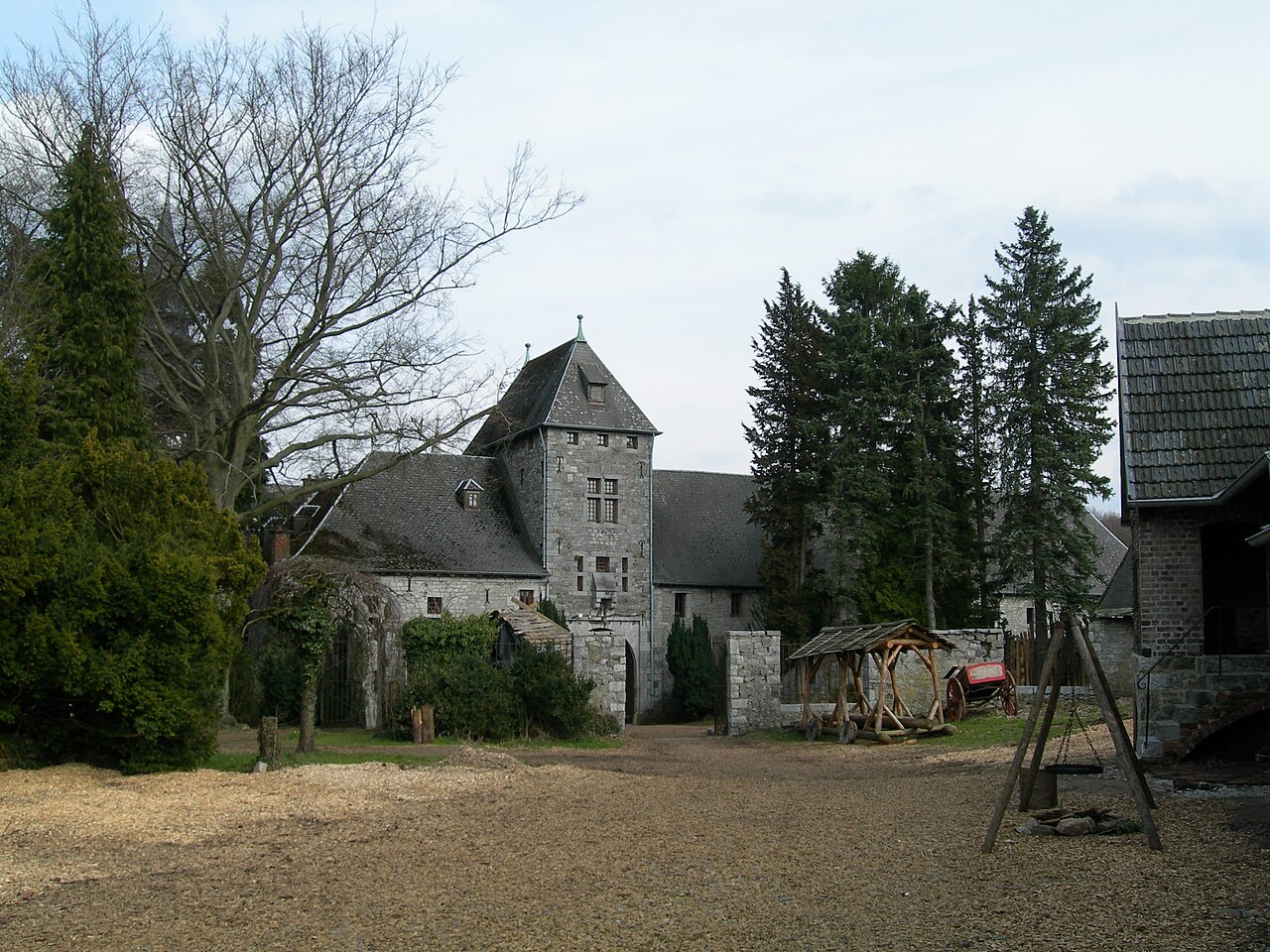
Eulenburg Castle

Eulenburg Castle: neo-Gothic residence near Bambusch, Belgium
Moresnet, Belgium
Post-Renaissance (17th–18th c.)
Well Preserved

Eulenburg Castle, also known locally as Kasteel Eulenburg or simply David, is situated just south of the village of Moresnet in the province of Liège, within the Wallonia region of Belgium. Despite its medieval appearance, the castle is a product of the late 19th century, embodying an eclectic architectural style heavily influenced by neo-Gothic design elements.

Construction and architectural style

The castle was constructed between 1878 and 1901 by Victor David, whose family were prominent landowners in the region. Unlike authentic medieval fortresses, Eulenburg Castle was conceived as a luxurious family residence rather than a defensive stronghold. Its layout follows an L-shaped plan, characteristic of many country houses of the period, blending functional living spaces with stylistic flourishes inspired by medieval architecture.

The architectural style is best described as eclectic with dominant neo-Gothic features. This includes pointed arches, decorative finials, and intricate stonework that evoke the Gothic revival popular in the 19th century. The castle's façade and structural details reflect a romanticized interpretation of medieval design rather than authentic medieval construction techniques.

Interior features and historic elements

One of the most remarkable aspects of Eulenburg Castle is its interior decoration, notably the incorporation of historic wood paneling. Shortly after the castle's completion, Victor David traveled to the German city of Aachen, where he purchased 18th-century wood paneling that had been removed from the Aachen city hall during a restoration project. This paneling was destined to be destroyed but was salvaged and installed within Eulenburg Castle, lending the interior a genuine historical ambiance.

The paneling adds a layer of authenticity and historical depth to the castle's otherwise late 19th-century construction, connecting it tangibly to earlier European craftsmanship and civic heritage.

Location and current status

Eulenburg Castle is located near Bambusch, close to Moresnet, in the scenic landscape of the Liège province. The castle’s setting in Wallonia places it within a region known for its rich history and diverse architectural heritage.

Today, Eulenburg Castle remains a private residence and is not open to the public. Its secluded status and private ownership mean that access is restricted, and it is primarily appreciated from a distance or through historical records.

Architectural significance and cultural context

While not a medieval fortress, Eulenburg Castle exemplifies the 19th-century trend of constructing romanticized castles that served as country homes for wealthy families. This trend reflected a fascination with the medieval past and the Gothic revival in architecture, which sought to evoke chivalry, tradition, and grandeur.

The castle’s eclectic style and the use of salvaged historic materials illustrate the era’s approach to heritage and aesthetics, blending new construction with elements of genuine antiquity. This makes Eulenburg Castle an interesting case study in the adaptation of medieval motifs for residential purposes during the post-Renaissance period.

Frequently asked questions (FAQ)

How do I get to Eulenburg Castle?
Eulenburg Castle is located in Moresnet, Belgium, easily accessible by car and public transport. If you are traveling by train, the nearest station is in the city of Eupen, from where you can take a local bus or taxi to the castle.
What is the historical significance of Eulenburg Castle?
Eulenburg Castle dates back to the 12th century and has played a crucial role in the region's history, particularly during feudal times. The castle has witnessed various historical events and changes in ownership, reflecting the turbulent history of Belgium.
When was Eulenburg Castle built?
Construction of Eulenburg Castle began in the 12th century, with significant modifications and expansions occurring over the centuries. The castle showcases a blend of medieval and later architectural styles, making it a fascinating site for history enthusiasts.
Can I take guided tours of Eulenburg Castle?
Yes, guided tours are available at Eulenburg Castle, providing visitors with an in-depth understanding of its history and architecture. These tours typically require advance booking, especially during peak tourist seasons.
Why is Eulenburg Castle considered an architectural gem?
Eulenburg Castle is renowned for its unique blend of Romanesque and Gothic architectural styles, featuring impressive towers and intricate stonework. Its strategic location on a hill also offers stunning views of the surrounding landscape, enhancing its architectural appeal.
Is it possible to host events at Eulenburg Castle?
Yes, Eulenburg Castle offers facilities for hosting various events, including weddings, corporate gatherings, and cultural events. The picturesque setting and historical ambiance make it a popular choice for memorable occasions.
What are the opening hours for Eulenburg Castle?
Eulenburg Castle is typically open to visitors from 10 AM to 5 PM, Tuesday through Sunday. However, it is advisable to check the official website for any seasonal changes or special holiday hours before your visit.
What is the best time to visit Eulenburg Castle?
The best time to visit Eulenburg Castle is during the spring and early autumn when the weather is pleasant and the surrounding gardens are in full bloom. These seasons also tend to have fewer tourists, allowing for a more peaceful experience.
Are there any ticket prices for visiting Eulenburg Castle?
Yes, there is a nominal entrance fee for visiting Eulenburg Castle, which helps maintain the site. Discounts may be available for students, seniors, and groups, so be sure to inquire about any applicable offers when purchasing your tickets.
What nearby attractions can I visit when I go to Eulenburg Castle?
Nearby attractions include the beautiful landscapes of the High Fens nature reserve and the historic town of Eupen. Both offer a variety of outdoor activities, cultural experiences, and dining options, making them great additions to your visit to the castle.

Information

Palace Castle

Loading map...

Visitor reviews

No reviews yet. Been here? Write the first review and help other travelers!

Write the first review

Visited this castle? Share your experience

Your review helps other travelers and adds first-hand knowledge to our encyclopedia.

Write a review

(5/5)

0/2000 characters

Your review will be visible after admin approval

Nearby castles

0.6 km

Alensberg Castle

Moresnet, Belgium

Alensberg Castle, also known as Château d'Alensberg, is a historic fortified structure located in a private garden west of the village of Moresnet, in the Liège province within Belgium's Wallonia region. The castle stands in the valley of the Geul river, a strategic location that influenced its original construction and subsequent history. Medieval origins and early ownership The castle was constructed in the mid-15th century by Jean d'Alensberg, a noble figure whose family name the castle bears. This period corresponds with the late medieval era, characterized by the transition from fortified medieval castles to more residential chateaus in the region. Alensberg Castle was initially built as a fortified keep, designed to control the surrounding valley and provide defense against regional conflicts. In the early 16th century, ownership of Alensberg Castle passed to the Tzevel family, notable also for owning the nearby Eyneburg Castle. This transfer of ownership reflects the common medieval practice of consolidating regional power through the acquisition of multiple fortifications. Ownership transitions and architectural changes The castle later came into the possession of the Dobbelstein family through marriage, maintaining their hold until the early 17th century. Subsequently, the Straeten family acquired the castle and retained it until the early 18th century. These families likely made modifications to the castle, adapting it to the evolving needs of aristocratic residence and defense, although detailed architectural records from these periods are scarce. In the 19th century, the castle was owned by Charles James Cockerill, an industrialist linked to the region's burgeoning industrial development. His ownership marks a shift in the castle's role from purely defensive to a symbol of status and heritage. Wartime impact and restoration During World War I, the strategic importance of the valley was underscored by the construction of a massive railway viaduct by German forces. This viaduct, measuring approximately 1200 meters long and 58 meters high, was built just 200 meters from the castle to facilitate the transport of artillery. Its proximity to Alensberg Castle placed the structure in the midst of military activity. In World War II, as German forces retreated, they deliberately destroyed the viaduct to hinder advancing Allied troops. The demolition caused significant damage to Alensberg Castle, particularly to its extensions. The destruction left the castle partially ruined and vulnerable. Post-war, in 1946-47, the damaged extensions were demolished, and efforts were made to restore the castle's keep to its original medieval form. This restoration aimed to preserve the historical integrity of the castle's core structure, emphasizing its late medieval architectural character. Architectural features and current status Alensberg Castle is primarily recognized for its medieval keep, a fortified tower that served as the main defensive and residential structure. The keep's robust stone construction and strategic placement within the valley highlight typical late medieval defensive architecture in the region. Although the castle once included extensive extensions and outbuildings, these were lost due to wartime damage and subsequent demolition. The surviving keep remains a testament to the castle's original design and function. Today, Alensberg Castle is private property and is not open to the public. Its location within a private garden means that the interior and detailed architectural elements are not accessible for visitation or study. Despite this, the castle remains an important cultural landmark reflecting the region's medieval heritage and the impact of modern warfare on historic structures.

Late Medieval (14th–15th c.)
Details
2.6 km
Eyneburg Castle — Belgium castle

Eyneburg Castle

Neu-Moresnet, Belgium

Eyneburg Castle, also known locally as Emmaburg, is a striking historic fortress nestled in the forested landscape south of Neu-Moresnet, in the province of Liège within Belgium's Wallonia region. This 13th-century castle stands prominently above the valley of the Geul river, commanding panoramic views of the surrounding countryside. Its origins trace back to the High Medieval period, when it was constructed as a fortified residence for the knights of Eyneburghe, a noble family whose legacy is intertwined with the castle's early history. Medieval origins and legendary associations The castle's local name, Emmaburg, is steeped in legend dating from the 19th century, which claims that Emma, a daughter of Charlemagne, once resided here and met her lover Einhard, the renowned biographer of Charlemagne. While this romantic tale lacks firm historical evidence, it has contributed to the castle's cultural mystique and allure. Architecturally, the original structure would have featured typical medieval defensive elements such as thick stone walls, a fortified keep, battlements, and possibly a moat, designed to protect its inhabitants during turbulent times. Ownership and architectural transformations through the centuries 15th to 17th centuries During the 15th century, Eyneburg Castle passed into the hands of the Bongaert family before later transferring to the Tzevel family. In the 16th century, the castle came under the ownership of the Donraedt family through marriage alliances, reflecting the common practice of property transfer among noble families during this era. The castle endured significant hardship in 1640 when it was largely destroyed by fire. However, it was rebuilt, preserving its role as a noble residence and fortress. 19th-century restoration and neo-Gothic revival The castle underwent a major transformation in the late 19th century after being purchased in 1897 by Theodor Nellessen, a fabric merchant from Aachen. Nellessen commissioned a comprehensive restoration led by the architect Louis Arntz, which bestowed upon Eyneburg Castle its current neo-Gothic architectural style. This restoration embraced the romantic historicism popular at the time, enhancing the castle's medieval character with pointed arches, decorative stonework, and ornate towers, blending historical authenticity with 19th-century aesthetics. Architectural features and current condition The castle's neo-Gothic appearance is characterized by its steeply pitched roofs, lancet windows, and crenellated battlements, which evoke the grandeur of medieval fortifications while serving as a picturesque residence. Despite its restoration, Eyneburg Castle has experienced periods of neglect in the 20th and 21st centuries. After the Nellessen family sold the property in 1958, the interior furnishings were auctioned off, and the castle has since changed ownership multiple times. As of recent years, the castle stands closed and appears empty, although its exterior remains visually impressive. It was put up for sale in 2018 for €2,800,000, but its current ownership status is uncertain. The castle's setting amid forests and gardens continues to offer scenic walks and views, preserving its appeal as a cultural landmark. Cultural significance and visitor experience Eyneburg Castle holds an important place in the heritage of the Wallonia region, embodying centuries of European medieval and neo-Gothic architectural evolution. Its blend of authentic medieval origins and 19th-century romantic restoration makes it a fascinating study for historians and architecture enthusiasts alike. While currently closed to the public, the castle's exterior and surrounding landscape provide a glimpse into its storied past and enduring charm. Previously, visitors could explore the castle's grounds and admire its architectural details, including the towers, battlements, and stone façades. The nearby valley of the Geul river adds to the picturesque setting, making Eyneburg a noteworthy destination for those interested in medieval castles and Belgian history.

High Medieval (11th–13th c.)
Details
3.1 km

Streversdorp Castle

Montzen, Belgium

Streversdorp Castle, also known as Château de Graaf or Burg Streversdorp, is a historic hill castle located southwest of the village of Montzen in the province of Liège, within Belgium's Wallonia region. This castle stands as a significant example of medieval and early modern noble architecture, reflecting centuries of architectural evolution, noble lineage, and regional history. Constructed originally in the 13th century by the noble Treversdorp family, the castle began as a fortified residence featuring a simple rectangular keep. This central keep, built primarily of sandstone rubble with walls up to 1.5 meters thick, remains a dominant feature of the eastern side of the castle. The keep rises three stories high and contains rare late Gothic mural paintings from the early 1500s on its vaulted ceilings and window recesses, illustrating the transition from medieval to Renaissance artistic styles. Medieval origins and noble ownership The castle's origins are steeped in the medieval period, with possible roots tracing back to the late Carolingian era around 915, though direct evidence for this early phase remains unconfirmed. The earliest documented owner was Egidius (Goswin de Treversdorp) in the late 13th century, from whom the castle derives its name. Over the following centuries, the castle passed through several noble families, including the van der Knavel family around 1350 and the Wilde family by 1380. In the early 15th century, the castle came under the ownership of the van Macrelaer family, before being acquired by the van der Heyden family, also known as Belderbusch, who held it from 1530 to 1810. This long tenure was marked by significant architectural modifications, reflecting the evolving needs and tastes of the nobility. Architectural evolution and expansions Between the 15th and 16th centuries, Streversdorp Castle underwent notable expansions. The original keep was incorporated into a larger complex featuring new wings arranged around a small inner courtyard, creating a roughly square ground plan. Corner towers were added, enhancing both the defensive capabilities and the residential comfort of the castle. The north wing, dating from the 15th century, retains many defensive features typical of the medieval period, such as narrow arrow slits designed for archers, stone machicolations for dropping projectiles on attackers, and battlements that were later adapted into window openings. This blend of military and residential architecture illustrates the castle's dual role as a fortress and noble residence. The southern side includes a corner pavilion built in the 16th century, reflecting Renaissance architectural influences. The west wing, also from the 16th century, is distinguished by two round towers with conical roofs, characteristic of the era's style. Additional circular towers at the northwest and southwest corners vary in form, with one being low and robust and the other taller and slender, both constructed in the early 1500s. Defensive features and water management Streversdorp Castle is an example of a Wasserburg, or water castle, surrounded by a wide moat measuring between 15 and 20 meters across. This moat provided a formidable defensive barrier against attackers. Access to the castle was controlled via a three-arched stone bridge, which historically connected to a drawbridge, allowing the inhabitants to control entry effectively. The castle's strategic use of water is further exemplified by nearby fishing ponds covering approximately 1.5 hectares, supplied by the Streversdorpbach stream. These ponds reflect the integration of sustainable water features into the castle's landscape, serving both practical and aesthetic purposes. 18th-century noble status and later history In the 18th century, a member of the Van der Heyden Belderbusch family was elevated to the rank of count by Joseph II, Holy Roman Emperor, in recognition of services rendered. The German title "Graf" inspired the alternate name "Château de Graaf" for the castle. The castle remained under noble ownership until the early 19th century, after which it changed hands several times. Notable owners included Arnold-Antoine Thiriart and, in 1908, the d’Othée family. In 1986, the owner of the nearby Château de Lontzen acquired Streversdorp Castle. 20th-century decline and restoration efforts By the 20th century, Streversdorp Castle had fallen into significant disrepair. The southwestern round corner tower collapsed in 1965, a loss that underscored the urgent need for preservation. At the end of the 1980s, a community of owners purchased the castle and undertook rebuilding efforts, including the reconstruction of the collapsed tower. The castle remains privately inhabited and is not open to the public. In 2005, a devastating fire destroyed a large portion of the roof over the agricultural wing and the adjacent chapel. Although restoration efforts began promptly, repairs have only been partially completed, leaving parts of the complex vulnerable to the elements. Architectural details and remaining features The castle occupies a roughly rectangular footprint of about 30 by 25 meters, primarily constructed from limestone blocks. The inner courtyard is surrounded by buildings from various periods, illustrating the castle's long history of adaptation and expansion. The central donjon is the oldest surviving structure, notable for its thick walls and Gothic murals. The presence of a former prison and cellar within the castle provides insight into its multifaceted functions beyond mere residence. The small chapel, consecrated in 1734, is built of brick and limestone and features a rounded arch portal adorned with the coats of arms of the Belderbusch and Westrem families. This chapel suffered serious damage in the 2005 fire and remains partially ruined. Two parallel agricultural wings dating from the 17th and 18th centuries lie south of the main castle. These buildings have been remodeled multiple times, reflecting the castle's role in local agricultural production. Inside the castle, traces of a tiled floor and 17th-century frescoes survive, though in deteriorated condition. These artistic elements provide a glimpse into the castle's decorative past and the lifestyle of its noble inhabitants. Cultural significance and current status Streversdorp Castle is a valuable cultural and architectural monument that encapsulates the historical evolution of noble residences in Belgium. Its combination of medieval defensive features and Renaissance residential expansions offers a unique window into the changing needs and tastes of European nobility over several centuries. Today, the castle remains a private residence and is not accessible to visitors. Despite this, its historical and architectural significance continues to be recognized by heritage organizations and scholars interested in medieval and early modern European castles. Frequently asked questions What is the historical significance of Streversdorp Castle? Streversdorp Castle represents a prominent example of medieval and Renaissance noble architecture, reflecting centuries of European noble lineage and defensive strategies. Can the public visit Streversdorp Castle? Currently, the castle is privately inhabited and not open for public tours or visits. When was the castle originally built? The castle was originally constructed in the 13th century by the Treversdorp family. What architectural styles are present in the castle? The castle features a blend of medieval defensive architecture and Renaissance residential additions. Has the castle undergone restoration? Yes, restoration efforts have been ongoing since the late 20th century, including rebuilding a collapsed tower and partial repairs after a 2005 fire. Where is Streversdorp Castle located? It is located southwest of Montzen village in the Liège province of Belgium.

High Medieval (11th–13th c.)
Details