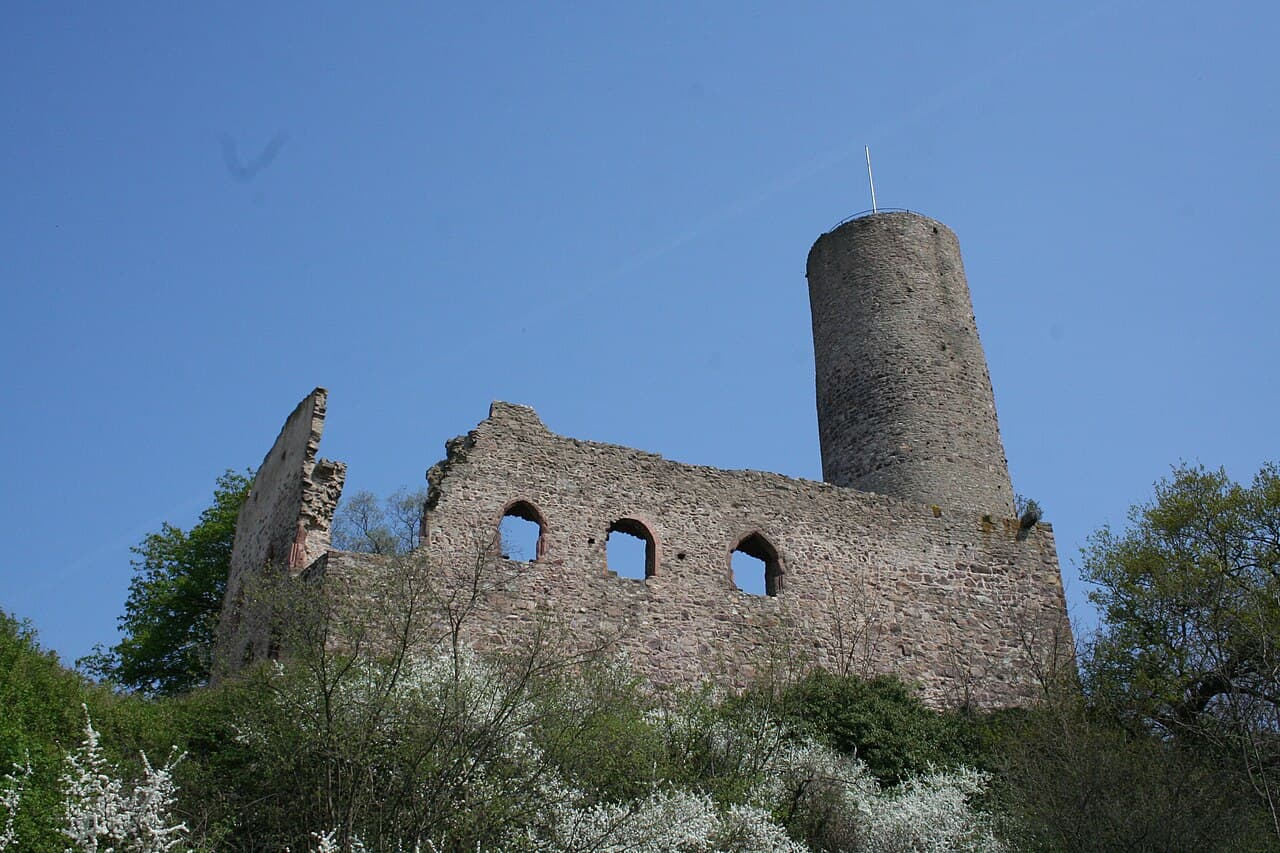
Strahlenburg Castle Ruins
Strahlenburg Castle Ruins stand as a striking testament to medieval fortification and feudal history in the town of Schriesheim, Germany. Constructed beginning around 1235 by Conrad von Strahlenberg, this hill castle was originally intended as part of a defensive network to protect the city and assert control over local trade through taxes and tolls. Despite initial disputes over the land—owned by the monastery of Ellwangen—the castle's construction proceeded after a legal settlement, marking the beginning of a complex history of ownership, conflict, and architectural evolution.
Early construction and architectural features
The initial phase of construction under Conrad von Strahlenberg included the building of a towering bergfried approximately 30 meters high, featuring characteristic round arches that reflect the early 13th-century architectural style. This defensive tower, a hallmark of medieval military architecture, was complemented by the inner curtain walls forming the castle's core defensive enclosure. The choice of building materials—local granite and porphyry—was typical for the region and contributed to the castle's robust and enduring structure.
During the 14th century, the castle underwent significant expansion, including the construction of the main residential building or palas. This structure is notable for its Gothic ogival windows, which feature pointed arches and a window store front that exemplifies the Gothic architectural influence spreading through Europe at the time. The palas served as the living quarters and administrative center, reflecting the dual military and domestic functions of the castle.
Historical context and ownership changes
Strahlenburg's history is marked by frequent changes in ownership and political turmoil. Originally a fief under the Benedictine monastery of Ellwangen, the castle's possession was contested, leading to legal disputes and agreements that shaped its development. Financial difficulties led Rennewart von Strahlenberg to pledge the castle to Hartmut V. von Cronberg in 1329, who made important renovations before his death in 1338.
In 1347, the castle was sold to Elector Ruprecht I of the Palatinate, a significant regional ruler. After his death, the castle passed through various branches of the Palatinate family until 1468, when it came into the hands of Ludwig I of Veldenz-Zweibrücken. This period was turbulent, culminating in a siege in 1470 by forces loyal to Elector Friedrich I of the Palatinate. The siege ended with the capture and execution of defenders, the burning of the castle, and the revocation of Schriesheim's municipal rights.
Destruction and decline
Following the siege, Strahlenburg was partially destroyed by fire between 1485 and 1520, with some sources suggesting it may have been further damaged during military conflicts such as the 1504 war. By the 18th century, the castle had fallen into ruin. In 1733, the local wine producers, concerned about theft, petitioned for protective walls around their vineyards. This led to the authorized demolition of much of the castle, with its stones repurposed for vineyard walls, marking a significant reduction of the original structure.
Architectural remains and current status
Today, visitors to Strahlenburg can observe the remains of the castle perched on the Ölberg slope, also known as the Schriesheimer Schlossberg. The site offers panoramic views over Schriesheim and the Upper Rhine Plain, extending to the Palatinate Forest and Donnersberg on clear days. The surviving bergfried stands approximately 27 meters tall, though it is currently closed to visitors due to structural concerns.
The remnants of the palas still display architectural features such as three early Gothic windows with twin lancet openings and circular lights above, dating to around 1237 or earlier. The castle's defensive perimeter is defined by an almost regular pentagonal ring wall, strategically oriented to protect the most vulnerable mountain slope side.
In the modern era, the castle ruins have been adapted for hospitality purposes. The Burggasthof Strahlenburg operates within the castle grounds, offering visitors a unique dining experience amid historic surroundings. This blend of heritage preservation and contemporary use underscores the castle's ongoing cultural significance.
Cultural impact and legacy
Throughout the 19th century, Strahlenburg inspired numerous artists and writers, contributing to the romanticism of medieval ruins in German culture. Notably, the playwright Heinrich von Kleist wrote the knights' tale "Cathy of Heibronn," which evokes the castle's evocative atmosphere. The castle's ruins have become a symbol of Schriesheim's historical identity and a focal point for tourism and local pride.
Preservation efforts by subsequent owners, including the Counts of Oberndorff, have helped maintain the site as a monument to the region's feudal past. Today, Strahlenburg Castle Ruins continue to attract visitors interested in medieval architecture, history, and scenic views.
Visitor information
- Access: The castle is accessible by hiking trails from Schriesheim, with signage guiding visitors to the ruins.
- Safety: Due to structural concerns, the bergfried tower is closed to the public.
- Facilities: The on-site restaurant offers food and refreshments, enhancing the visitor experience.
- Best time to visit: Spring through autumn when weather conditions allow for comfortable exploration and panoramic views.
Frequently asked questions (FAQ)
- How do I get to Strahlenburg Castle Ruins?
- Strahlenburg Castle Ruins are located on the Ölberg slope near Schriesheim. Visitors can reach the site via marked hiking trails starting from the town center, offering a scenic ascent to the ruins.
- What is the historical significance of Strahlenburg Castle?
- Strahlenburg Castle was a strategic medieval hill castle built in the 13th century, reflecting the feudal struggles and territorial disputes of the region. It played a key role in local defense and administration during the High Middle Ages.
- Is the bergfried tower open to visitors?
- For safety reasons, the bergfried tower at Strahlenburg Castle is currently closed to visitors due to structural concerns. Visitors can still admire the tower's exterior and surrounding ruins.
- Are there facilities at the castle site?
- Yes, the Burggasthof Strahlenburg operates within the castle grounds, providing food and refreshments to visitors in a historic setting.
- When is the best time to visit Strahlenburg Castle Ruins?
- The best time to visit is from spring to autumn when weather conditions are favorable for hiking and enjoying the panoramic views from the castle site.
Photo gallery

Information
Sources & official resources
Verify the information above using these authoritative references.
Loading map...
Visitor reviews
No reviews yet. Been here? Write the first review and help other travelers!
Write the first reviewVisited this castle? Share your experience
Your review helps other travelers and adds first-hand knowledge to our encyclopedia.



