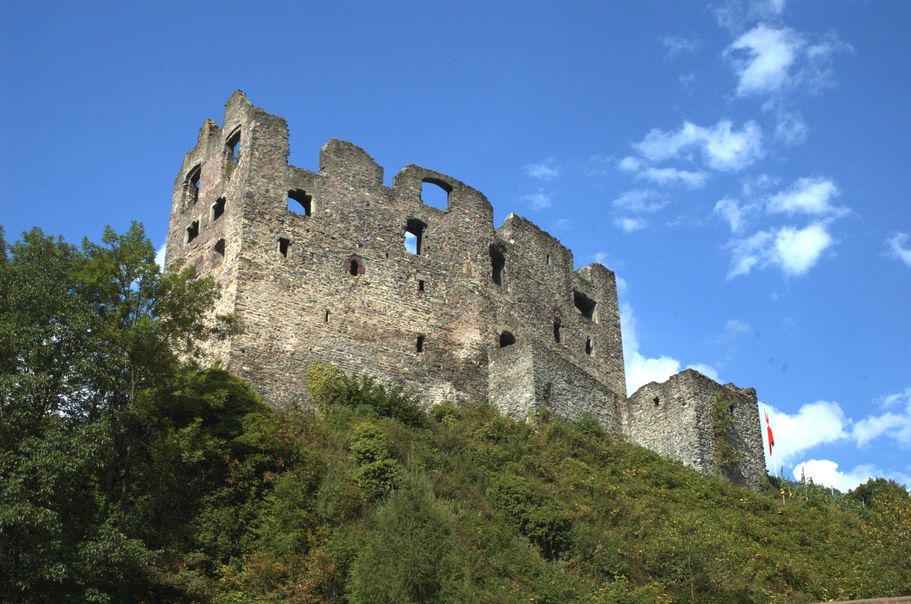
Strahlegg Castle Ruin
Strahlegg castle ruin stands prominently on a rocky promontory overlooking the northern shore of Lake Walen in the municipality of Amden, Switzerland. This site uniquely embodies a layered history stretching from the Roman Empire through the Middle Ages, illustrating the strategic military significance of this vantage point over centuries. The castle ruin today is a compelling testament to the region's evolving defensive architecture and historical conflicts.
The Roman origins and strategic significance
The earliest known construction at Strahlegg dates back to 15 BCE during the reign of Emperor Augustus. Roman builders established a watchtower here as part of an extensive communication network of lookout posts across eastern Switzerland. These towers enabled visual signaling, facilitating rapid transmission of messages across the frontier. The Roman tower at Strahlegg was built with roughly cut limestone blocks and featured a nearly square base approximately 10.4 meters on each side.
The tower's foundation incorporates six stepped offsets—horizontal ledges in the stonework designed to support the structure's floors and walls. Beam holes in all four walls indicate the use of wooden beams to hold internal floors and external defensive walkways, a typical Roman military architectural feature. The highest offset inside the tower marks the position of the original wooden floor beams.
Medieval transformation and military role
Following the decline of Roman control, the original tower fell into disuse but was later rebuilt during the Middle Ages. While no surviving medieval documents explicitly mention Strahlegg castle, archaeological evidence shows the site was re-fortified under the Habsburg dynasty. The medieval builders added masonry primarily to the upper section of the western wall, adapting the Roman foundations to meet contemporary defensive needs.
Strahlegg played a role in regional conflicts, notably during the 1388 Näfels War, when it was held by Habsburg forces. The castle was captured and destroyed by troops from the canton of Glarus, marking the end of its military function. The breach in the southern wall, which served as the entrance, reflects the castle's violent capture and subsequent ruin.
Architectural features and surviving remains
The ruin today preserves the tower's walls up to six meters in height, showcasing the contrast between Roman masonry and medieval construction techniques. The base walls are predominantly Roman, while the upper western wall section reveals medieval additions. The tower's nearly square footprint and robust stone construction highlight its original purpose as a defensive lookout.
Beam holes on the north and south walls suggest the presence of an upper floor inside the tower, while those on the east and west walls likely supported an external defensive walkway. The combination of Roman engineering and medieval fortification features makes Strahlegg a valuable site for understanding the continuity of military architecture from antiquity to the late Middle Ages.
Archaeological rediscovery and cultural significance
After centuries of neglect, the ruin was rediscovered in the 19th century when archaeological interest in Roman and medieval sites increased. A detailed study conducted in 1960 confirmed the dual phases of construction, revealing how the site evolved from a Roman frontier watchtower to a medieval fortified outpost.
Today, Strahlegg castle ruin is recognized as a cultural property of national significance in Switzerland. It offers visitors a tangible connection to the region's layered history and the enduring strategic importance of this location overlooking Lake Walen. The site remains accessible, allowing for direct appreciation of its architectural and historical legacy.
Visiting Strahlegg castle ruin
Visitors to Strahlegg castle ruin can explore the remains of the tower and its surrounding landscape, enjoying panoramic views of Lake Walen and the Swiss Alps. The site provides insight into Roman military communication systems and medieval defensive architecture. While the ruin is partially preserved, care should be taken when navigating the uneven terrain and ancient stonework.
The ruin's location on a hilltop makes it a rewarding destination for hikers and history enthusiasts interested in Switzerland's Roman and medieval heritage. Informational signage at the site helps contextualize the historical phases and architectural features visible today.
Frequently asked questions (FAQ)
- When was Strahlegg castle originally built?
- Strahlegg castle originated as a Roman watchtower constructed around 15 BCE during Emperor Augustus's reign.
- What historical events affected Strahlegg castle?
- The castle was involved in the 1388 Näfels War, held by Habsburg forces before being captured and destroyed by troops from Glarus.
- What architectural features remain visible at the ruin?
- Visitors can see the nearly square tower base with Roman limestone masonry, medieval upper wall additions, beam holes for floors and walkways, and a breached southern entrance.
- Is Strahlegg castle ruin accessible to visitors?
- Yes, the ruin is accessible and offers panoramic views of Lake Walen, though visitors should exercise caution due to uneven terrain and partial preservation.
- Why is Strahlegg castle significant?
- Strahlegg castle illustrates the transformation from a Roman frontier watchtower to a medieval fortified outpost, reflecting centuries of military architecture in Switzerland.
Information
Website
Visit websiteSources & official resources
Verify the information above using these authoritative references.
Loading map...
Visitor reviews
No reviews yet. Been here? Write the first review and help other travelers!
Write the first reviewVisited this castle? Share your experience
Your review helps other travelers and adds first-hand knowledge to our encyclopedia.