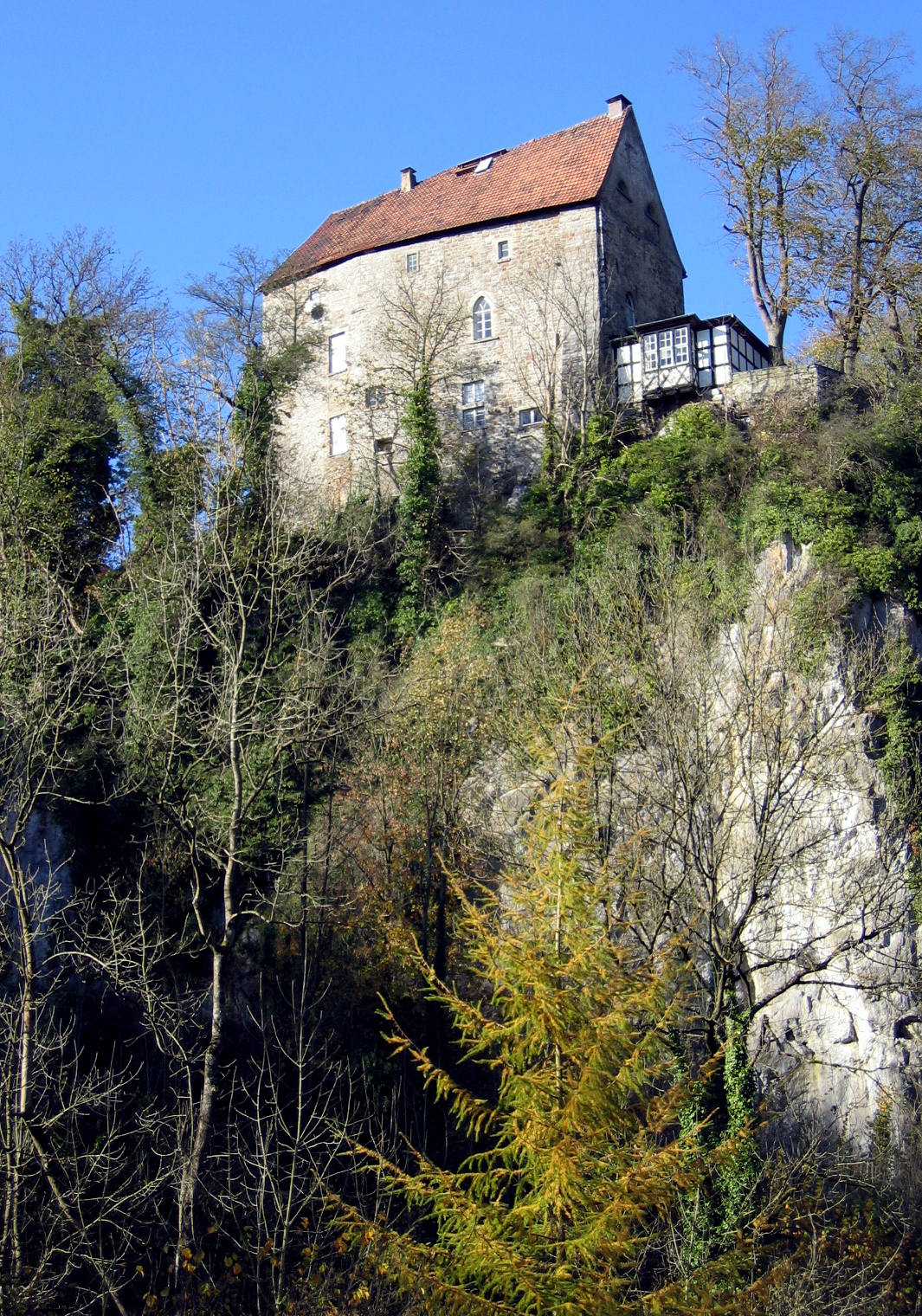
Stesser Burg
Stesser Burg is a significant hillfort located in the municipality of Meschede, Germany, notable for its long history spanning from the late Iron Age through the medieval period. Positioned strategically on a wooded hill near the Ruhr River, this site offers a remarkable example of an early fortified settlement that evolved through multiple phases of occupation and adaptation.
The origins and early Iron Age occupation
The earliest evidence of human activity at Stesser Burg dates back to the late Iron Age, possibly as early as the 3rd century BCE. Archaeological investigations have uncovered a variety of artifacts, including a decorated fragment of an arm ring that closely resembles similar items found at other Celtic sites in Central Europe. This suggests that the inhabitants had connections with the broader La Tène culture, a hallmark of Celtic material culture during this period.
Further evidence of the site's significance during the Iron Age includes a gold-blass coin composed of a mixture of gold, silver, and copper, dating from the mid-1st century BCE. This coin indicates ongoing occupation and possibly trade or wealth accumulation during the height of the La Tène cultural era. The fort's location on a hill provided a natural defensive advantage, which was enhanced by a continuous defensive wall following the ridge's contours, enclosing approximately 2.4 hectares.
Early medieval reoccupation and Merovingian influences
Following the Iron Age, Stesser Burg experienced a resurgence in use during the Early Middle Ages, around the late 7th century CE. This phase is supported by finds such as a gold fibula with equal-armed decorations and a gold tremissis coin from the Merovingian period. These artifacts highlight the site's sustained importance and suggest it functioned as a fortified settlement or refuge during this era.
The early medieval phase likely saw adaptations to the existing fortifications to meet contemporary defensive needs, although the precise nature of these modifications remains under investigation. The continuity of occupation through such a turbulent historical period underscores the strategic value of the site.
Medieval occupation and fortification enhancements
Between the 10th and 14th centuries, spanning the High and Late Middle Ages, Stesser Burg continued to be occupied or reused. Ceramic fragments from this period indicate ongoing human activity within the fort's enclosure. During this time, additional earthworks to the southeast of the main enclosure may have served as an outer bailey, a fortified courtyard typical in medieval castle complexes, suggesting further defensive enhancements.
The site’s internal layout includes four additional ramparts dividing the interior space, which may have organized residential, administrative, or military functions within the fort. Two curved southern ramparts, distinct from the later straight ramparts, hint at different construction phases and architectural evolution over time.
Architectural features and defensive structures
The ringfort occupies the entire summit of the hill, enclosed by a continuous defensive wall that follows the natural ridge. The southern section features a complex arrangement of terraces, ramparts, and ditches, indicative of sophisticated defensive planning. The curved shape of some southern ramparts points to earlier construction phases, while straighter ramparts likely date to later medieval modifications.
Although no gates have been definitively identified through excavation, digital terrain models suggest possible entrance points on the western side, aligning with the current access path. Additional potential breaks in the ramparts to the north and east provide clues to how access was controlled and organized.
Archaeological investigations and preservation efforts
Stesser Burg was officially designated a protected monument by the city of Meschede in 1984, recognizing its cultural and historical value. Archaeological surveys, including metal detector investigations conducted by the LWL Archaeology for Westphalia in 2014, have confirmed the site's origins as a late Iron Age fortification with multiple occupation phases.
Material remains such as pottery fragments embedded within the ramparts and ceramic shards from various periods provide valuable insights into the daily life and cultural influences at the site across centuries. The surrounding beech forest helps preserve the earthworks by limiting erosion and human disturbance.
Environmental setting and current condition
Located within a protected natural area, Stesser Burg remains a visible and tangible link to the region's ancient and medieval past. The site’s earthworks, including the ramparts and ditches, are well preserved and can be appreciated in situ. The extensive woodland coverage contributes to the site's preservation by protecting the soil and limiting modern development.
Visitors today can explore the site’s natural and archaeological features, gaining insight into the complex defensive strategies employed over centuries and the cultural transitions from Iron Age Celtic communities to medieval settlements.
Frequently asked questions (FAQ)
- What is the historical significance of Stesser Burg?
- Stesser Burg is a multi-period hillfort that was first established in the late Iron Age and later reused during the Early and High Middle Ages. Its continuous occupation illustrates the strategic importance of the site over centuries in the region near the Ruhr River.
- Can I visit Stesser Burg today?
- Yes, Stesser Burg is located within a protected natural area and its earthworks remain visible. Visitors can explore the site, although facilities may be limited as it is primarily an archaeological site rather than a developed tourist attraction.
- When was Stesser Burg originally built?
- The earliest construction phase of Stesser Burg dates back to the late Iron Age, possibly the 3rd century BCE, with subsequent phases through the medieval period up to the 14th century CE.
- What architectural features are notable at Stesser Burg?
- The site features a continuous defensive wall enclosing about 2.4 hectares, multiple ramparts including curved and straight sections, terraces, ditches, and internal divisions that reflect its evolution from an Iron Age fort to a medieval fortified settlement.
- Are there any artifacts found at Stesser Burg?
- Archaeological finds include decorated Iron Age arm ring fragments, a gold-blass coin from the 1st century BCE, a Merovingian gold fibula, a gold tremissis coin, and various ceramic shards from Iron Age and medieval periods.
Information
Current owner
Municipality of Meschede
Loading map...
Visitor reviews
No reviews yet. Been here? Write the first review and help other travelers!
Write the first reviewVisited this castle? Share your experience
Your review helps other travelers and adds first-hand knowledge to our encyclopedia.