Steinvikholm Castle
Steinvikholm Castle stands as a monumental testament to Norway's medieval history and religious transformation. Constructed between 1525 and 1532 by Olav Engelbrektsson, the last Catholic Archbishop of Nidaros, this fortress occupies roughly half of the rocky island of Steinvikholm in Stjørdal municipality. It is recognized as the largest construction from the Norwegian Middle Ages and one of the most powerful fortifications of its time, symbolizing the Catholic Church's authority during a period of significant religious upheaval.
The castle's strategic location on an island presented both defensive advantages and logistical challenges. Without any natural springs, fresh water had to be transported from the mainland until a well was dug in 1542, which thereafter provided a reliable water source. Access to the island was primarily by boat or via a wooden bridge, the latter serving as the sole land connection and heavily fortified to protect against invaders. The fortress's design, while typical of early 16th-century European castles, was somewhat outdated due to the emergence of gunpowder artillery, yet it remained a formidable stronghold.
Historical significance and construction
Steinvikholm Castle was built during a turbulent era marked by the Protestant Reformation and the struggle between Norwegian independence and Danish rule. Archbishop Olav Engelbrektsson commissioned the fortress after returning from Rome, anticipating military and religious conflict. His resistance against the Danish monarchs Frederick I and Christian III culminated in Steinvikholm becoming the Catholic Church’s last bastion in Norway.
Following the Reformation's success in 1537, Engelbrektsson fled into exile, leaving behind treasures from Nidaros Cathedral, including the shrine and coffin of St. Olav. These relics remained at Steinvikholm until 1564 before being returned to the cathedral, although St. Olav's grave has since been lost to history. The castle then served as an administrative center for the local royal governor until about 1575, enduring military tensions such as the Nordic Seven Years’ War, during which it was besieged but surrendered without battle due to water shortages and civilian presence.
Architectural features and defensive design
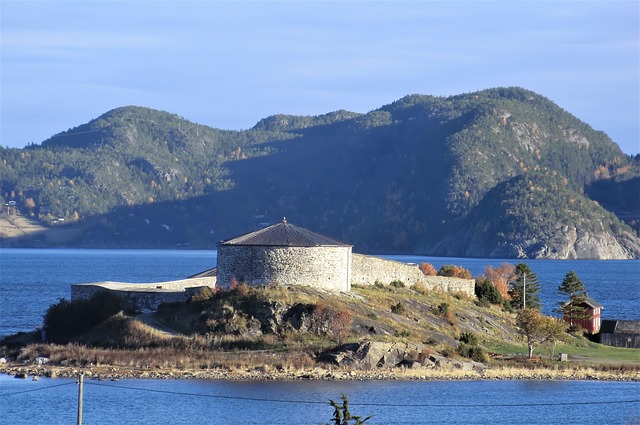
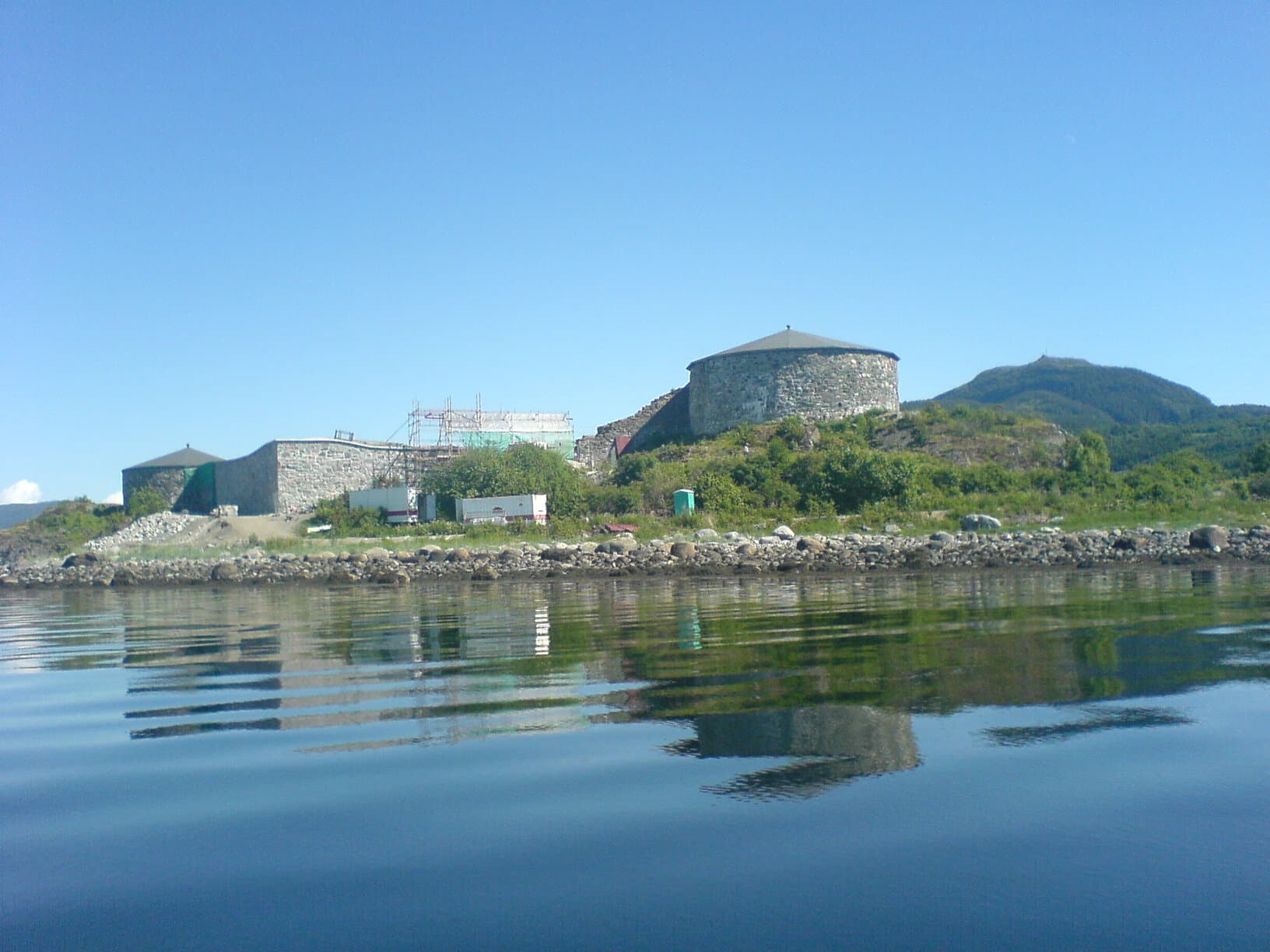
Occupying an almost square footprint approximately 52.5 by 50 meters, Steinvikholm Castle was constructed with thick soapstone walls—between 3.8 and 4.4 meters thick—sourced from quarries near Trondheim. Two prominent round towers anchor opposite corners: the larger "Bonden" tower, nearly 20 meters in diameter, was positioned on the highest point to command views over the land approach, bridge, and fjord, while the smaller tower guarded the waterside.
The castle’s outer walls doubled as the main building’s walls, with no separate outer curtain wall. Inside, the courtyard measured about 17 by 24 meters, surrounded by two-story buildings with cellars likely used for storage. Defensive features included a fortified gate with a portcullis guarding the wooden bridge, supported by two wooden palisades spaced about 25 meters apart. Cannons were mounted on the towers and eastern wing, reflecting the adaptation to gunpowder weaponry.
A hidden exit in the northeastern tower led to a concealed anchorage, allowing discreet access or escape by boat. This feature underscored the castle’s strategic design tailored to its island setting. The fortress’s construction bears carved stonemasons’ marks—bumerker—that are the youngest known in Norway, indicating skilled craftsmanship by masons associated with Nidaros Cathedral, possibly under master mason Peter Steinhugger.

Photo by Erik Fløan • Public domain
Decline, preservation, and cultural legacy
After the late 16th century, Steinvikholm Castle gradually fell into disuse and was partially dismantled from 1661 onward. Stone was quarried from its walls for other constructions, an act tacitly approved by Danish-Norwegian authorities aiming to erase symbols of Norwegian resistance. The castle’s height diminished significantly, with current ruins standing at roughly one-third of the original height.
Interest in the castle revived in the 19th century with archaeological excavations beginning in 1849. The Norwegian Society for the Preservation of Ancient Monuments acquired the site in 1893, initiating restoration efforts that continued through the 20th and into the 21st centuries. These efforts included masonry repairs and the installation of new copper roofs on the towers to protect the ruins.
Today, Steinvikholm Castle is owned and operated by the preservation society and serves as a cultural venue. Since 1993, the island has hosted an annual midnight opera depicting the life and struggles of Archbishop Olav Engelbrektsson. This event, organized by Steinvikholm Musikkteater, draws visitors each August, celebrating the castle’s enduring historical and cultural significance.
Water supply challenges and solutions
The absence of natural freshwater sources on Steinvikholm island was a significant logistical challenge for the castle’s inhabitants. Initially, water had to be ferried from the mainland, a difficult and vulnerable process during sieges. The digging of a well in 1542 provided a permanent solution, reportedly never running dry thereafter, which was crucial for the castle’s defensive viability.
Military role during the Nordic Seven Years’ War
During the Nordic Seven Years’ War (1563–1570), Steinvikholm Castle was a strategic military site. Although besieged, it surrendered without combat due to water shortages and the presence of civilians, highlighting the fortress’s limitations despite its formidable construction. This episode marked the transition of the castle from a religious stronghold to a military-administrative center under Danish-Norwegian control.
Frequently asked questions (FAQ)
- How do I get to Steinvikholm Castle?
- Steinvikholm Castle is located on an island accessible by boat or via a wooden bridge connecting it to the mainland. Visitors typically reach the site by car to Stjørdal municipality and then proceed on foot to the island.
- What is the historical significance of Steinvikholm Castle?
- Steinvikholm Castle was built as the last stronghold of the Catholic Church in Norway during the Reformation. It was the residence of Archbishop Olav Engelbrektsson and symbolizes the religious and political conflicts of early 16th-century Norway.
- When is the best time to visit Steinvikholm Castle?
- The best time to visit Steinvikholm Castle is during the summer months, particularly in August when the annual midnight opera about Archbishop Olav Engelbrektsson is performed, offering a unique cultural experience.
- Can I explore the castle ruins on my own?
- Visitors can explore the castle ruins independently during opening hours. The site includes informative signage, but guided tours may be available during special events or by prior arrangement.
- Is there an entrance fee to visit Steinvikholm Castle?
- Entrance fees vary depending on events. The castle is often accessible for free or for a small fee during the annual opera performances. It's best to check ahead for current ticket prices and opening hours.
Photo gallery

Photo by Erik Fløan•Public domain


Information
Current owner
The society for the Preservation of Norwegian Ancient Monuments
Website
Visit websiteSources & official resources
Verify the information above using these authoritative references.
Loading map...
Visitor reviews
No reviews yet. Been here? Write the first review and help other travelers!
Write the first reviewVisited this castle? Share your experience
Your review helps other travelers and adds first-hand knowledge to our encyclopedia.