Steinenschloss Castle
Steinenschloss Castle, also known locally as Burg Steinenschloss, is a striking medieval hill castle ruin nestled in the forest east of the village of Thaleischweiler-Fröschen, within the Rhineland-Palatinate region of Germany. This fortress, perched on a rocky plateau overlooking the surrounding valleys, offers a fascinating glimpse into the architectural and historical developments of the High Medieval period. Despite its current ruinous state, the castle's remains reveal a complex and robust structure that once served as a strategic stronghold for the influential Counts of Leiningen.
The origins of Steinenschloss Castle trace back to approximately 1100 AD, making it one of the earlier stone fortifications in the region. The castle's name, "Steinenschloss," meaning "stone castle," is a modern attribution dating from around 1900, derived from the nearby hamlet of Steinen that existed below the castle hill in the 13th century. Historical records and archaeological evidence suggest that the castle was already in ruins by the late 12th century, having suffered destruction likely linked to military campaigns by Emperor Frederick Barbarossa.
Historical context and origins
The site of Steinenschloss Castle holds a long history of human occupation predating the medieval fortress. Archaeological findings indicate settlement activity in the area dating back to the Late Stone Age and the early Iron Age Hallstatt period. This suggests the rocky hill was valued for its strategic position at the confluence of the Schwarzbach and Rodalb rivers, controlling important valley routes.
The castle was probably founded by the Counts of Leiningen, a noble family with significant influence in the region during the High Medieval era. Their choice of location reflects typical medieval defensive priorities: commanding views, natural rock defenses, and control over trade and communication routes. The proximity of a Roman villa about one kilometer away may have provided convenient building materials, as sandstone from the villa ruins was likely repurposed for the castle's construction.
Architectural features and layout
Castle structure and fortifications
Steinenschloss Castle occupies a roughly iron-shaped plateau approximately 70 meters long and 46 meters wide. The castle is divided into two main sections, separated by a natural rock ledge that houses a cistern for water collection. The entire complex is enclosed by a robust curtain wall constructed from carefully hewn sandstone blocks, with sections reinforced by large, rough-faced stones characteristic of the Salian and Staufer masonry traditions of the 11th and 12th centuries.
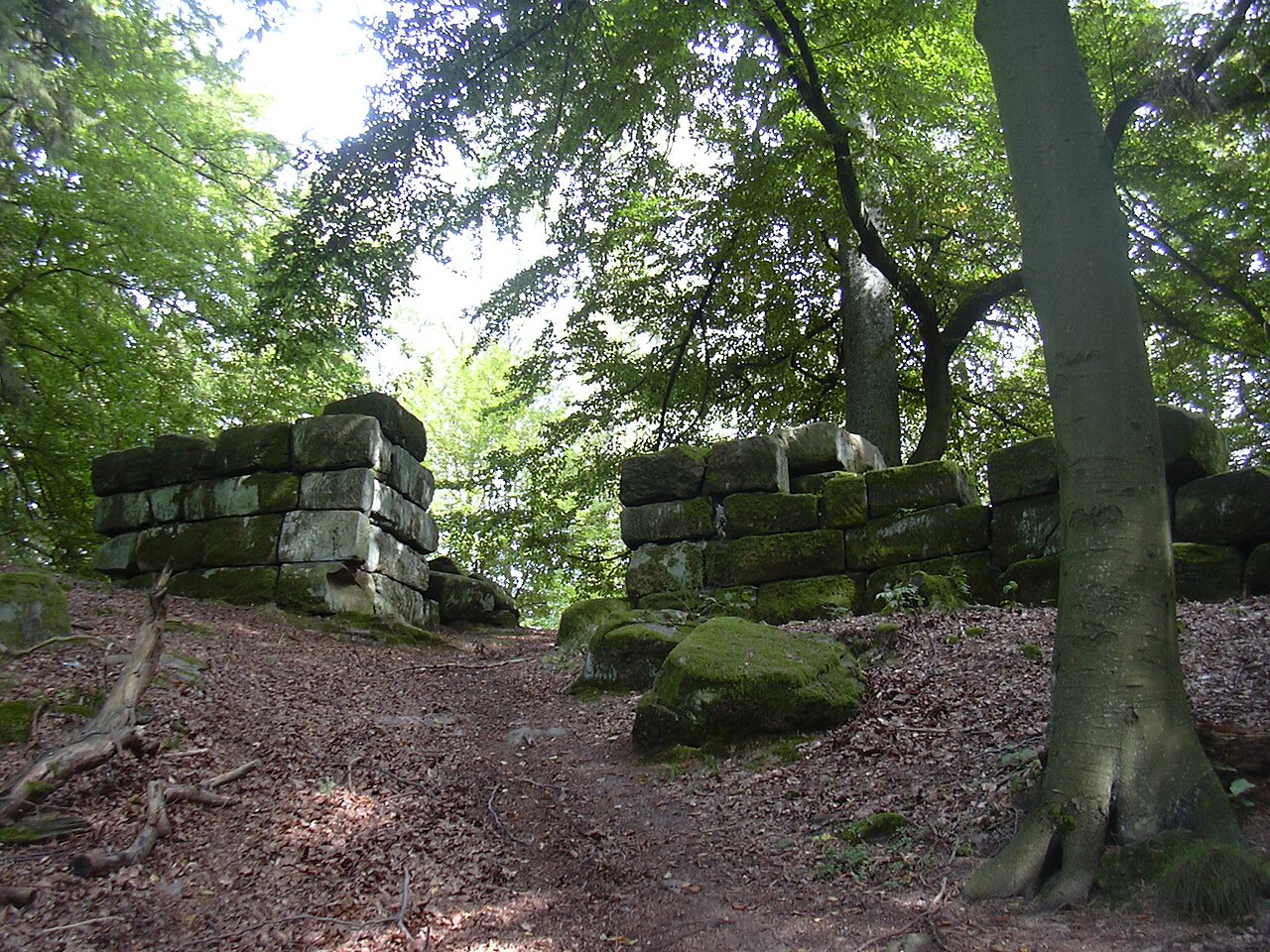
To the west, the castle features a bailey or outer courtyard, which extends along a moat and bends southward. This area likely contained auxiliary buildings and served as a first line of defense. The lower castle area included guard rooms and the main entrance, originally secured by a gate measuring 2.5 meters wide and 3.15 meters high. Defensive features such as a moat and a drawbridge controlled access to the inner castle.
The massive round keep
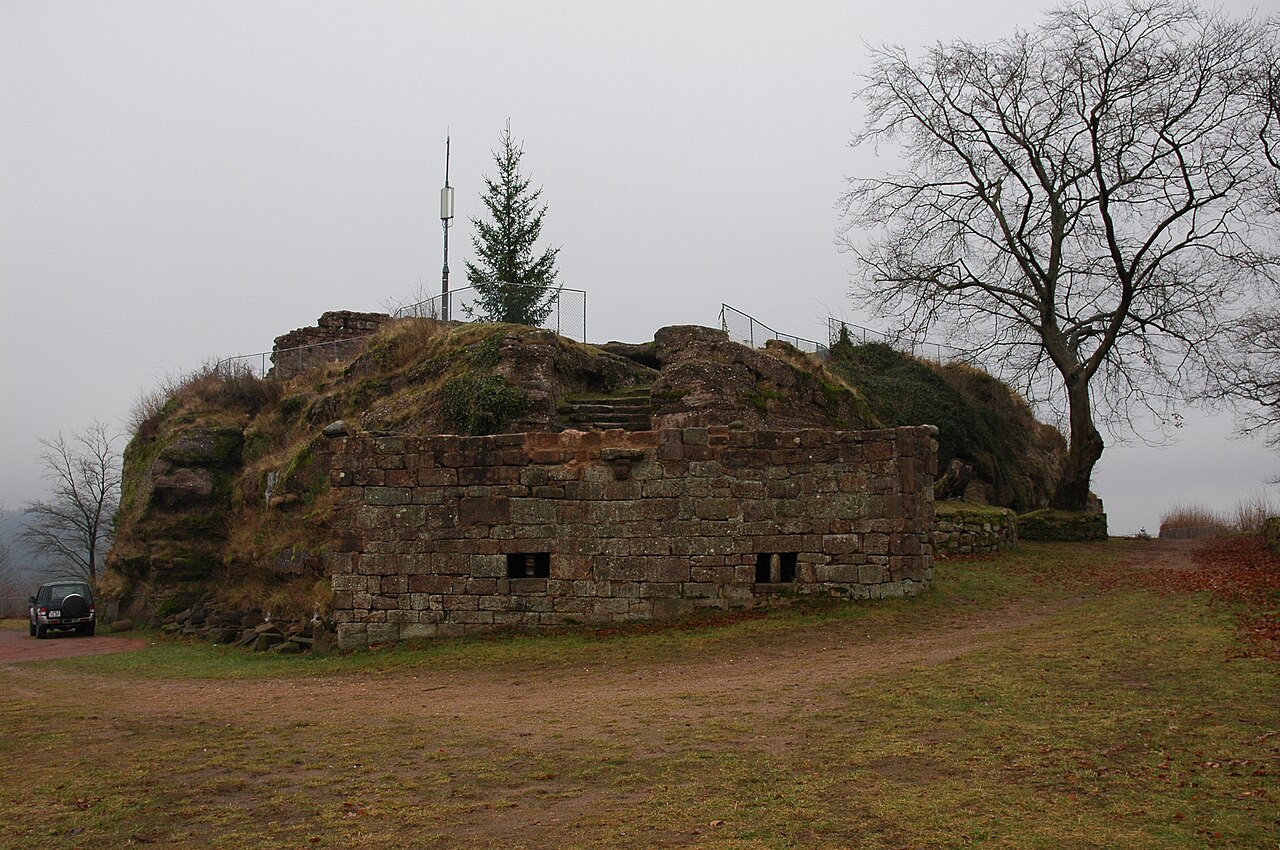
The castle's most prominent architectural element is its massive round keep, constructed between approximately 1125 and 1166. With walls 2.5 meters thick and an interior diameter of 8.5 meters, this tower was one of the largest of its kind in the Rhineland-Palatinate region during the Middle Ages. Its external diameter measures about 13.5 meters. The keep likely served multiple roles, functioning as the main defensive bergfried and possibly providing residential space.
Adjacent to the keep, the upper castle housed essential living quarters, including a palas or great hall, a kitchen, latrines, and an armory. The northern side was protected by a bent shield wall, incorporating elements from the 11th century alongside 12th-century reconstructions, reflecting repairs after damage likely caused by the fire that destroyed the castle.
Destruction and decline
Shortly after the completion of the round keep, Steinenschloss Castle suffered a devastating fire. Historical sources suggest this destruction may have been part of the 1168 military campaign led by Holy Roman Emperor Frederick Barbarossa, who ordered the slighting of several castles in the Saarbrücken area to consolidate imperial control. Steinenschloss was possibly one of these targeted fortresses.
By 1237, documents confirm the castle was already in ruins and it was never rebuilt as a fortified residence. Over the following centuries, the ruin passed through the hands of various noble families, including branches of the Leiningen family, Zweibrücken-Bitsch, and Hanau-Lichtenberg. Despite changes in ownership, the castle remained abandoned and gradually fell into further disrepair.
Archaeological investigations and conservation
Interest in the ruins of Steinenschloss Castle began in the late 19th century with initial excavations led by Christian Mehlis. These early efforts were limited by financial constraints. Renewed archaeological work took place after World War II under Dr. L. A. Hoffmann and continued with additional excavations starting in 1968. In 1973, the Burgverein Steinenschloss association was established to support ongoing research, preservation, and public engagement with the site.
The local Heimatverein Thaleischweiler-Fröschen currently manages conservation efforts. Significant parts of the curtain wall and the palas area, including latrines, have been stabilized to prevent further decay. The lower castle's gate has been partially reconstructed to reflect its original form. The round keep's remains have been partly re-erected, reaching heights of up to ten meters, allowing visitors to appreciate the impressive scale of the medieval fortress.
Artifacts and cultural significance
Excavations at Steinenschloss have uncovered a variety of artifacts that shed light on the castle's historical life and medieval craftsmanship. Finds include ceramic discs and gaming pieces made from sandstone and deer antler, iron tools and weapon fragments, as well as decorative items such as door handles, keys, and gilded bronze fittings. Notably, a double-headed eagle ornament in gilded bronze was discovered, symbolizing imperial connections or noble heraldry.
In the western outer area of the site, a stone artifact featuring a round-arched slit window and a shell-like emblem hints at ornamental architectural elements that once adorned the castle. These discoveries contribute valuable insights into the castle's function, status, and the daily lives of its inhabitants.
Visiting Steinenschloss today
Today, Steinenschloss Castle stands as a well-preserved ruin accessible to the public without restrictions. Its secluded forest setting offers a peaceful atmosphere despite its proximity to regional roads. Visitors can explore the remains of the curtain walls, the reconstructed gate, the palas foundations, and the impressive round keep. The site provides an evocative experience of medieval fortification architecture and the turbulent history of the Rhineland-Palatinate region.
Visitors should be prepared for natural conditions, including insect activity, especially during warmer months. The castle's location near the L477 road makes it relatively easy to reach, and its historical significance and architectural features make it a rewarding destination for enthusiasts of medieval history and castle architecture.
Frequently asked questions (FAQ)
- How do I get to Steinenschloss Castle?
- Steinenschloss Castle is located in Thaleischweiler-Fröschen, Germany, and can be accessed by car or public transport. If you are driving, follow local signage for parking facilities nearby. For public transport, check local bus and train schedules that connect to the nearest stations.
- What is the historical significance of Steinenschloss Castle?
- Steinenschloss Castle dates back to the 11th century and has a rich history tied to the region's feudal past. It served as a strategic fortress and residence for various noble families throughout the centuries. Today, it stands as a testament to medieval architecture and the historical evolution of the area.
- When was Steinenschloss Castle built?
- Construction of Steinenschloss Castle began in the early 11th century, making it one of the older castles in the region. It has undergone several renovations and restorations over the years, reflecting different architectural styles. The castle's enduring presence highlights its significance throughout history.
- Can I visit Steinenschloss Castle year-round?
- Yes, Steinenschloss Castle is open to visitors year-round, although certain areas may be restricted during inclement weather or special events. It's advisable to check the castle's official website or contact the visitor center for the most current information regarding accessibility. Guided tours are available to enhance your experience.
- Why is Steinenschloss Castle a popular tourist attraction?
- Steinenschloss Castle is popular for its stunning architecture, beautiful surroundings, and rich history. Visitors are drawn to its picturesque views and the opportunity to explore medieval structures. Additionally, the castle often hosts cultural events and exhibitions, making it a vibrant part of the local community.
- Is it possible to access Steinenschloss Castle with mobility challenges?
- Steinenschloss Castle aims to be accessible to all visitors, with designated pathways and support for those with mobility challenges. However, some areas may have limited accessibility due to the castle's historic design. It is recommended to contact the visitor center in advance to inquire about specific accommodations.
- What are the opening hours for Steinenschloss Castle?
- Steinenschloss Castle typically opens from 10 AM to 6 PM during the peak tourist season, with reduced hours in the off-season. It is advisable to check the castle's official website for any seasonal changes in hours or holiday closures. Guided tours may have specific time slots, so plan accordingly.
- Are there any ticket prices to visit Steinenschloss Castle?
- Yes, there is an admission fee to enter Steinenschloss Castle, which helps fund its maintenance and preservation. Ticket prices are generally reasonable, with discounts available for children, students, and seniors. Be sure to check the official website for the most current pricing information and any special offers.
- What nearby attractions can I visit after Steinenschloss Castle?
- After visiting Steinenschloss Castle, you can explore several nearby attractions, including local museums and scenic parks. The charming village of Thaleischweiler-Fröschen offers quaint shops and eateries to enjoy. Additionally, the beautiful countryside surrounding the castle provides opportunities for hiking and nature walks.
Information
Website
Visit websiteAddress
Next to the L477 road, Thaleischweiler-Fröschen, Rhineland-Palatinate, Germany
Sources & official resources
Verify the information above using these authoritative references.
Loading map...
Visitor reviews
No reviews yet. Been here? Write the first review and help other travelers!
Write the first reviewVisited this castle? Share your experience
Your review helps other travelers and adds first-hand knowledge to our encyclopedia.