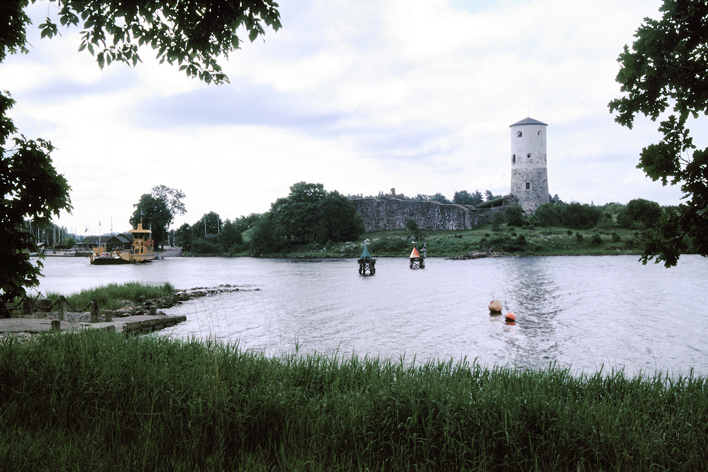
Stegeholm Castle Ruins
Stegeholm castle ruins are located on Slottsholmen island at the mouth of Gamlebyviken bay in Västervik, Sweden. This historic site represents the remains of a medieval fortress and later a stately palace, reflecting centuries of regional conflict and architectural evolution. The earliest records of Stegeholm date to the 14th century, with construction likely completed before 1370 under the direction of Albert II, Duke of Mecklenburg, father of King Albert of Sweden. Originally built as a stronghold staffed by German knights, the castle was strategically positioned to guard the narrow waterway connecting the Baltic Sea to the inland bay, protecting the nearby old town of Gamleby, now Västervik.
Medieval origins and early history
The initial fortress at Stegeholm was constructed using robust medieval masonry techniques typical of late medieval fortifications. It served as a military and administrative center under various noble owners. After its establishment by Germanic builders, the castle passed to Bo Jonsson Grip and his descendants until 1419. Subsequently, control shifted to King Eric of Pomerania, under whose reign the castle became embroiled in regional conflicts linked to the political tensions of the Kalmar Union.
Stegeholm endured several sieges during the 15th century, including an unsuccessful assault in 1434 led by Engelbrekt Engelbrektsson’s lieutenant, Jösse Nilsson, and a siege in 1436 commanded by Bo Knutsson. These events highlight the castle's significance as a contested stronghold during periods of political unrest between Swedish separatists and union loyalists.
Destruction and rebuilding in the 16th century
In 1517, the castle and the relocated town of Västervik suffered devastation when Christian II’s Danish fleet set fire to both, marking a turning point in the site's history. Swedish forces recaptured and rebuilt Stegeholm in 1521, restoring its defensive capabilities. The castle's ownership was later granted by King Eric XIV in 1562 to the influential Sture family, who managed the surrounding county. In 1570, the area was renamed Stegeholm and Västervik by King John III in honor of his aunt, the widow of Svante Sture.
The von königsmarck palace and final destruction
By the mid-17th century, the medieval fortress was replaced by a grand palace constructed under the auspices of Field Marshal Hans Christoff von Königsmarck, who received the fief in 1651. This palace represented a shift from purely military architecture to a more palatial residence, reflecting contemporary styles and the increasing importance of comfort and status. However, the palace did not survive long; in September 1677, a combined Danish and Dutch fleet destroyed the palace and much of Västervik during a military campaign, leaving Stegeholm in ruins.
Post-destruction use and preservation efforts
Following its destruction, the castle ruins became a source of building material for the local population. By 1734, stones from Stegeholm were quarried for use in town construction. Industrial activities such as tar boiling and metalworking were established within the surviving walls, integrating practical uses into the historic site.
In 1881, the Society for the Beautification of Västervik initiated landscaping and conservation projects to preserve the ruins and enhance the site's appearance. Maintenance responsibilities were transferred to the city authorities of Västervik in 1903, ensuring ongoing care. Archaeological investigations in 2016 focused on medieval refuse deposits near the shoreline, providing insights into the daily life and environment during the castle's occupation.
Architectural features and current state
Stegeholm was originally a hill castle built on an island, utilizing natural water defenses and strong masonry walls characteristic of late medieval military architecture. The fortress included defensive walls, gates, and towers designed to control access and protect the surrounding waterways. The later von Königsmarck palace introduced more expansive residential elements but was destroyed before significant architectural details could be preserved.
Today, the site consists of fragmentary ruins surrounded by landscaped grounds that commemorate its layered history. The ruins serve as a cultural venue, hosting the annual Västervik Visfestival since 1966, which celebrates Swedish song and music traditions within the atmospheric remains of the castle.
Historical significance and cultural legacy
Stegeholm castle ruins embody the turbulent history of the Baltic region during the late medieval and early modern periods. Its role as a contested fortress during the Kalmar Union conflicts, its destruction and rebuilding, and eventual transformation into a palace reflect broader shifts in political power and architectural trends. The site’s preservation and use as a cultural venue highlight its continuing importance to the heritage of Västervik and Sweden.
Frequently asked questions (FAQ)
- How do I get to Stegeholm castle ruins in Västervik?
- Stegeholm castle ruins are located on Slottsholmen island, accessible by foot from the center of Västervik. The site is near the waterfront and well signposted from the town center.
- What is the best time to visit Stegeholm castle ruins?
- The best time to visit Stegeholm is during the summer months when the weather is mild and the annual Västervik Visfestival takes place, offering a unique cultural experience within the ruins.
- Is there an entrance fee to visit Stegeholm castle ruins?
- Visiting the Stegeholm castle ruins is free of charge, making it an accessible historical site for all visitors.
- Can I explore the ruins of Stegeholm castle freely?
- Yes, visitors can freely explore the ruins and the surrounding landscaped grounds. However, some areas may be restricted for safety reasons, so it is advisable to follow posted signs and guidelines.
- What historical events are associated with Stegeholm castle?
- Stegeholm was involved in significant events including sieges during the 15th century, destruction by Christian II’s fleet in 1517, rebuilding in 1521, and final destruction by Danish-Dutch forces in 1677.
Information
Address
Slottsholmsvägen, Västervik, Sweden
Loading map...
Visitor reviews
No reviews yet. Been here? Write the first review and help other travelers!
Write the first reviewVisited this castle? Share your experience
Your review helps other travelers and adds first-hand knowledge to our encyclopedia.