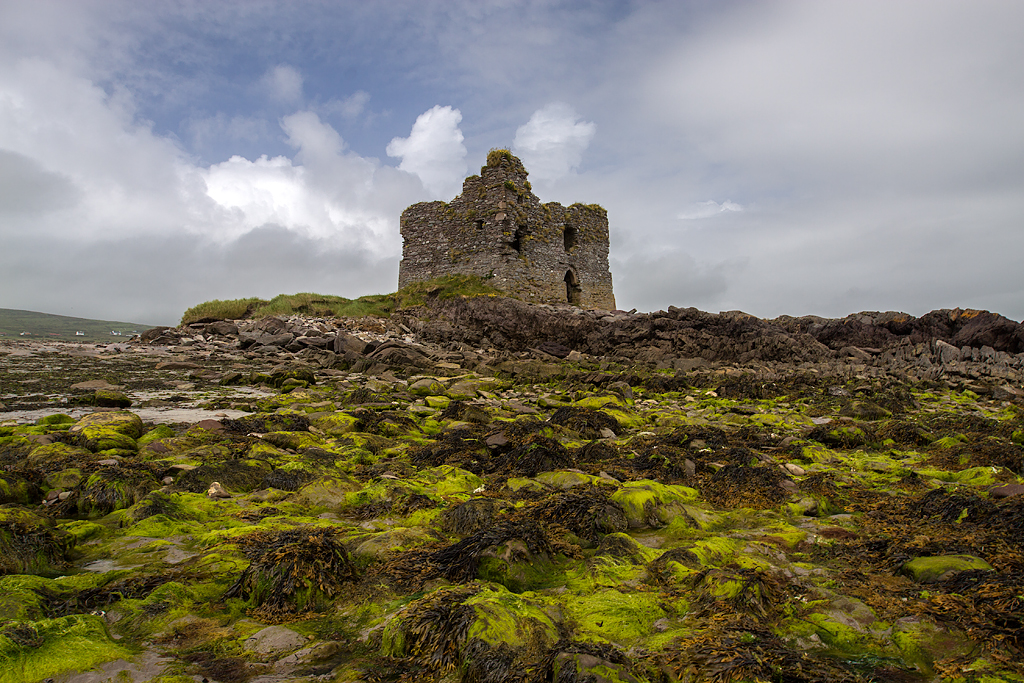
Staigue Stone Fort
Staigue Stone Fort is an impressive late Iron Age stone ringfort located in County Kerry, Ireland, north of the small hamlet of Castlecove. This ancient structure stands at the head of a valley, commanding a strategic position that would have been ideal for defense and surveillance in its time. The fort's construction dates back to approximately 300 to 400 AD, placing it firmly within the late Iron Age period of Irish history.
Historical context and purpose
The fort is believed to have been built as a defensive stronghold for a local lord or king, reflecting the social and political organization of early Irish society. During this period, ringforts served as protected homesteads for the elite, combining residential and defensive functions. Over time, Staigue Stone Fort may have also served other purposes, including use as a place of worship or even an observatory, although the exact nature of these functions remains uncertain.
Architectural features and construction techniques
Staigue Stone Fort is distinguished by its circular design and the use of large undressed stones carefully stacked without mortar, a technique known as dry stone construction. The fort's walls are massive and sloping, reaching heights of up to 5.5 meters in certain areas. This design would have provided formidable protection against attackers while also allowing defenders to monitor the surrounding landscape.
The fort is surrounded by the remains of a ditch, which would have added an additional layer of defense. Inside, the fort's interior is largely empty, emphasizing its role as a stronghold rather than a permanent residence. However, there are two small chambers built into the thickness of the walls, which may have been used for storage or as shelters during attacks.
One of the most notable architectural elements is the complex network of stairways integrated into the walls, leading to terraces and the top of the fortifications. These stairways are similar to those found at nearby Cahergall Stone Fort, indicating a shared regional style or construction tradition. The terraces would have provided vantage points for lookouts and defenders.
Comparison with other Irish ringforts
Staigue Stone Fort is one of the largest and best-preserved examples of a stone ringfort in Ireland. While many ringforts were constructed using earthworks or timber, Staigue's robust stone walls have allowed it to survive in a remarkable state. Its design shares similarities with other stone forts in the region, such as Cahergall and Leacanabuaile, which also feature thick stone walls and internal stairways.
Visiting Staigue Stone Fort
The site is freely accessible to visitors and offers a fascinating glimpse into Ireland's Iron Age past. While there is no formal entrance fee, visitors are encouraged to pay a small 'trespass fine' of 1 euro as a gesture of support for the site's upkeep. The fort's remote location and well-preserved condition make it a rewarding destination for those interested in ancient architecture and Irish history.
Visitors can explore the fort's walls and stairways, gaining insight into the construction methods and defensive strategies of early Irish societies. The surrounding landscape also provides scenic views of the Kerry countryside.
Frequently asked questions (FAQ)
- When was Staigue Stone Fort built?
- Staigue Stone Fort was constructed during the late Iron Age, approximately between 300 and 400 AD.
- What is the architectural style of Staigue Stone Fort?
- The fort features dry stone construction with massive sloping walls up to 5.5 meters high, typical of late Iron Age ringforts in Ireland.
- Can I visit Staigue Stone Fort for free?
- Yes, Staigue Stone Fort is freely accessible to visitors. However, a small 'trespass fine' of 1 euro is suggested to support site maintenance.
- What are the notable features of Staigue Stone Fort?
- Notable features include its circular dry stone walls, internal chambers, and a network of stairways leading to terraces and the top of the walls.
- How does Staigue Stone Fort compare to other Irish ringforts?
- It is one of the largest and best-preserved stone ringforts in Ireland, similar in design to Cahergall Stone Fort with thick walls and stairways.
Information
Loading map...
Visitor reviews
No reviews yet. Been here? Write the first review and help other travelers!
Write the first reviewVisited this castle? Share your experience
Your review helps other travelers and adds first-hand knowledge to our encyclopedia.