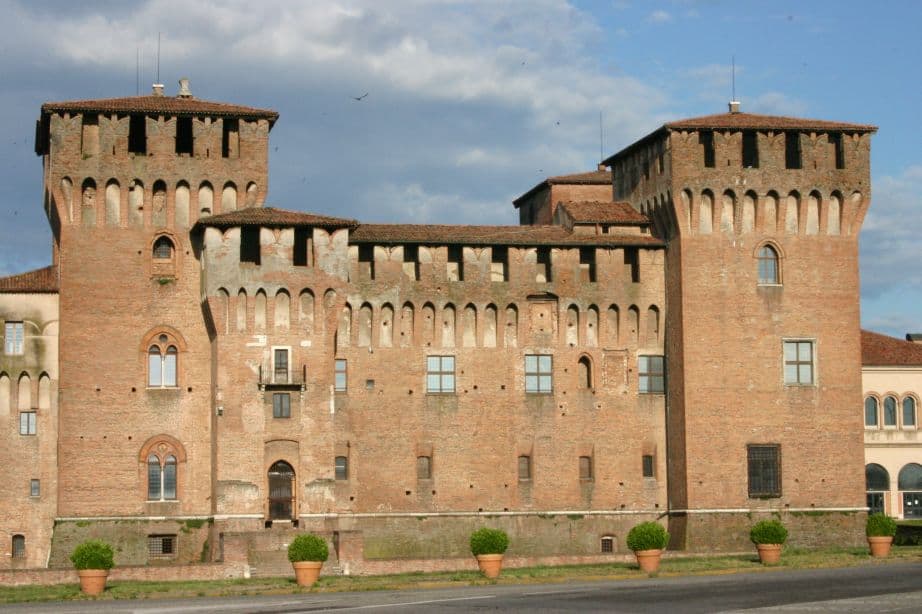
St. George Castle
St. George Castle (Italian: Castello di San Giorgio) is a remarkable example of a late medieval fortress that evolved into a Renaissance princely residence, located in Mantua, Lombardia, Italy. Commissioned by Francesco I Gonzaga and constructed between 1395 and 1406 under the guidance of the eminent military architect Bartolino da Novara, the castle was originally designed as a stronghold to protect Mantua’s urban center and its vital access routes, including the San Giorgio bridge.
The castle’s layout is a square plan fortified by four corner towers, surrounded by a defensive moat and accessed through three gates, each equipped with a drawbridge. This design reflects the military architecture of the period, emphasizing strong defensive capabilities. The southwest tower likely served as the bergfried, a main defensive keep typical of medieval fortresses.
Historical development and transformation
Originally built on the site of the demolished church of Santa Maria di Capo di Bove, the castle’s earliest components include the northwest corner tower and adjoining wing, which predate the main construction and date back to the late 13th or early 14th century. These sections lack typical battlements and stylistic features of Bartolino da Novara, indicating an earlier phase of fortification.
During the 15th century, the castle underwent a significant transformation under the rule of Marquis Ludovico II Gonzaga. Between 1459 and 1460, in preparation for the Papal Council of Mantua convened by Pope Pius II, the castle was restored by architects Luca Fancelli and Antonio de Manetto Ciaccheri. This restoration marked the castle’s transition from a purely military fortress to a residential and ceremonial palace. The austere defensive features were softened, with battlements removed from the corner towers, which became more symbolic than functional.
The castle became the residence of Isabella d’Este, one of the most influential noblewomen of the Italian Renaissance, who established it as a cultural hub. Isabella’s Grand Apartment on the piano nobile included elaborately decorated rooms such as the Salle de Leonbruno, Salle de la Grotte, and the Studiolo. These spaces were adorned with allegorical frescoes by renowned artists including Andrea Mantegna, Perugino, Correggio, and Lorenzo Costa.
The camera degli sposi and artistic treasures
The castle’s most famous interior is the Camera degli Sposi (Chamber of the Newlyweds), located in the northeast tower. Painted by Andrea Mantegna between 1465 and 1475, the vaulted ceiling frescoes are celebrated for their sophisticated trompe-l’oeil effects, including a simulated oculus that opens to the sky, and vivid depictions of the Gonzaga family and court. This masterpiece combines traditional fresco and secco techniques, designed to impress visitors with the power and prestige of the Gonzaga dynasty.
Adjacent to the residential quarters is a chapel originally decorated by Mantegna with tempera and gold paintings, including the notable "Death of the Virgin" panel. Although the original artworks were relocated to Ferrara in the late 16th century, the chapel remains an important architectural feature of the castle.
Architectural features and defensive elements
The castle’s fortifications include a crenellated parapet with a battlemented walkway along the curtain walls, allowing defenders to patrol and repel attackers. The walls were reinforced with projecting bastions known as Wurferkern for enhanced close-range defense. Heraldic shields and decorative motifs once adorned the outer walls, reflecting the castle’s transition from fortress to noble residence.
Within the courtyard, Andrea Mantegna designed porticos inspired by the Gonzaga family palace at Revere, contributing to the Renaissance refinement of the complex. The castle also features several notable halls including the Sala dei Soli, Sala degli Stemmi, Sala delle Sigle, Sala delle Armi, Sala dello Zodiaco, and the Sala dei Principi, each decorated with frescoes by artists such as Giulio Romano, Giovan Battista Bertani, and Pisanello.
Connection to the Ducal Palace
The castle is physically connected to the larger Ducal Palace complex via the Scalone di Enea (Staircase of Aeneas), built in 1549 by Giovan Battista Bertani. This grand staircase leads from the castle to the Salone di Manto and onward to the courtyard and loggia designed by Luca Fancelli in 1472 following Mantegna’s plans. Despite this connection, the castle maintains a distinct and isolated architectural identity within the complex.
Later history and uses
After serving as a princely residence until the late 16th century, the castle’s function shifted significantly. Guglielmo Gonzaga moved the family seat to the renovated Corte Vecchia, and the castle gradually lost its residential status.
Following the political changes of the 19th century, Mantua fell under Austrian control after 1815. The castle was repurposed as a high-security prison, primarily detaining political prisoners and opponents of Austrian rule. Among those imprisoned were the Martyrs of Belfiore and patriots such as Ciro Menotti and Teresa Arrivabene. The Tyrolean rebel leader Andreas Hofer was also held here before his execution in 1810.
The castle sustained structural damage during the 2012 Emilia earthquake, which led to restoration efforts to preserve its historical and architectural integrity. Today, the castle stands as a restored monument reflecting its multifaceted history from medieval fortress to Renaissance palace and prison.
Visiting st. george castle today
Visitors to St. George Castle can explore its well-preserved fortifications, frescoed interiors, and historical chambers that narrate the story of the Gonzaga family and Renaissance art. The castle remains a cultural landmark in Mantua, attracting scholars, art lovers, and tourists interested in medieval and Renaissance architecture and history.
Frequently asked questions (FAQ)
- How do I get to St. George Castle?
- St. George Castle is located in Mantua, Italy, and is easily accessible by public transport. You can reach the castle by taking a train to Mantua and then a short bus ride or a pleasant walk through the city to the castle grounds.
- What is the historical significance of St. George Castle?
- St. George Castle, built in the late 14th century, served as a military fortress and played a vital role in the defense of Mantua. It stands as a symbol of the city’s rich history, reflecting the architectural styles of the time and the political power of the Gonzaga family.
- When was St. George Castle constructed?
- Construction of St. George Castle began in 1395 under the orders of Francesco Gonzaga. The castle was completed in the early 15th century and has since been preserved as a significant historical landmark.
- Can I visit St. George Castle year-round?
- Yes, St. George Castle is open to visitors throughout the year, though hours may vary by season. It’s advisable to check the official website for the most current visiting hours before your trip.
- Why is the architecture of St. George Castle noteworthy?
- The architecture of St. George Castle showcases a blend of Gothic and Renaissance styles, characterized by its robust defensive structures and elegant designs. The castle’s unique layout and strategic position highlight its historical importance in military architecture.
- Is it possible to access all areas of St. George Castle?
- While many areas of St. George Castle are accessible to visitors, some sections may be restricted for preservation purposes. However, guided tours offer insights into the castle’s history and allow access to the most significant areas.
- What are the ticket prices for visiting St. George Castle?
- Ticket prices for St. George Castle are typically reasonable, with discounts available for students and seniors. It’s recommended to purchase tickets in advance or check the official website for any special offers or group rates.
- What is the best time to visit St. George Castle?
- The best time to visit St. George Castle is during the spring and fall when the weather is mild and the tourist crowds are smaller. Visiting during these seasons allows you to enjoy the beautiful surroundings and the rich history without the hustle and bustle of peak summer tourism.
- Are there any nearby attractions to visit after St. George Castle?
- Yes, after visiting St. George Castle, you can explore other nearby attractions such as the Palazzo Ducale and the beautiful Piazza delle Erbe. Mantua is rich in cultural and historical sites, making it easy to plan a full day of exploration.
Photo gallery

Information
Website
Visit websiteSources & official resources
Verify the information above using these authoritative references.
Loading map...
Visitor reviews
No reviews yet. Been here? Write the first review and help other travelers!
Write the first reviewVisited this castle? Share your experience
Your review helps other travelers and adds first-hand knowledge to our encyclopedia.



