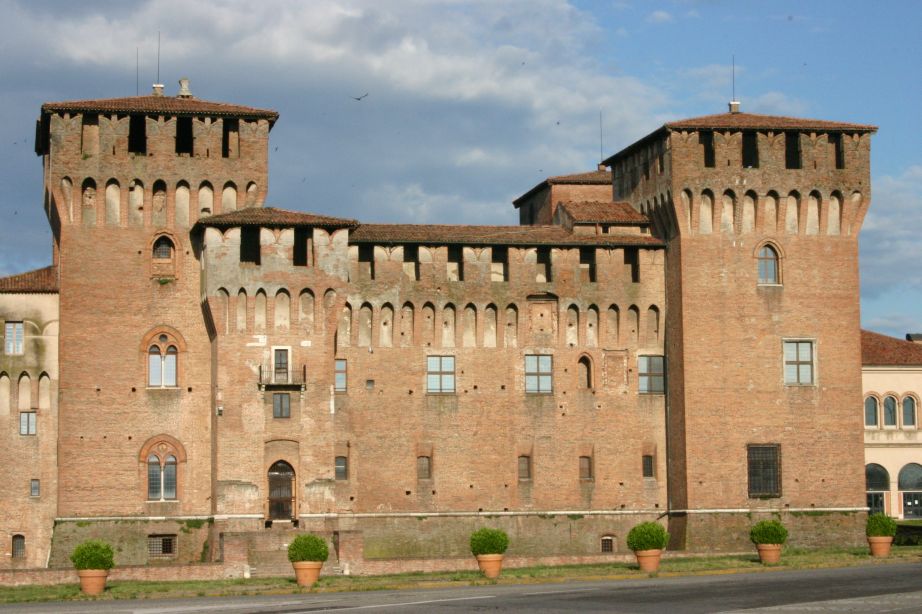
Castel d'Ario Castle
Castel d'Ario Castle stands as a remarkable example of medieval military architecture in the Lombardia region of Italy. Constructed in the 10th century AD by the influential Bonacolsi family, who were the ruling dynasty of Mantua before the rise of the Gonzaga family, this fortress played a critical role in the defense of Mantuan territory. Strategically positioned on the border with the Veneto region, it formed an integral part of a defensive network alongside the castles of Castelbelforte and Villimpenta. Its location was pivotal in controlling the movements between these regions, reflecting the turbulent political and military landscape of northern Italy during the Early Medieval period.
The castle is notable for its distinctive pentagonal layout, a relatively uncommon design among medieval fortifications. The perimeter is fortified by five towers, including a prominent tower at the main entrance. This entrance tower still reveals the original site of a portcullis, a heavy grilled door that could be lowered to block access, and the remains of a ravelin opposite the gate, which served as an additional defensive outwork to protect the entrance from direct assault. Such architectural features underscore the castle’s military purpose and the sophistication of its defensive planning.
Architectural features and defensive structures
The castle's walls and towers were constructed primarily from local stone and brick, materials typical of the region and period. The sturdy walls were designed to withstand sieges and attacks common in the medieval era. Inside the castle, the praetorian palace underwent significant restoration at the end of the 20th century, revealing well-preserved frescos on the first-floor walls. These frescos prominently feature the escutcheons of the Scaligeri family, the lords from Verona who controlled the castle for approximately twenty years during the 14th century. The presence of these heraldic symbols highlights the castle’s changing ownership and the complex feudal allegiances of the time.
Among the towers within the castle, the Torre della Fame (Tower of Hunger) is particularly infamous. This tower earned its name after the discovery of skeletons in the mid-19th century, believed to be the remains of prisoners from the Pico della Mirandola and Bonacolsi families. According to historical accounts, these captives were deliberately starved to death in this tower. A commemorative headstone on the castle’s main door serves as a somber reminder of this grim episode, reflecting the harsh realities of medieval justice and power struggles.
Historical context and ownership
The castle’s history is deeply intertwined with the political dynamics of northern Italy during the Middle Ages. Initially built by the Bonacolsi family, the fortress later came under the control of the Gonzaga and Scaligeri families, two of the most powerful noble houses in the region. The Scaligeri, originating from Verona, held the castle during the latter half of the 14th century, a period marked by frequent conflicts among regional powers.
The Pico family and Modena's turbulent history
A significant chapter in the castle’s history involves Francesco I Pico, who was appointed by the emperor in 1311 to govern the city of Modena. His tenure was brief and fraught with conflict, as he quickly became despised by both the Guelph and Ghibelline factions within the city. Betrayed and attacked with the aid of the Bolognese army, Francesco managed to escape an ambush and return to Modena. According to legend, he then embarked on a relentless campaign of revenge against his enemies.
This violent retribution alarmed the citizens of Modena, who sought intervention from Rinaldo Bonacolsi, the lord of Mantua. Bonacolsi captured Francesco Pico and his two sons, subjected them to public humiliation by parading them tied to donkeys through the streets while being pelted with stones, and ultimately imprisoned them in the castle’s main tower. There, they were left to starve, an event that has become a notorious episode in the castle’s history and contributed to its grim reputation.
Preservation and cultural significance
Today, Castel d'Ario Castle is recognized as one of the most important medieval fortifications in the Mantuan territory. Its well-preserved pentagonal structure and surviving towers offer valuable insights into medieval military architecture and the feudal history of northern Italy. The restoration work on the praetorian palace and the discovery of historical frescos have enhanced the castle’s cultural value, attracting historians, architects, and visitors interested in medieval heritage.
The castle’s connection to notable historical figures and families, such as the Bonacolsi, Gonzaga, Scaligeri, and Pico della Mirandola, enriches its narrative and underscores its role in the complex political and social fabric of the region. Visitors today can explore the castle’s imposing walls, towers, and courtyards, gaining a tangible sense of the medieval past and the defensive strategies employed in a border fortress.
Architectural legacy and tourism
Castel d'Ario Castle’s unique pentagonal design and its integration into a broader defensive system highlight the evolution of castle construction techniques during the Early Medieval period. Its preservation allows for study and appreciation of medieval fortification principles, including the use of portcullises, ravelins, and multi-towered defenses.
As a cultural landmark, the castle contributes to the regional identity of Lombardia and serves as a focal point for tourism in Castel D'Ario. Its historical significance, combined with ongoing preservation efforts, ensures that Castel d'Ario Castle remains a vital link to Italy’s medieval past and a compelling destination for those interested in history and architecture.
Frequently asked questions (FAQ)
- What is the historical significance of Castel d'Ario Castle?
- Castel d'Ario Castle dates back to the Middle Ages and played a vital role in the defense of the region. Its strategic location allowed it to serve as a stronghold for various noble families and was pivotal during local conflicts. Today, it stands as a testament to the architectural and military history of Italy.
- When was Castel d'Ario Castle built?
- Construction of Castel d'Ario Castle began in the 12th century, with various modifications and expansions occurring over the centuries. The castle's design reflects the architectural styles prevalent during the medieval period, showcasing unique features that have been preserved through time. Visiting the castle offers a glimpse into its rich past and evolution.
- What are the opening hours for Castel d'Ario Castle?
- Castel d'Ario Castle is open to visitors from Tuesday to Sunday, with hours typically from 10 AM to 5 PM. It is advisable to check the official website or contact the visitor center for any seasonal changes or special events that may affect opening hours. Plan your visit accordingly to make the most of your experience.
- Can I access Castel d'Ario Castle with a wheelchair?
- While efforts have been made to improve accessibility at Castel d'Ario Castle, some areas may present challenges due to the castle's historical architecture. It is recommended to contact the castle staff beforehand to inquire about specific accessibility options and assistance available for visitors with mobility impairments. They are committed to helping all guests enjoy their visit.
- What is the best time to visit Castel d'Ario Castle?
- The best time to visit Castel d'Ario Castle is during the spring and early autumn months, when the weather is mild and the surrounding landscape is in full bloom. Visiting during these seasons allows for a more enjoyable experience while exploring the castle and its grounds. Additionally, special events may be held during these times, enhancing your visit.
- Are there any nearby attractions to Castel d'Ario Castle?
- Yes, Castel d'Ario Castle is located near several other attractions, including the charming town of Mantua, which is famous for its Renaissance architecture and vibrant cultural scene. Visitors can also explore local parks and nature reserves that offer beautiful views and outdoor activities. A day trip combining these sites can create a rich and fulfilling experience.
- How much are the ticket prices for Castel d'Ario Castle?
- Ticket prices for Castel d'Ario Castle are generally affordable, with discounts available for students, seniors, and families. Children under a certain age may enter for free, making it a great option for family outings. It's best to check the official website for current pricing and any special offers or guided tour options.
Information
Loading map...
Visitor reviews
No reviews yet. Been here? Write the first review and help other travelers!
Write the first reviewVisited this castle? Share your experience
Your review helps other travelers and adds first-hand knowledge to our encyclopedia.