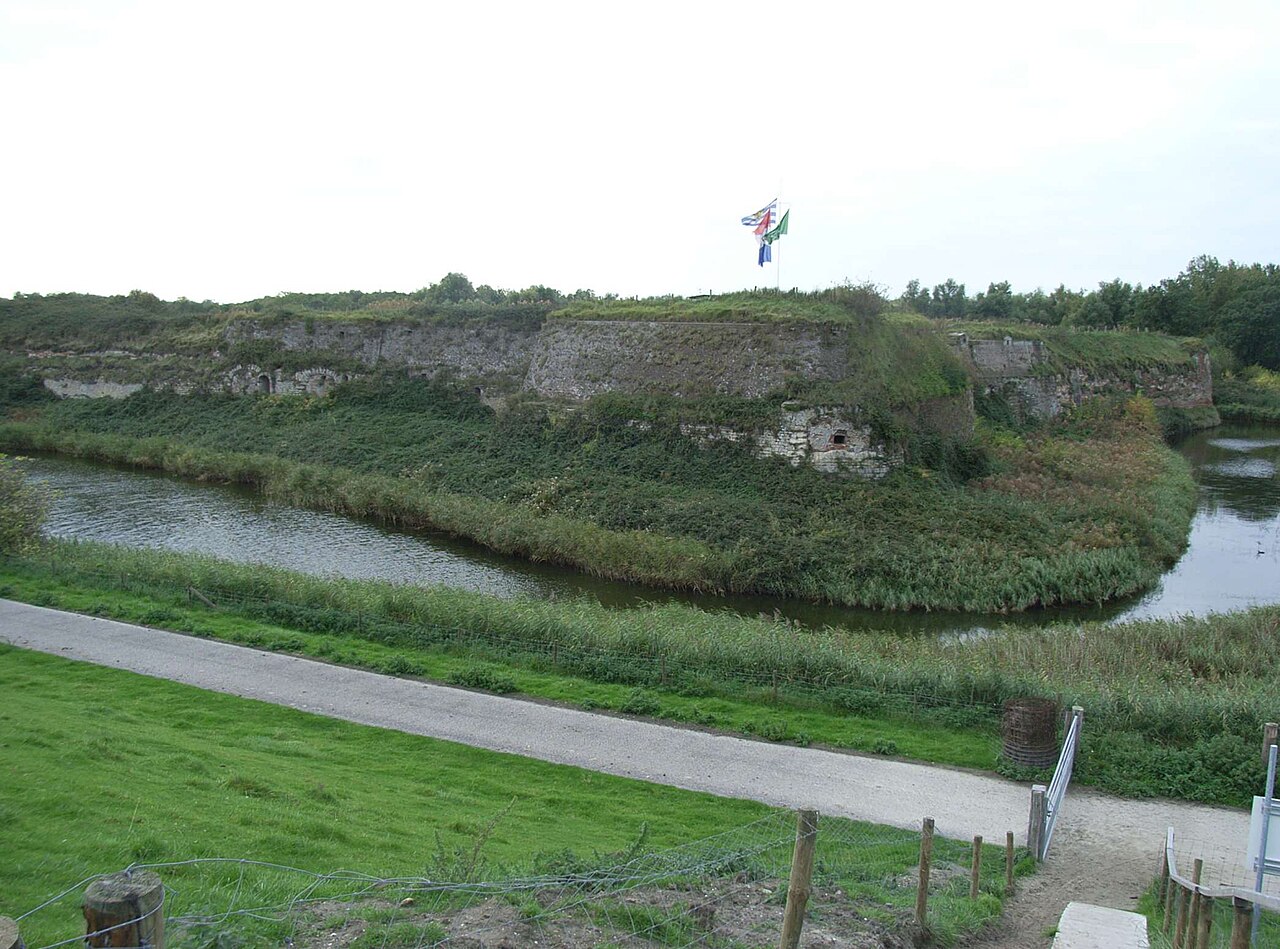
St. Aldegonde Castle
St. Aldegonde Castle, originally known as Souburg Castle, was a significant medieval fortress located in the village of West-Souburg in the province of Zeeland, Netherlands. Its origins trace back to the early 13th century, marking it as a typical example of a High Medieval moated castle that served as the seat of local nobility, specifically the Lords of Souburg.
Early history and noble connections
The initial construction of the castle likely began in the early 1200s, featuring a rectangular moated design with a fortified bailey. This design was common in the region and period, providing both defense and a status symbol for its owners. Throughout the 15th century, the castle played a role in regional noble alliances and marriages. Notably, in 1451, Adrian of Borselen married Maria van Cats at the castle, linking prominent Zeeland families.
After Maria's death, Adrian remarried in 1457 to Anne of Burgundy, an illegitimate daughter of Philip the Good, Duke of Burgundy. This connection brought the castle under the influence of the powerful Burgundian dynasty. Upon Adrian's death in 1468 without heirs, ownership of the castle passed to the Duke of Burgundy. By 1509, it became the residence of Philip of Burgundy, another illegitimate child of Philip the Good, who later became Bishop of Utrecht in 1517.
Ownership changes and the 80 years' war impact
Following Philip of Burgundy's ecclesiastical appointment, the castle was sold to Jeronimus de Rollé, the bailiff of Veere. During the turbulent times of the 80 Years' War (1568–1648), the castle was occupied by the Sea Beggars, a group of Dutch privateers and rebels fighting against Spanish rule.
To prevent the castle from falling into the hands of the Spanish forces, the Sea Beggars deliberately set fire to it, reducing it to ruins with only some walls left standing. This act of destruction was a strategic military decision reflecting the intense conflict in the region.
Rebirth as st. aldego nde castle
In 1578, the castle's remains were acquired by Philips of Marnix, Lord of St. Aldegonde, a notable figure in Dutch history and a close advisor to William of Orange. He undertook the task of rebuilding the castle and made it his residence. From this period onward, the castle became known as St. Aldegonde Castle, named after its new lord.
After Philips of Marnix's death, his heirs sold the castle to the town of Middelburg. The castle's ownership passed through various hands over the following centuries, reflecting the shifting political and social landscape of the Netherlands.
Modernization and decline
In 1746, Adriaan Steengracht purchased the castle and initiated modernization efforts to update its structure and possibly adapt it to contemporary residential standards. However, after Steengracht's death in 1770, the castle was neglected by his heirs, leading to its progressive dilapidation.
By 1783, the castle was sold for demolition, and it was subsequently torn down. This marked the end of the castle as a physical structure, erasing much of its presence from the landscape.
Archaeological rediscovery and site description
During the construction of a new residential area between 1971 and 1972, the foundations of St. Aldegonde Castle were uncovered. Archaeological excavations revealed that the castle had a moated rectangular layout with a rectangular bailey, consistent with early medieval fortification designs in the region.
Unfortunately, no visible remains of the castle exist today, as it was completely demolished in the late 18th century. The site remains an important archaeological and historical point of interest, reflecting the castle's past significance.
Architectural features and significance
The castle's original structure featured typical High Medieval defensive elements such as thick stone walls, a moat, and a fortified bailey designed to protect inhabitants from attacks. Its rectangular plan was practical for both defense and administration. The castle's association with the powerful Burgundian dynasty and later with prominent Dutch figures like Philips of Marnix underscores its historical importance.
Its destruction during the 80 Years' War exemplifies the turbulent military history of the Netherlands and the strategic role castles played in this conflict. The subsequent rebuilding and renaming of the castle reflect the changing political allegiances and social structures of the time.
Cultural legacy and historical context
St. Aldegonde Castle's story is intertwined with major historical events in Dutch history, including noble family alliances, Burgundian influence, and the struggle for Dutch independence. The castle's name honors Philips of Marnix, a key figure in the Dutch Revolt and cultural history.
Though the castle no longer stands, its archaeological remains contribute valuable insights into medieval castle construction and noble life in Zeeland. The site serves as a reminder of the region's medieval heritage and the evolution of fortifications over centuries.
Frequently asked questions (FAQ)
- How do I visit the site of St. Aldegonde Castle?
- The site of St. Aldegonde Castle is located at Westerzicht 267 in West-Souburg. Since no visible remains exist, visiting involves viewing the archaeological site within the residential area. There are no formal visitor facilities or opening hours.
- What historical events is St. Aldegonde Castle known for?
- St. Aldegonde Castle is known for its association with the Burgundian dynasty, its destruction by the Sea Beggars during the 80 Years' War, and its connection to Philips of Marnix, a key figure in Dutch history.
- What architectural features did St. Aldegonde Castle have?
- The castle featured a moated rectangular layout with a rectangular bailey, typical of High Medieval Gothic defensive architecture, including thick stone walls and a moat for protection.
- Why was the castle demolished?
- The castle was demolished in 1783 after falling into dilapidation following the death of its last private owner, as it was no longer maintained and was sold for demolition.
- Is there anything to see at the castle site today?
- Today, nothing remains of St. Aldegonde Castle above ground. The foundations were uncovered during residential construction in the 1970s, but the site has no visible ruins or visitor facilities.
Information
Address
Westerzicht 267, West-Souburg, Netherlands
Loading map...
Visitor reviews
No reviews yet. Been here? Write the first review and help other travelers!
Write the first reviewVisited this castle? Share your experience
Your review helps other travelers and adds first-hand knowledge to our encyclopedia.