Srebrenik Castle
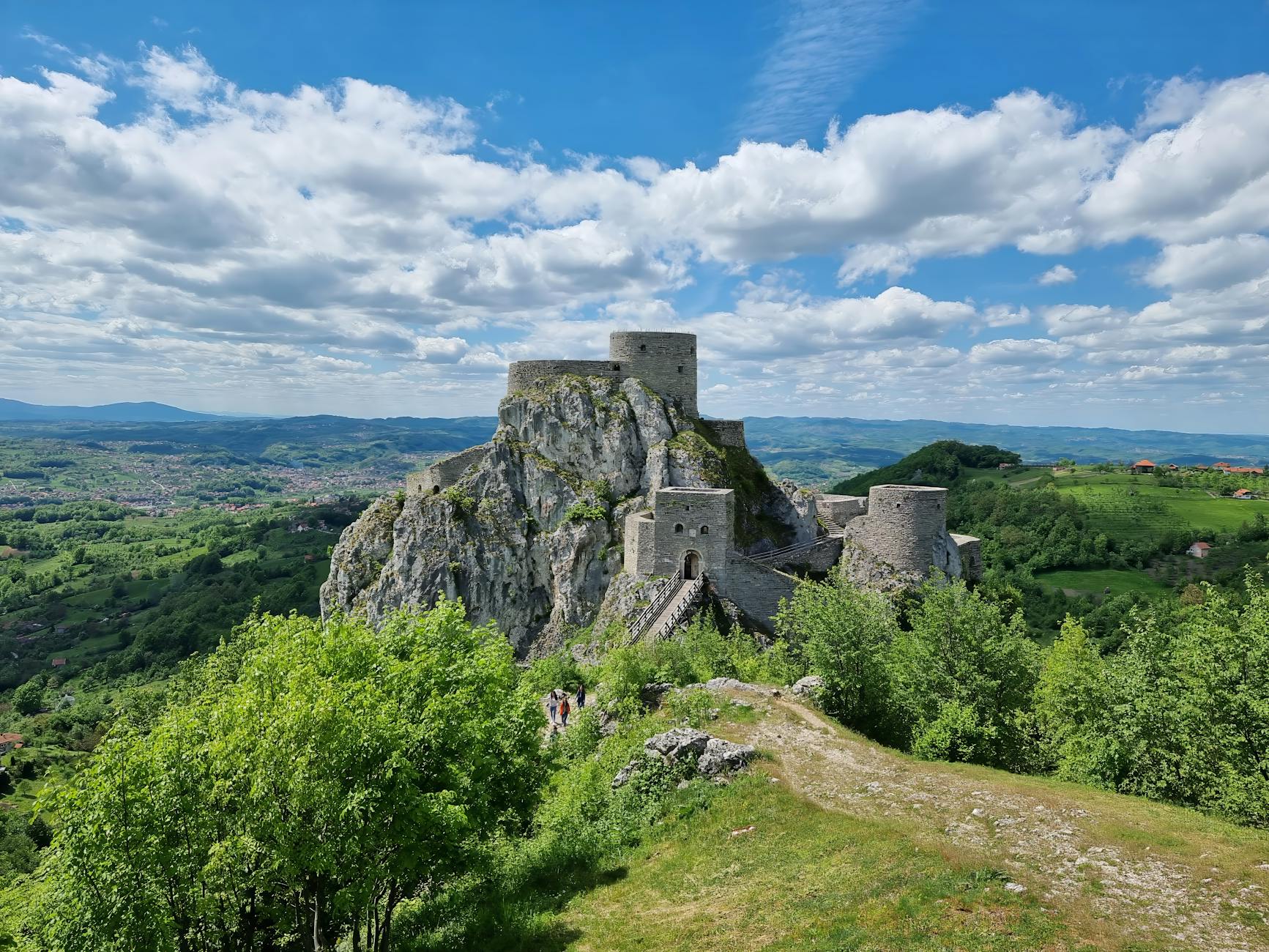
Srebrenik castle stands prominently on the northeastern slopes of Majevica mountain, near the village of Gornji Srebrenik, approximately 5 km from the city center of Srebrenik in Bosnia and Herzegovina. This late medieval fortress is strategically perched on a steep, nearly inaccessible rock, fortified by a deep trench beneath it and accessible only by a small bridge. Its commanding position on important medieval military routes made it a critical stronghold during the turbulent history of the region.
Early history and strategic significance
The exact date of Srebrenik castle's construction and its original builder remain unknown, as no contemporary historical documents provide definitive information. However, the earliest written records mentioning the castle date back to 1333 in edicts issued by Stephen II to the Republic of Ragusa. This confirms the castle's existence and strategic importance by the early 14th century.
Throughout the 14th century, the fortress played a pivotal role in the military conflicts between the Kingdom of Hungary and the Bosnian state. In 1363, King Louis I of Hungary dispatched an army under his palatine Nicholas Kont to Bosnia, which suffered significant losses near Srebrenik, underscoring the fortress's defensive strength. Later, in 1393, the castle was captured by King Sigismund of Luxembourg, marking the beginning of a period of contested control.
Changing rulers and military engagements
During the late 14th and early 15th centuries, Srebrenik castle changed hands multiple times. The Hungarians recaptured it in 1405, 1408, and 1410. Subsequently, it was granted as a gift to the Serbian despot Stefan Lazarević, although the Hungarians maintained a garrison there. By 1433, King Thomas of Bosnia had regained control, but it was seized again in 1452 by Đurađ Branković, Stefan Lazarević's nephew, who returned it to Hungarian control.
The fortress's strategic value increased with the advancing Ottoman Empire. By 1462, the entire župa Usora, including Srebrenik, fell under Ottoman control. However, logistical difficulties and an epidemic forced the Ottoman army to retreat, allowing Matthias Corvinus, King of Hungary, to recapture the castle. To strengthen defenses against further Ottoman incursions, Matthias established the banate of Srebrenik in 1464, granting it to Nicholas of Ilok, who later became the titular King of Bosnia.
Ottoman period and decline
The exact date when the Ottomans permanently recaptured Srebrenik is uncertain but is most likely between 1510 and 1519. Following the Battle of Mohács in 1526 and the subsequent expansion of Ottoman borders, the fortress saw little military action. It was either abandoned or maintained by a minimal garrison during this period.
During Ottoman rule, the castle belonged to the Smoluća Nahija, with Prince Vlatko, son of Vladimir, overseeing the region. The principality included several settlements, with a population divided between Christian and Muslim households. This demographic detail highlights the complex social fabric of the area during Ottoman administration.
In the 18th century, as Ottoman borders contracted, Srebrenik regained strategic importance. Austrian spies reported the fortress as old and in poor condition, requiring repairs. Some restoration efforts occurred around 1756, although the specifics remain undocumented. The castle ceased to function as a military garrison in 1835, marking the end of its active defensive role. The Ottoman-built mosque within the castle grounds, dating from the early 16th century, continued to be maintained for some time thereafter.
Architectural features and defensive structures
Srebrenik castle's architecture reflects its military purpose and the challenging terrain. Constructed on a steep rock, the fortress is naturally defensible, enhanced by a deep trench that surrounds the base, limiting access. The only entrance is a narrow bridge crossing this trench, designed to control and restrict entry.
The castle's walls and towers were built to withstand sieges common in the late medieval period. Its position on important military roads necessitated robust fortifications to guard against frequent attacks by Hungarian and Ottoman forces. Although much of the original structure has deteriorated over centuries, remnants of its defensive walls and foundations remain visible, offering insight into medieval military architecture in the region.
Cultural and historical legacy
Srebrenik castle is a significant cultural landmark in Bosnia and Herzegovina, symbolizing the region's complex medieval and early modern history. Its role in the conflicts between the Kingdom of Hungary, the Bosnian state, Serbian despots, and the Ottoman Empire illustrates the shifting political landscape of the Balkans.
Today, the castle is a popular destination for visitors interested in medieval fortifications and Balkan history. While it stands mostly in ruins, ongoing preservation efforts aim to protect its remains and promote understanding of its historical importance. The site also attracts scholars studying the military and social history of the region.
Visitors to Srebrenik can explore the rugged terrain and imagine the strategic challenges faced by its defenders. The castle's commanding views over the surrounding landscape underscore why it was so fiercely contested for centuries.
Frequently asked questions (FAQ)
- What is the historical significance of Srebrenik Castle?
- Srebrenik Castle is a medieval fortress that dates back to the 13th century, playing a crucial role in the defense of the region against various invasions. It has been a symbol of resilience and strength for the local population and is recognized for its unique architectural style that blends medieval and Ottoman influences.
- When was Srebrenik Castle built?
- Srebrenik Castle was constructed in the 13th century, specifically around the year 1333. It was strategically positioned to control the surrounding area and has undergone various modifications over the centuries, reflecting the historical changes in the region.
- Can I visit Srebrenik Castle?
- Yes, Srebrenik Castle is open to visitors, allowing you to explore its historic walls and enjoy panoramic views of the surrounding landscape. Guided tours are often available, providing insights into the castle's history and architecture.
- What are the opening hours for Srebrenik Castle?
- Srebrenik Castle generally opens to visitors from 9 AM to 5 PM, but it's advisable to check ahead for any changes in hours, especially during holidays or special events. The castle may offer extended hours during the peak tourist season.
- Is it possible to access Srebrenik Castle with a wheelchair?
- While Srebrenik Castle is a historic site with some uneven terrain, parts of the castle may be accessible. However, due to its ancient structure, visitors with mobility challenges should prepare for some limitations regarding access to certain areas.
- What is the best time to visit Srebrenik Castle?
- The best time to visit Srebrenik Castle is during the spring and early fall when the weather is mild and pleasant. This allows for an enjoyable exploration of the castle and its surroundings, as well as participation in local events that may occur during these seasons.
- Are there any nearby attractions to Srebrenik Castle?
- Yes, nearby attractions include the charming town of Srebrenik itself, where visitors can explore local culture and cuisine. Additionally, the surrounding natural landscapes offer opportunities for hiking and enjoying the picturesque views of Bosnia and Herzegovina.
- What are the ticket prices for Srebrenik Castle?
- Ticket prices for Srebrenik Castle are generally quite affordable, making it accessible for all visitors. Discounts may be available for students and groups, so it's worth inquiring at the entrance for the latest pricing information.
Information
Loading map...
Visitor reviews
No reviews yet. Been here? Write the first review and help other travelers!
Write the first reviewVisited this castle? Share your experience
Your review helps other travelers and adds first-hand knowledge to our encyclopedia.