Spynie Palace
Spynie Palace stands as a remarkable example of a medieval Scottish episcopal residence, located near Elgin, Scotland. Established in the late 12th century, it served as the fortified home of the Bishops of Moray for around five centuries, reflecting the complex interplay of religious authority, architecture, and military necessity in medieval Scotland.
Before the foundation of Spynie Palace, the bishops of Moray moved between various sites such as Birnie and Kinneddar, lacking a fixed residence. This changed decisively in 1206 when Pope Innocent III granted Bishop Bricius de Douglas formal permission to establish Spynie as the permanent seat of the bishopric. By approximately 1208, Spynie became the administrative and residential center for the bishops, even after the cathedral itself was relocated to Elgin in 1224 due to Spynie’s relative isolation and vulnerability to attack. Despite the cathedral's move, the bishops retained Spynie Palace as their main residence, underscoring its importance as a fortified stronghold and ecclesiastical hub.
Early history and ecclesiastical significance
The earliest surviving documentary mention of Spynie Palace dates from between 1292 and 1296, during the period of English King Edward I's occupation of Scotland. The first official writ issued from the site appears in 1343, confirming its continued role as a center of ecclesiastical governance. Initially constructed primarily of timber within a ringwork earthwork enclosure, the palace evolved over the centuries to incorporate substantial stone buildings and defensive structures.
Architectural evolution and fortification
Transition from timber to stone
During the 13th century, the palace underwent significant architectural transformation, replacing many of its original wooden buildings with stone constructions. Among the earliest stone structures was a chapel featuring colored glass windows, reflecting the palace's dual role as a religious and residential complex. By the 14th century, the main castle was a nearly square stone fortress surrounded by curtain walls approximately seven meters high. The original main entrance faced south, protected by a projecting southeast tower equipped with narrow arrow slits for archers.
Mid-15th century enhancements
Bishop John de Winchester (1435–1460), who also served as the Scottish king’s Master of Works, was instrumental in strengthening the palace’s defenses. He relocated the main gate to the east wall and fortified it with a robust portcullis. The gatehouse included a gatekeeper’s chamber with a fireplace, indicating it was actively manned. These improvements likely involved craftsmen familiar with contemporary restoration projects at nearby Elgin Cathedral, demonstrating the interconnectedness of ecclesiastical architecture in the region.
David’s tower and late medieval expansion
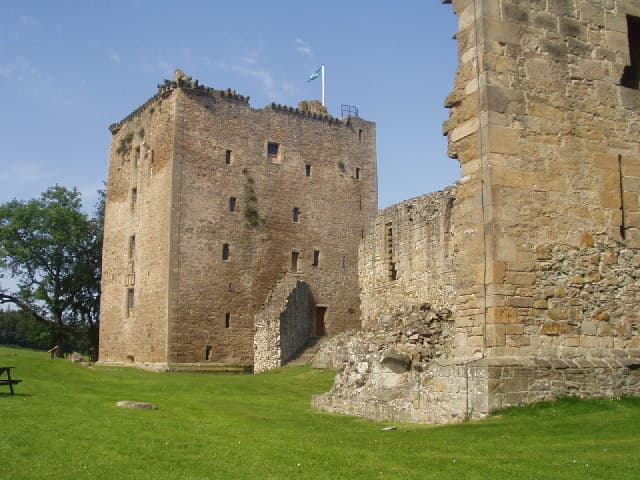
One of the palace's most significant architectural features is David’s Tower, constructed in the late 15th century under Bishop David Stewart and completed by Bishop William Tulloch. This tower is notable for being the largest medieval tower in Scotland by volume, measuring 19 by 13.5 meters at its base and rising 22 meters high across six floors plus a garret. Its basement contains a circular dungeon with a domed vaulted roof, designed for secure imprisonment with minimal light.
The ground floor of David’s Tower housed a large hall with built-in stone seating and large windows, emphasizing comfort alongside defense. Access between floors was provided by a spiral staircase in the northeast corner. Upper floors contained spacious main rooms with adjoining chambers. The tower was finished with exterior render and interior plaster, focusing on durability and function rather than elaborate decoration.
16th-century modifications and military adaptations
During the 16th century, the palace saw further expansion and modernization to adapt to evolving military technology and domestic needs. Bishop Patrick Hepburn introduced wide-mouth gun loops to accommodate firearms, a significant advancement reflecting the changing nature of warfare. Enlarged windows improved natural lighting and comfort. A walled garden and orchard were established south of the castle precinct, including a rabbit warren and a dovecot built in 1569, reflecting the self-sustaining lifestyle of the palace inhabitants.
Historical conflicts and later use
Spynie Palace was deeply involved in the turbulent history of Scotland during the late medieval and early modern periods. In the late 14th century, it was seized by Alexander Stewart, the Wolf of Badenoch, a notorious figure in regional clan conflicts. In the mid-16th century, the palace held English prisoners during the Rough Wooing conflicts. The castle also played a role in the Scottish Reformation and subsequent civil wars.
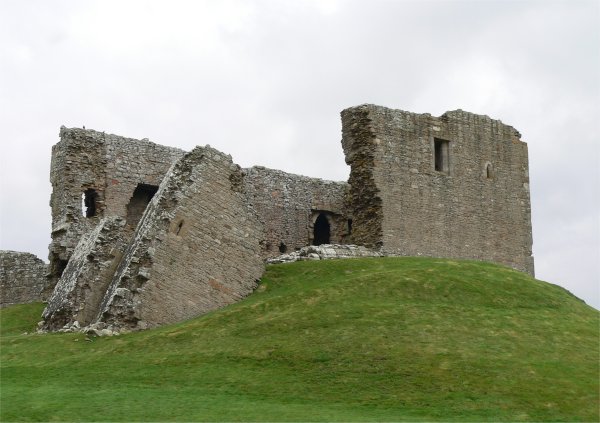
In 1573, Regent Morton ordered the palace be made available for Crown use, and in 1587 it was granted to Alexander Lindsay, 1st Lord Spynie. It reverted to Crown control in 1605. During the Covenanting conflicts of the 1640s, Bishop John Guthrie prepared the palace for siege; however, it was surrendered quickly. The tower sustained serious damage during this period, including undermining and an explosion that caused structural deformation of the east wall.
After the restoration of Episcopacy in 1662, church ownership was reestablished, but the palace gradually fell into disrepair. The last bishop resident, William Hay, was expelled in 1689, and the palace reverted to the Crown. Subsequently, valuable materials were removed, and the site suffered from stone robbing until preservation efforts began in the late 20th century.
Architectural remains and preservation
The surviving layout of Spynie Palace reveals a large fortified complex originally enclosed by a rectangular ringwork earthwork with a surrounding ditch. This early enclosure measured between 45 and 65 meters across, similar in size to the later stone curtain wall that replaced it. The initial timber buildings included essential facilities such as the bishop’s hall, private chambers, chapel, brewhouse, and bakehouse.
Stone construction progressed in the 13th century, with the chapel's colored glass windows highlighting the palace's religious significance. The 14th-century stone curtain walls, about seven meters high, enclosed a nearly square plan with defensive towers and narrow arrow slits.
The mid-15th century gatehouse remains are well preserved, showcasing the portcullis and gatekeeper’s chamber. David’s Tower dominates the site with its impressive size and complex internal layout, including the vaulted dungeon, grand hall, and multiple floors of living quarters.
Defensive upgrades in the 16th century, such as wide-mouth gun loops, illustrate adaptation to firearm warfare. The palace grounds included a walled garden, orchard, rabbit warren, and dovecot, reflecting the lifestyle and self-sufficiency of its occupants.
Despite damage during the 17th-century conflicts, late 20th-century conservation efforts stabilized the structure, including rebuilding parts of the curtain wall and installing a concealed concrete base to prevent further collapse. Today, the remains of Spynie Palace offer valuable insight into the architectural and historical development of medieval Scottish episcopal residences.
Frequently asked questions (FAQ)
- How do I get to Spynie Palace?
- Spynie Palace is located just outside Elgin, United Kingdom. Visitors can reach the palace by car, taking the A96 road, or by public transport, with local buses connecting Elgin to nearby areas. There is also parking available on-site for those driving.
- What is the historical significance of Spynie Palace?
- Spynie Palace was the residence of the Bishops of Moray from the 12th to the 17th centuries, showcasing the power of the church in medieval Scotland. The palace is an important example of ecclesiastical architecture and reflects the region's rich history. Its ruins tell the story of the evolution of religious authority in Scotland.
- When was Spynie Palace built?
- Construction of Spynie Palace began in the late 12th century, with significant expansions and renovations occurring over the following centuries. The palace was largely completed by the 15th century, making it a prominent seat of power during that time. Its architecture highlights various styles that developed through the medieval period.
- Can I take guided tours of Spynie Palace?
- Yes, guided tours of Spynie Palace are available, providing visitors with in-depth knowledge of its history and architecture. Tours typically run during the peak season and can be booked in advance through the official website or on-site. Self-guided tours are also an option for those who prefer to explore at their own pace.
- Why is Spynie Palace a popular tourist attraction?
- Spynie Palace attracts visitors due to its intriguing history, stunning architecture, and beautiful surrounding landscapes. It offers a unique glimpse into the life of medieval bishops and the architectural styles of the era. Additionally, the site is a peaceful retreat for those interested in Scottish heritage.
- Is it possible to visit Spynie Palace year-round?
- Spynie Palace is typically open to visitors from spring through autumn, with limited access during the winter months. It's advisable to check the official website for specific opening hours and seasonal events. Visiting during the warmer months allows for a more enjoyable experience with guided tours and better weather.
- What are the ticket prices for Spynie Palace?
- Ticket prices for Spynie Palace are generally affordable, with discounts available for children, students, and seniors. Family tickets may also be offered to encourage group visits. It's best to check the official website for the most current pricing and any special promotions.
- What is the best time to visit Spynie Palace?
- The best time to visit Spynie Palace is during the late spring and summer months when the weather is mild and the gardens are in full bloom. This period also coincides with extended opening hours and a variety of events and activities. Visiting during weekdays may provide a quieter experience compared to weekends.
- Are there any nearby attractions to visit along with Spynie Palace?
- Yes, there are several nearby attractions worth visiting, including Elgin Cathedral and the Moray Golf Club. The scenic Moray coastline is also just a short drive away, offering beautiful views and outdoor activities. Visitors can easily plan a full day exploring both Spynie Palace and its surrounding sites.
Photo gallery

Information
Website
Visit websiteSources & official resources
Verify the information above using these authoritative references.
Loading map...
Visitor reviews
No reviews yet. Been here? Write the first review and help other travelers!
Write the first reviewVisited this castle? Share your experience
Your review helps other travelers and adds first-hand knowledge to our encyclopedia.