Spynie castle
Spynie Castle stands as a remarkable relic of medieval Scotland, serving as the fortified residence of the Bishops of Moray for approximately 500 years. Located in Moray, Scotland, this castle reflects a complex architectural evolution from a timber structure in the late 12th century to a grand stone palace featuring the largest medieval towerhouse in Scotland. The castle's history is deeply intertwined with the religious and political shifts of Scotland from the High Medieval period through the post-Reformation era.
Early origins and medieval development
The origins of Spynie Castle trace back to the late 12th century, when the bishop's residence was initially constructed as a wooden structure. Archaeological excavations reveal that this early phase was surrounded by a substantial rectangular ringwork and ditch, enclosing an area roughly 45 by 65 meters. This enclosure was notably large compared to other medieval ringworks in Britain. The early buildings likely included a bishop's house with essential facilities such as a hall, bed chambers, a chapel, and practical amenities like a brewhouse and bakehouse.
By the 13th century, stone construction began with the establishment of a chapel featuring coloured glass windows. The gradual replacement of timber with stone continued into the 14th century, culminating in the erection of the first main castle building: a near-square stone structure enclosed by a 7-metre-high curtain wall. The surviving walls on the south and west sides date from this period, outlining much of the palace's footprint as it is known today.
Architectural features of the 14th century palace
The main gate, located on the south side, led visitors through a range of buildings into the central courtyard. A chapel was situated on the first floor of this range, evidenced by three large pointed-arched windows still visible in the standing walls. The west courtyard wall contains two tall traceried windows, indicating the presence of a significant hall in that position. At the south-west corner, the basement of a later towerhouse incorporates the foundations of a cylindrical tower, likely dating from the 14th century, which may have housed the bishop's private chambers in its upper stories.
The palace's northern and eastern extents were naturally limited by the edge of the plateau on which it was built, a strategic location that originally overlooked a sea-loch providing safe anchorage for fishing and merchant vessels. This proximity fostered a thriving medieval settlement adjacent to the palace, though no traces of this town survive today.
15th and 16th century expansions: david's tower and service buildings
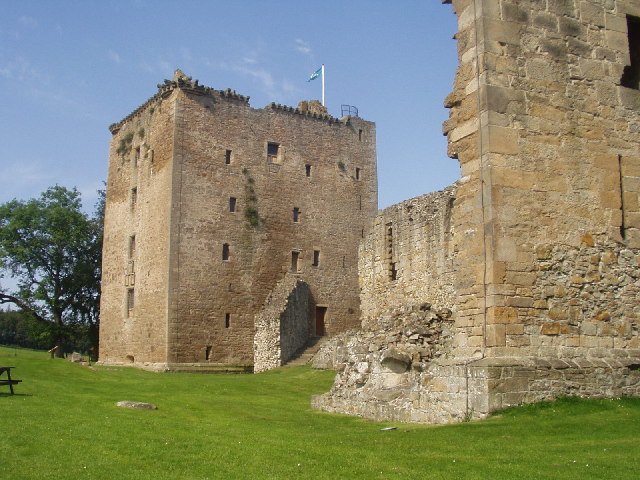
Significant construction occurred during the episcopate of Bishop David Stewart (1461-1477), who initiated the replacement of the cylindrical tower with a massive rectangular towerhouse at the south-west corner. This ambitious project was completed by his successor, Bishop William Tulloch (1477-1482). Known as David's Tower, this structure is the largest medieval towerhouse in Scotland, measuring approximately 19 meters by 13.5 meters at the base and rising to 22 meters in height.
The tower's interior included the bishop's hall on the first floor, with three additional floors of chambers above, all beneath a vaulted ceiling and topped by an attic storey. The walls were built thick enough to contain smaller chambers and closets within their breadth, demonstrating advanced medieval architectural techniques. To the north of David's Tower, the earlier hall range was demolished and replaced with new service buildings, reflecting the evolving needs of the bishop's household.
The bishopric and religious significance
The Bishopric of Moray was established in 1107, initially centered on the Holy Trinity Church at Spynie, which served as the cathedral and the bishop's seat. However, in 1224, the cathedral was relocated to Elgin, though Spynie remained the principal episcopal residence until 1686. The castle thus functioned as a religious and administrative hub for over five centuries, witnessing significant historical events and ecclesiastical transformations.
During the early period, the castle's location on the edge of a sea-loch allowed it to benefit from maritime trade and fishing. Over the centuries, the loch gradually silted up, and much of the surrounding land was reclaimed for agriculture, altering the castle's landscape and isolating it from its original maritime context.
Historical events and notable residents
Mary, Queen of Scots, stayed at Spynie Castle from 17 to 19 September 1562 during the Huntly expedition, a significant military campaign in Scotland. Her host was Bishop Patrick Hepburn, a relative of the Earl of Bothwell, who would later become Mary's third husband. This visit underscores the castle's importance as a political and religious center during turbulent times.
Following the Scottish Reformation, the castle was used by Protestant bishops. In 1589, James VI also stayed at Spynie, further marking its status as a royal and episcopal residence. The castle endured conflict during the 17th century; in 1640, General Munro besieged Spynie, compelling Bishop Guthrie to surrender and leading to the bishop's imprisonment.
The last resident bishop, Colin Falconer, died at Spynie in 1686. The office of bishop was abolished in the Scottish Church shortly thereafter, and the castle fell into disrepair. Bishop Hay, the final bishop associated with Spynie, was removed from office in 1688, marking the end of the castle's ecclesiastical function.
Architectural decline and modern preservation efforts
After the abolition of the episcopacy, Spynie Castle gradually deteriorated. By the 17th century, its condition worsened due to neglect and the changing political landscape. In the late 20th century, significant efforts were made to stabilize the structure. During the 1970s, large scaffolding was erected to support the castle, and a curtain wall was reinstated to disguise a concrete plinth installed to prevent the tower's collapse.
Today, Spynie Castle remains a partially preserved monument, offering valuable insights into medieval Scottish ecclesiastical architecture and the lifestyle of the bishops who once inhabited it. Its impressive scale, especially the massive towerhouse, continues to attract historians, architects, and visitors interested in Scotland's rich heritage.
Architectural highlights and unique features
- David's Tower: the largest medieval towerhouse in Scotland by volume, showcasing advanced defensive and residential design.
- 14th-century curtain walls: defining the castle's perimeter and enclosing a large courtyard with a chapel and hall.
- Pointed-arched windows: remnants of the chapel, illustrating Gothic architectural influence.
- Tracery windows: indicating the location of the bishop's hall and reflecting the aesthetic priorities of the period.
- Cylindrical tower foundations: incorporated into later structures, hinting at earlier defensive designs and private chambers.
- Ringwork and ditch enclosure: an early medieval fortification feature uncommon in scale for Scotland.
Visitor information and cultural significance
Spynie Castle is a significant cultural landmark within the Scottish region of Moray. While the castle itself is in ruins, it remains accessible to visitors interested in medieval architecture and Scottish ecclesiastical history. The castle's location near the site of the original cathedral and medieval settlement adds to its historical context.
Visitors can explore the remains of the curtain walls, the towering presence of David's Tower, and the archaeological traces of the earlier wooden and stone structures. The castle's story offers a vivid window into the religious, political, and social dynamics of medieval Scotland.
Frequently asked questions (FAQ)
- When was Spynie Castle originally built?
- Spynie Castle was originally built in the late 12th century as a wooden bishop's residence before evolving into a stone castle in the 13th and 14th centuries.
- What is the architectural significance of David's Tower at Spynie Castle?
- David's Tower is the largest medieval towerhouse in Scotland, notable for its massive rectangular design, vaulted ceilings, and chambers built within thick walls.
- Can visitors explore the interior of Spynie Castle today?
- As Spynie Castle is partially preserved and in ruins, visitors can explore the exterior remains, curtain walls, and the towering structure of David's Tower, but interior access may be limited for safety reasons.
- What historical events are associated with Spynie Castle?
- Spynie Castle hosted Mary, Queen of Scots in 1562, was besieged by General Munro in 1640, and served as the residence of bishops until the late 17th century.
- Is Spynie Castle accessible year-round for visitors?
- Visiting hours may vary, but Spynie Castle is generally accessible year-round as an outdoor historical site. Visitors should check local resources for seasonal access information.
Information
Loading map...
Visitor reviews
No reviews yet. Been here? Write the first review and help other travelers!
Write the first reviewVisited this castle? Share your experience
Your review helps other travelers and adds first-hand knowledge to our encyclopedia.