Duffus Castle
Duffus Castle stands as a remarkable example of a medieval motte-and-bailey fortress located near Elgin in Scotland. Constructed around 1140 by the Flemish nobleman Freskin, the castle played a significant role in the turbulent history of northern Scotland for over five centuries. Originally built on the Laich of Moray, a fertile plain that was once a swampy foreshore of Spynie Loch, the site offered a more defensible position in the medieval landscape than it appears today.
Early motte-and-bailey construction and strategic location
The initial fortification at Duffus Castle was a classic motte-and-bailey design, common in 12th-century Scotland. The motte was a large, artificial mound with steeply sloping sides, topped by wooden buildings surrounded by a wooden palisade. This design provided a strong defensive advantage, with a wide and deep ditch encircling the base of the motte to deter attackers. The adjoining bailey contained essential domestic and service buildings such as brew and bake houses, workshops, and stables, all protected by a palisade and ditch. Access to the motte’s summit was via steps cut into the mound itself.
This fortification was established by Freskin, who was granted lands by King David I after suppressing a rebellion in Moray in 1130. Freskin’s family, known as the de Moravia or Murray family, maintained control of Duffus Castle until the late 13th century. The castle’s strategic location on the Laich of Moray allowed it to control the surrounding fertile lands and maintain authority in the region.
Historical transitions and medieval conflicts
Ownership of Duffus Castle passed through several prominent Scottish families, reflecting its importance as a hereditary stronghold. In 1270, the castle came into the possession of the Cheyne family through marriage. However, the original wooden structure was destroyed during the 1297 rebellion against English rule, a turbulent period during the wars of Scottish independence. The castle likely suffered further damage during the campaigns of Robert the Bruce in 1306.
Following these conflicts, the castle was rebuilt in stone in the early 14th century under the direction of Reginald le Chen. In 1305, he received a royal grant from King Edward I of England for 200 oak trees to facilitate the construction, highlighting the scale and importance of the project. This stone reconstruction marked a significant architectural evolution from timber to more durable materials, reflecting broader trends in medieval castle-building.
Architectural evolution and structural details
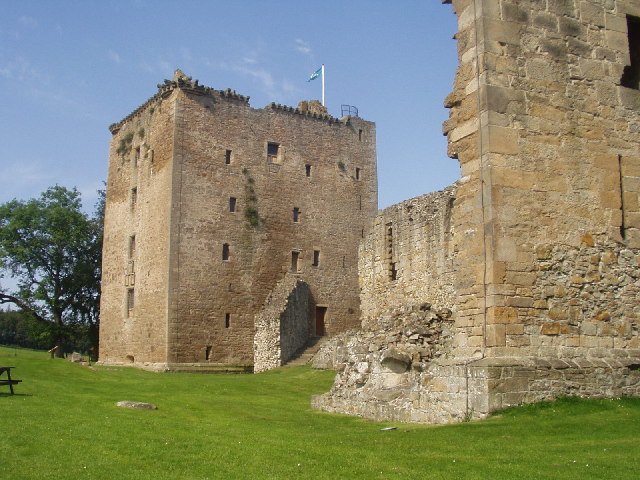
The stone castle featured a two-storey rectangular tower situated atop the motte, serving as the lord’s main residence. The upper floor housed the lord’s hall, bedrooms, and latrine, while the ground floor was used for storage and accommodation of household members. Defensive features included narrow windows designed for protection, a single ground-level entrance with a portcullis, and upper floor doors opening onto a walkway along the curtain wall, enhancing security and access.
Surrounding the motte was a curtain wall enclosing the bailey, which contained evidence of multiple buildings indicated by putlog holes, suggesting a complex of domestic and service structures. Later additions by the Sutherland family in the northern bailey included a kitchen, a great hall for receptions, and a large bedroom known as the great chamber. These became the primary living quarters after structural issues arose with the tower on the motte.
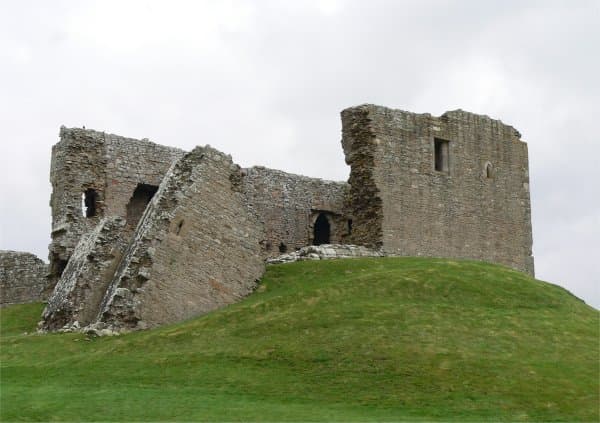
Over time, the motte’s artificial mound proved insufficient to support the heavy stone tower permanently. The tower experienced subsidence, leading to partial collapse and eventual sliding down the mound’s side. This structural failure shifted the focus of residence to the bailey’s great hall and living quarters, which were modified and expanded over the centuries.
Later history and decline
Duffus Castle remained in use until 1705, when it was abandoned following the death of the 2nd Lord Duffus. By this time, the castle was considered unsuitable for modern habitation. Notably, the castle was visited in 1689 by John Graham, 1st Viscount of Dundee, shortly before the Battle of Killiecrankie, indicating its continued strategic and symbolic significance during Scotland’s late 17th-century conflicts.
Today, Duffus Castle is a Scheduled Monument under the care of Historic Environment Scotland. The remains consist primarily of earthworks and ruined stone structures that reveal the castle’s layered history and architectural adaptations over centuries. The site offers valuable insights into medieval Scottish fortifications, noble residences, and the evolution of defensive architecture.
Architectural significance and preservation
Duffus Castle exemplifies the transition from early timber motte-and-bailey castles to more durable stone fortifications in medieval Scotland. Its construction techniques, defensive features, and domestic arrangements provide a detailed case study of noble residences adapting to changing military and social needs.
The castle’s location on the Laich of Moray illustrates strategic site selection in relation to natural landscape features, while its successive ownership by the Murray, Cheyne, and Sutherland families reflects the political and familial dynamics of the Scottish nobility.
Preservation efforts have stabilized the ruins, allowing visitors to explore the extensive earthworks, the motte, and the remains of stone buildings. The site’s interpretation highlights its historical importance and architectural development, making Duffus Castle a key destination for those interested in Scotland’s medieval heritage.
Frequently asked questions (FAQ)
- What is the historical significance of Duffus Castle?
- Duffus Castle is a prime example of a motte-and-bailey castle, built in the 12th century. It was the seat of the powerful Moray family and played an important role in the region's history during medieval Scotland.
- When was Duffus Castle built?
- Duffus Castle was constructed in the late 12th century, with significant developments occurring throughout the 13th and 14th centuries. The castle's architecture reflects the evolution of defensive structures during this period.
- How do I get to Duffus Castle?
- Duffus Castle is located just outside Elgin, Scotland, easily accessible by car. Visitors can follow the A96 road and take the B9103 towards Duffus, with parking available near the site.
- Is it possible to visit Duffus Castle year-round?
- Yes, Duffus Castle is open to visitors year-round, allowing guests to explore its historic grounds. However, it's advisable to check local weather conditions and any specific site announcements before planning your visit.
- What are the opening hours of Duffus Castle?
- Duffus Castle is typically open from dawn until dusk, providing ample time for visitors to enjoy the site. Please verify opening times on the official website or local resources, as they may vary seasonally.
- Can I bring my dog to Duffus Castle?
- Yes, dogs are welcome at Duffus Castle, but they should be kept on a lead at all times. This policy ensures the safety of both your pet and the local wildlife.
- What nearby attractions can I visit while in Elgin?
- While in Elgin, visitors can explore the Elgin Cathedral, the Moray Museum, and the scenic Lossie Forest. Each of these attractions offers a unique glimpse into the history and natural beauty of the Moray region.
- Are there any ticket prices for visiting Duffus Castle?
- There is no entry fee to visit Duffus Castle, making it an excellent option for budget-conscious travelers. Donations are appreciated to help maintain the site and preserve its historical significance.
- When is the best time to visit Duffus Castle?
- The best time to visit Duffus Castle is during the spring and summer months when the weather is more favorable. This season also allows for the most vibrant scenery, enhancing your overall experience at the castle.
Photo gallery

Information
Website
Visit websiteSources & official resources
Verify the information above using these authoritative references.
Loading map...
Visitor reviews
No reviews yet. Been here? Write the first review and help other travelers!
Write the first reviewVisited this castle? Share your experience
Your review helps other travelers and adds first-hand knowledge to our encyclopedia.