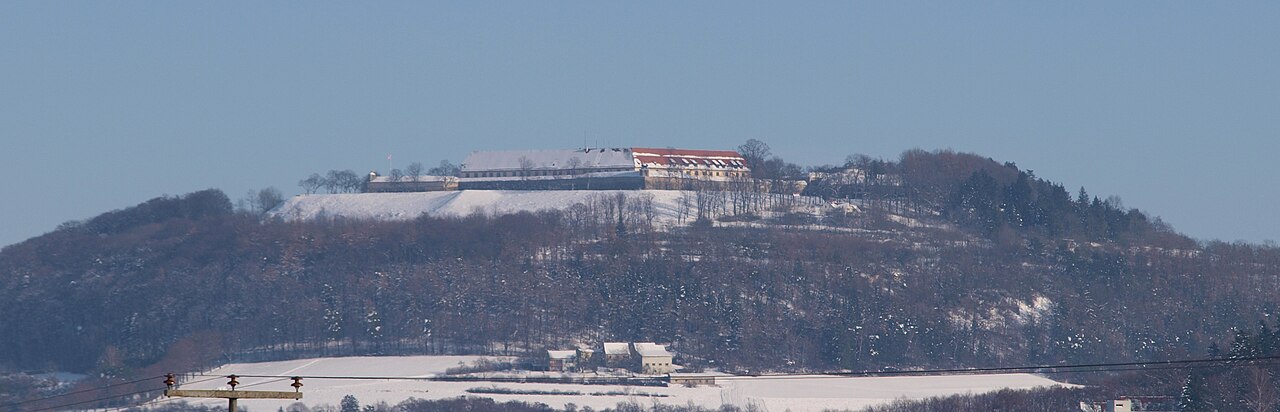
Spielberg Castle
Spielberg Castle is a historically significant medieval fortress located in the Middle Franconian region of the Franconian Alb, situated above the village of Spielberg, part of the municipality of Gnotzheim, Germany. This castle complex traces its origins back to the 12th century, making it a notable example of high medieval architecture and feudal power structures in the region.
Historical background and early ownership
The castle was originally part of the extensive castle system of the Counts of Truhendingen during the 12th and 13th centuries. These counts acted as Vögte (guardians) of the Eichstätt Monastery, a significant ecclesiastical institution, from the mid-12th century. Their role likely involved reinforcing territorial claims stemming from a 1053 donation by Emperor Henry III to the monastery. Documentary evidence from the first half of the 12th century mentions a figure named Tibertus (Dyepertus) de Spilberg, associated with the Nuremberg Burgrave and possibly connected to the Truhendingen family or their guardianship duties. A document dated August 20, 1150, refers to Tibertus as "Dieppertus de Spileberc" and places Spielberg within the lordship of Oettingen, helping to narrow the castle's construction period to at least the early 12th century.
Some historians speculate that Tibertus von Spielberg might be the same individual as Dietprecht/Diephart von Gnotzheim, mentioned in 1130, indicating a continuity of local nobility. The village of Gnotzheim, lying below the castle, had its own noble presence dating back to around 1099 with Pertholt von Gnozzesheim.
Transition of ownership and architectural developments
Following the extinction of the Truhendingen family line, ownership of Spielberg Castle passed to the Counts of Oettingen in 1363. It subsequently became the ancestral seat of the Oettingen-Spielberg line, which was elevated to a principality in 1734. The castle's political affiliations shifted over time, coming under Prussian rule in 1796 and then becoming part of Bavaria in 1806.
In 1827, the castle was purchased by Prince Carl Philipp von Wrede, who later gifted it to his daughter, Princess Amalie zu Oettingen-Spielberg. The castle remained in the family until 1983, when Prince Albrecht zu Oettingen-Spielberg entrusted the complex to the Steinacker family of artists.
Architectural features and renovations
The castle complex, dating primarily from around 1400, has undergone several significant renovations and expansions. Between 1625 and 1627, the construction of the so-called Herrenhaus (Palas) took place, reflecting the architectural styles and residential needs of that period.
Later, between 1730 and 1735, Prince Johann Alois I. von Oettingen (1707–1780) commissioned a representative interior redesign of the castle's three-story main building and its castle chapel, the latter first documented in 1427. This refurbishment embraced the early Rococo style, emphasizing ornate decoration and elegance in the interiors.
Castle chapel
The castle chapel is a notable feature, with its origins in the early 15th century. The Rococo redesign brought intricate stucco work and delicate frescoes, enhancing its spiritual and artistic significance within the castle complex.
Modern artistic transformation and museum
From 1983 to 1987, the castle underwent a remarkable transformation under the stewardship of Ernst Steinacker (1919–2008), a sculptor and painter based in Wemding, along with his family. They converted the castle into a museum and art gallery, now known as the Schlossgalerie (Castle Gallery).
This gallery showcases the works of Ernst Steinacker, his wife Ingrid, and their children Veit Steinacker and Annette Steinacker-Holst. The art collection centers on themes of the soul and the unity of the human being, integrating sculpture and painting to create a harmonious artistic environment.
The Steinacker family's contributions have redefined the castle complex, including the castle courtyard and the surrounding meadows, turning these spaces into an artistic ensemble that blends history with contemporary creativity.
Location and regional significance
Spielberg Castle's position above the village of Spielberg offers strategic views over the surrounding Franconian Alb landscape. The castle's location within the Middle Franconian region situates it within a historically contested and culturally rich area of Germany.
Its integration into the local nobility's network and its role as a guardian of ecclesiastical properties highlight its importance in regional power dynamics during the high medieval period.
Visitor information and cultural heritage
Today, Spielberg Castle stands as a partially preserved complex that offers visitors insight into medieval architecture, aristocratic history, and modern artistic endeavors. The castle's museum and gallery provide a unique cultural experience, combining historical ambiance with contemporary art.
Visitors can explore the castle grounds, appreciate the early Rococo interiors, and engage with the Steinacker family's artworks, which collectively narrate the castle's layered history and ongoing cultural relevance.
Frequently asked questions (FAQ)
- How do I get to Spielberg Castle?
- Spielberg Castle is located in Gnotzheim, Germany, and can be accessed by car or public transportation. If you're driving, there are parking facilities nearby. For public transport, check local bus schedules for routes that connect to Gnotzheim.
- What is the historical significance of Spielberg Castle?
- Spielberg Castle dates back to the 12th century and has played a crucial role in the region's history. Originally built for defense, it has witnessed many historical events, including feudal conflicts and local governance. Today, it stands as a testament to medieval architecture and the region's rich heritage.
- When was Spielberg Castle last renovated?
- The most recent renovations of Spielberg Castle were completed in the early 2000s to preserve its historical integrity while enhancing visitor access. These renovations have made it easier for tourists to explore the castle while maintaining its original architectural charm.
- Can I take a guided tour of Spielberg Castle?
- Yes, guided tours are available at Spielberg Castle, offering visitors an in-depth look at its history and architecture. Tours are typically conducted in English and German, and they provide fascinating insights into the castle's past. It's recommended to check the schedule and book in advance during peak tourist seasons.
- Why is Spielberg Castle a popular tourist attraction?
- Spielberg Castle attracts visitors for its stunning architecture, rich history, and beautiful surrounding landscape. Its strategic location offers breathtaking views of the surrounding countryside, making it a picturesque destination for photography and exploration. Additionally, the castle often hosts cultural events and exhibitions that enhance its appeal.
- Is it possible to access all areas of Spielberg Castle?
- While many areas of Spielberg Castle are accessible to visitors, some sections may be restricted due to preservation efforts. The main areas open to the public include the courtyard, main hall, and some exhibition rooms. Visitors with mobility challenges should inquire about accessibility options before their visit.
- What are the opening hours for Spielberg Castle?
- Spielberg Castle is typically open to visitors from 10 AM to 5 PM, but hours may vary depending on the season. It is advisable to check the official website or contact the castle directly for the most current information on opening times and any seasonal closures.
- What are the ticket prices for visiting Spielberg Castle?
- Ticket prices for Spielberg Castle are generally affordable, with discounts available for students, seniors, and children. Adult tickets usually cost around €8, while reduced tickets may be priced at €5. Group rates are also available, so consider visiting with friends or family for a better deal.
- What is the best time to visit Spielberg Castle?
- The best time to visit Spielberg Castle is during the spring and early autumn when the weather is mild, and the surrounding landscape is particularly beautiful. Additionally, these seasons typically see fewer crowds compared to the summer months, allowing for a more enjoyable experience. However, special events may also draw larger crowds, so plan accordingly.
Loading map...
Visitor reviews
No reviews yet. Been here? Write the first review and help other travelers!
Write the first reviewVisited this castle? Share your experience
Your review helps other travelers and adds first-hand knowledge to our encyclopedia.