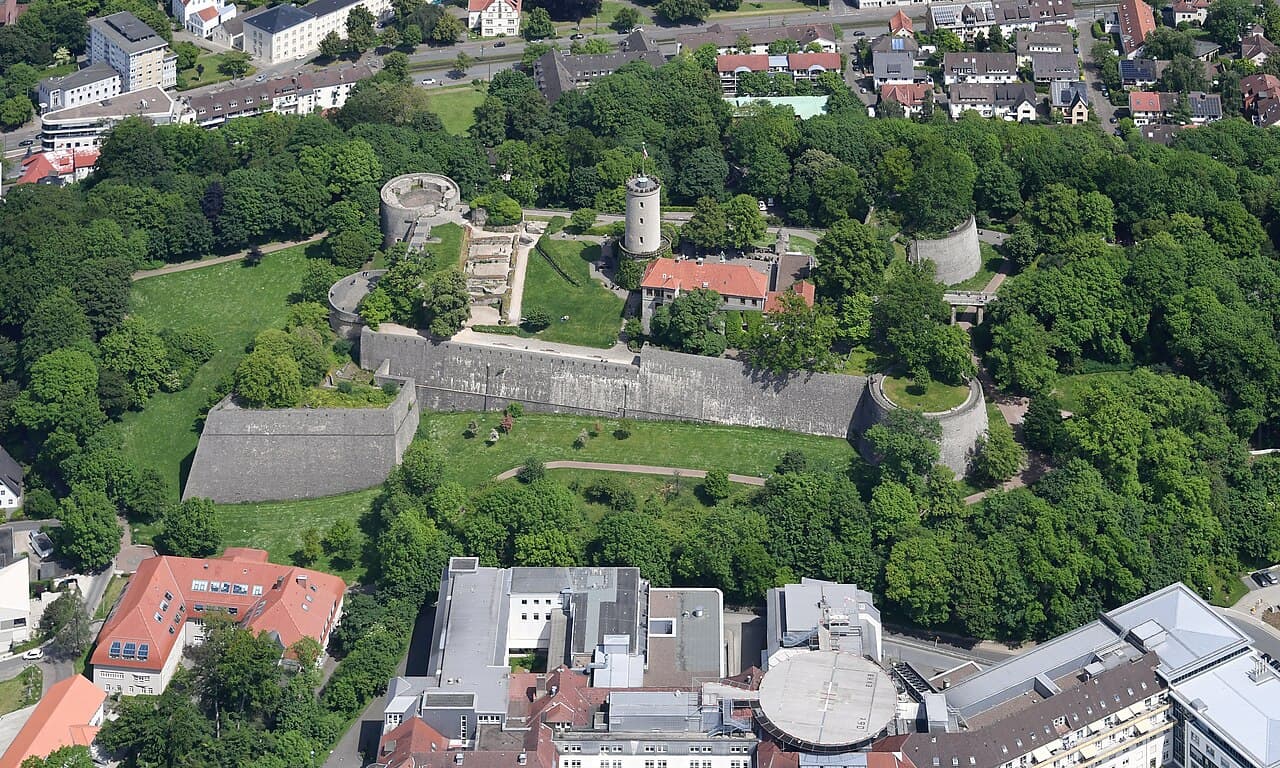
Sparrenberg Castle
Sparrenberg Castle, also known as the Sparrenburg, is a prominent hill castle located in the city of Bielefeld, in the German region of North Rhine-Westphalia. Perched atop the Sparrenberg hill at an altitude of approximately 180 meters, the castle overlooks the city center by some 60 meters, commanding a strategic position overlooking the Bielefeld Pass through the Teutoburg Forest. This elevated location was crucial for controlling trade and military movements in the region, making the castle a vital defensive and administrative stronghold since its construction in the 13th century.
The castle was originally erected before 1250 by the counts of Ravensberg to protect their territorial interests and to serve as the ruling seat of their county. The establishment of Sparrenberg Castle likely predates the founding of the city of Bielefeld around 1200, as castles typically preceded urban settlements to provide security and governance. The first documented mention of the castle dates to 1256, confirming its early medieval origins.
Medieval origins and early history
The counts of Ravensberg built Sparrenberg Castle as a fortified residence and military bastion. Its primary role was to guard the Bielefeld Pass, a critical passage through the Teutoburg Forest, which was an important route for trade and military campaigns. The castle's strategic importance was underscored by its function as the administrative center of the county.
In 1346, the ruling line of Calvelage-Ravensberg ended with the death of Bernard, Count of Ravensberg, without heirs. The castle and county passed by marriage to Count Gerhard I of Jülich-Berg, marking a shift in ownership and political influence. The castle briefly served again as a ruling seat from 1410 to 1428 under Count William II of Ravensberg from the House of Jülich. By the early 16th century, the castle was under the control of the Duke of Cleves through inheritance, reflecting the complex feudal allegiances of the region.
Transformation into a renaissance fortress
The advent of gunpowder and artillery in the late medieval period necessitated significant changes to castle defenses. Recognizing this, the dukes of Cleves, who controlled the castle in the early 16th century, ordered extensive modernization to convert Sparrenberg into a fortress capable of withstanding cannon fire and employing artillery.
Starting around 1530, a round bastion known as the Mühlenrondell was constructed on the western side of the castle, accessible only via a bridge from the main castle. This bastion allowed control over the Bielefeld Pass with artillery fire. From 1556, the Italian fortress master builder Alessandro Pasqualini and his son directed the reconstruction, which was completed in 1578. This work transformed Sparrenberg into the largest fortress in Westphalia, surrounded by a terrace and high defensive walls.
The fortress featured four bastions at its corners: the original western Mühlenrondell was expanded into a pointed bastion called the Scherpentiner, named after the serpentine artillery pieces of the period. The other three corners also received round bastions, enhancing the fortress's defensive capabilities against siege artillery.
Military engagements and political changes
The early 17th century brought significant military conflict to the region. The death of John William, Duke of Jülich-Cleves-Berg in 1609 without male heirs triggered the War of the Jülich Succession. The castle sustained damage during this period, including an earthquake in 1612. The 1614 Treaty of Xanten awarded the castle to Brandenburg-Prussia, which allowed Dutch forces to occupy it in 1615.
During the Thirty Years' War, the castle changed hands multiple times. The Dutch retreated in 1623 before advancing Spanish forces. Brandenburg's attempt to retake the castle in 1625 failed. The fortress endured a prolonged siege by Swedish and Hessian troops in 1636-1637, after which it was handed over to French allies in 1642. The 1648 Peace of Westphalia confirmed Brandenburg-Prussia's control.
The fortress successfully resisted sieges during the Franco-Dutch War, notably in 1673 against Münster troops and in 1679 against French forces. However, by the late 17th century, Sparrenberg's military importance waned as fortification technology advanced. Parts of the fortress were repurposed as a prison, and some outer walls were dismantled under King Frederick II of Prussia to build barracks in the city.
Romantic restoration and modern use
In the 19th century, the castle experienced a revival inspired by the Romantic movement. The Committee for the Renovation of the Tower on the Sparrenberg was established, leading to the restoration of the tower in 1842-43. The city of Bielefeld purchased the castle complex in 1879 for a modest sum, initiating further development of the site.
Architect E. Hillebrand designed a Gothic-style great hall building, which opened in 1888, housing a ballroom, restaurant, and museum rooms. In 1900, a monument to the Grand Elector Frederick William was erected in the courtyard, attended by Emperor William II, the nominal last count of Ravensberg.
Damage during world war ii and postwar restoration
During World War II, Sparrenberg Castle was used as an anti-aircraft emplacement. It suffered heavy damage during an air raid on 30 September 1944, with only the tower remaining undamaged. Extensive cleanup and restoration efforts took place from 1948 to 1987.
Between 1955 and 1983, the rebuilt estate building housed the German Museum of Playing Cards. Archaeological discoveries during restoration revealed the original fortress floor and catacombs beneath the northern bastion, adding to the site's historical richness.
In 2014, a new visitor center designed by architect Max Dudler was opened, featuring a museum gift shop, ticket counter, and kiosk. The castle grounds are accessible year-round free of charge, with the main fortress and tower open to visitors from April to October.
Visitor experience and cultural significance
Sparrenberg Castle remains the signature landmark of Bielefeld and a popular tourist destination. Visitors can explore the 37-meter tower, extensive casemates (underground corridors), and the restored fortress walls. The northwestern part of the underground corridor is closed except for special tours to protect bat habitats.
Each year, the castle hosts the Sparrenburgfest, a medieval festival featuring reenactments, markets, and traditional crafts, celebrating the castle's rich history and cultural heritage.
Efforts to preserve the castle have included innovative fundraising campaigns such as "One stone for the castle", allowing donors to sponsor engraved stones used in restoration paving.
Overall, Sparrenberg Castle exemplifies the evolution of medieval fortifications into Renaissance bastions, reflecting the military, political, and cultural shifts of Westphalia over centuries. Its prominent hilltop location, extensive Renaissance bastions, and ongoing preservation make it a vital historical monument and cultural treasure in Germany.
Frequently asked questions (FAQ)
- What is the historical significance of Sparrenberg Castle?
- Sparrenberg Castle, built in the 13th century, is a prominent landmark in Bielefeld, Germany. It played a crucial role in the defense of the region during the Middle Ages and has witnessed numerous historical events over the centuries, making it an important site for both local history and cultural heritage.
- When was Sparrenberg Castle constructed?
- Sparrenberg Castle was constructed around the year 1250. It was built as a fortification to protect the city of Bielefeld and has undergone various renovations and restorations throughout its long history, preserving its architectural significance.
- How do I get to Sparrenberg Castle?
- Sparrenberg Castle is easily accessible by public transportation, with several bus lines serving the area. If you prefer to drive, there is parking available nearby, and the castle is located within walking distance from the city center, making it a convenient destination.
- What are the opening hours for Sparrenberg Castle?
- Sparrenberg Castle is open to visitors daily from 10 AM to 6 PM during the summer months and from 10 AM to 4 PM in the winter. However, it is advisable to check the official website for any seasonal changes or special events that may affect opening hours.
- Can I take guided tours of Sparrenberg Castle?
- Yes, guided tours of Sparrenberg Castle are available and provide an in-depth look at its history and architecture. These tours are often led by knowledgeable guides who can share fascinating stories and details about the castle's past.
- Is it possible to host events at Sparrenberg Castle?
- Yes, Sparrenberg Castle offers facilities for hosting various events, including weddings and corporate gatherings. The picturesque setting and historic ambiance make it a unique venue for special occasions.
- What are the ticket prices for visiting Sparrenberg Castle?
- The ticket prices for Sparrenberg Castle are generally affordable, with discounts available for students, seniors, and groups. Children under a certain age often enjoy free admission, making it a great family-friendly destination.
- When is the best time to visit Sparrenberg Castle?
- The best time to visit Sparrenberg Castle is during the spring and summer months when the weather is pleasant, and the surrounding gardens are in full bloom. However, autumn also offers beautiful foliage, making it an attractive time to explore the castle and its grounds.
- Are there any nearby attractions to visit along with Sparrenberg Castle?
- Yes, nearby attractions include the historical Old Town of Bielefeld, the Botanical Garden, and the beautiful Teutoburg Forest. Visitors can easily plan a full day of exploration, enjoying both cultural and natural sights in the area.
Photo gallery

Information
Loading map...
Visitor reviews
No reviews yet. Been here? Write the first review and help other travelers!
Write the first reviewVisited this castle? Share your experience
Your review helps other travelers and adds first-hand knowledge to our encyclopedia.



