Schloss Holte
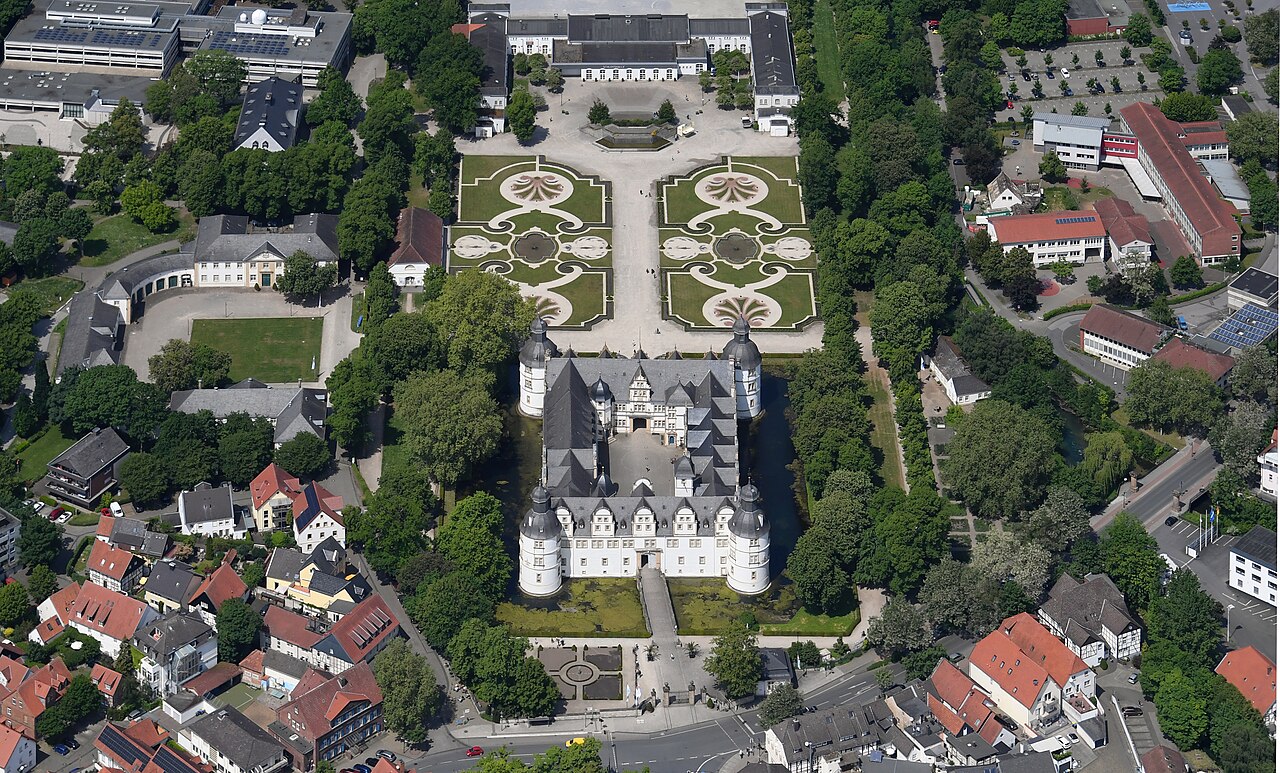
Schloss Holte is a notable baroque water castle located in the East Westphalian town of Schloß Holte-Stukenbrock, Germany. Its origins trace back to a medieval fortified site, evolving significantly over centuries into the elegant hunting lodge and residence seen today. The castle stands on a roughly one-hectare island surrounded by a man-made pond fed by the Ölbach stream, embodying the classic characteristics of a water castle with defensive and aesthetic elements intertwined.
Medieval origins and early history
The site of Schloss Holte was originally established as a fortified castle by the Counts of Rietberg during the late Middle Ages, serving as a defensive stronghold on the border with the neighboring Lippe territory. The first recorded mention of the castle dates to 1529, describing a fortified manor featuring two towers and a chapel. Throughout the 16th century, the castle was a focal point of regional conflicts, notably suffering destruction by fire in 1556 during a feud between Johann II of Rietberg and Bernhard VIII of Lippe.
The destruction marked a turning point, leading to a period of decline until the estate passed through marriage to the Counts of East Frisia after the extinction of Johann II’s male lineage in 1562. This transition brought new influences and a significant rebuilding effort in the early 17th century.
Rebuilt as a hunting lodge in the early 17th century
Between 1608 and 1616, Count Johann III of East Frisia and his wife Sabina Catharina von Rietberg undertook the reconstruction of Schloss Holte, transforming it from the ruins of the medieval fortress into a hunting lodge. The rebuilding incorporated remnants of the original structure, blending medieval foundations with contemporary architectural styles of the period.
The castle’s design from this era reflects the Renaissance influence with early Baroque elements, such as the curved domes topping the two square corner towers on the southern facade and the octagonal stair tower with rusticated stonework and heraldic decoration. The stair tower’s doorway is crowned by the Rietberg family coat of arms, flanked by reclining lions and surmounted by a triangular pediment, symbolizing the noble lineage and status of its builders.
Religious and political transformations
Under the East Frisian ownership, the castle and estate underwent a re-Catholicization, marked by the construction of a chapel dedicated to Saint Ursula in 1654. This chapel was supervised by the Minorite religious order, reflecting the religious shifts of the time. The chapel later suffered a fire in 1864 but was repaired and expanded in 1947 to accommodate a growing Protestant congregation, illustrating the evolving religious landscape of the region.
Following the death of the last East Frisian count in 1687, Schloss Holte passed by marriage to the Kaunitz family in 1699. The Kaunitz family rarely resided at the castle, and during the Napoleonic era, the estate’s political status changed as it was mediatised and later incorporated into Prussia by 1818.
19th-century revival and industrial connection
By the early 19th century, the castle had fallen into neglect until its acquisition in 1822 by Friedrich Ludwig Tenge, an entrepreneur who initiated significant renovations. From 1839, he converted Schloss Holte into a residence for his son-in-law, Julius Meyer, and established an ironworks south of the castle, linking the estate to the burgeoning industrial activity of the region.
Before the revolution of 1848/49, the castle served as a meeting place for the "Holter Kreis," a local democratic political group, highlighting its role in regional social and political movements. The ironworks operated until its demolition in 1979, while the castle itself underwent restorations to preserve its historical character.
Architectural features and current state
Schloss Holte is characterized by its hexagonal ring wall enclosing the island, originally reinforced by six polygonal corner towers. Today, two southern towers remain fully preserved with their distinctive baroque domes and lanterns, while the western and eastern towers survive only as partial ruins. The northern and northwestern sections of the wall are missing, though the inner side once featured single-story utility buildings.
Access to the island is via a masonry bridge from around 1840, notable for its cast-iron balustrade adorned with winged griffins, crafted by the nearby Holter ironworks. The main castle building has a simple rectangular footprint with a plain facade, emphasizing function over ornamentation. The southern entrance facade is the most architecturally significant, featuring the corner towers and the central stair tower.
The eastern tower, with walls approximately three feet thick, historically housed a washroom and bath chamber and marks the eastern boundary of the chapel area. The rear facade replaces the original towers with three dormer windows at roof level, reflecting later modifications.
Inside, renovations in 1955 uncovered a historic beam ceiling decorated with stucco, indicative of the building's aesthetic refinement. The chapel’s altar base contains a sandstone slab bearing the coats of arms of the counts of Rietberg, underscoring the castle’s noble heritage.
Grounds and landscape
The castle is surrounded by a park originally designed in the English garden style around 1840, including a garden island. Over time, much of the park has reverted to dense woodland, though some original trees remain, preserving a glimpse of the historic landscape design.
Present-day use and accessibility
Today, Schloss Holte remains a privately owned estate under the Tenge-Rietberg family. The castle buildings have been adapted into rental apartments, but the estate and park are not open to the public. Despite limited access, the castle's architectural and historical significance continues to mark it as an important cultural landmark in East Westphalia.
Frequently asked questions (FAQ)
- What is the historical significance of Schloss Holte?
- Schloss Holte originated as a medieval fortified castle and was rebuilt as a Renaissance hunting lodge in the early 17th century, reflecting regional political and religious changes.
- Can I visit Schloss Holte and its park?
- Schloss Holte is privately owned and not open to the public, including its park and buildings, as it has been converted into private rental apartments.
- When was Schloss Holte rebuilt after its destruction?
- The castle was rebuilt between 1608 and 1616 by Count Johann III of East Frisia and Sabina Catharina von Rietberg, incorporating remnants of the original medieval structure.
- What architectural features does Schloss Holte have?
- The castle features a hexagonal ring wall with polygonal corner towers, a masonry bridge with cast-iron balustrades, and a main building with Baroque domed towers and an octagonal stair tower.
- Who owns Schloss Holte today?
- The castle remains privately owned by the Tenge-Rietberg family, descendants of Friedrich Ludwig Tenge who acquired the estate in the 19th century.
Information
Opening hours
Not open to the public
Ticket prices
Not open to the public
Current owner
Private owner
Website
Visit websiteSources & official resources
Verify the information above using these authoritative references.
Loading map...
Visitor reviews
No reviews yet. Been here? Write the first review and help other travelers!
Write the first reviewVisited this castle? Share your experience
Your review helps other travelers and adds first-hand knowledge to our encyclopedia.