Sonnenstein Castle
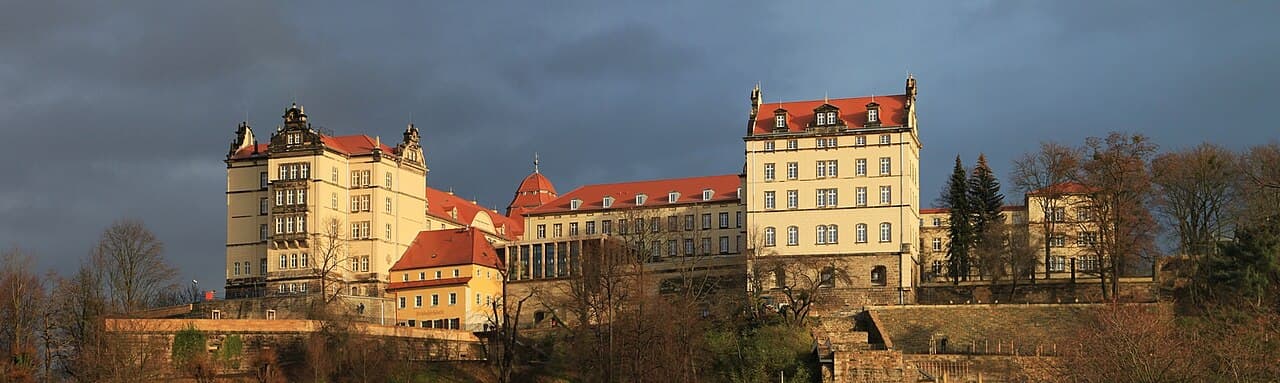
Sonnenstein Castle is a late-medieval hill castle located in Pirna, near Dresden, Germany. Constructed after 1460 on the site of an earlier medieval fortress, the castle's history spans several centuries and reflects significant shifts in its function and cultural significance. Originally built as a defensive stronghold, Sonnenstein Castle's imposing stone walls and elevated position exemplify typical features of hill castles designed to oversee and protect the surrounding landscape.
The architectural evolution of Sonnenstein Castle
The castle's architecture retains elements characteristic of the late-medieval period, including robust curtain walls, battlements, and fortified towers that were integral for defense. Over time, modifications were made to adapt the castle for new uses, especially during its transformation into a mental hospital in the early 19th century. Despite these changes, the castle's core medieval structure remains discernible, with its strategic placement on a hilltop offering commanding views of the Elbe valley.
Structural features and layout
Sonnenstein Castle originally featured a central keep surrounded by defensive walls and a series of outbuildings. The castle's layout was designed to maximize defense, with thick stone walls and narrow windows suitable for archers. The elevated site not only provided military advantage but also ensured visibility over trade routes and the town of Pirna below.
From fortress to mental hospital: a complex history
In 1811, Sonnenstein Castle was repurposed as a mental hospital, marking a significant shift from military to medical use. This institution became notable for its early adoption of progressive psychiatric treatments. It was one of the first "therapeutic asylums," incorporating activity rooms such as billiards and music rooms to aid patient rehabilitation. The hospital gained international recognition for its advanced methods and served as a model for similar institutions worldwide.
Notable patients and contributions to psychiatry
Among its patients was Daniel Paul Schreber, who wrote his influential memoir, Denkwürdigkeiten eines Nervenkranken, during his stay from 1900 to 1902. Schreber's writings contributed to the understanding of mental illness and have been studied extensively in psychiatric literature.
The dark chapter: Sonnenstein during World War II
During the Second World War, Sonnenstein Castle was tragically transformed into a killing centre as part of the Nazi Aktion T4 program. From early 1940 until June 1942, a section of the castle was converted to include a gas chamber and crematorium in the cellar of the former men's sanitary building (C 16). The facility was surrounded by high brick walls and hoardings to conceal its true purpose.
Operation of the killing centre
The killing centre operated with a staff of about 100 personnel, who managed the extermination of approximately 15,000 victims under the T4 program and the related Sonderbehandlung 14f13. Many staff members were later transferred to extermination camps in occupied Poland due to their experience with mass murder techniques. The centre was dismantled in late 1942, with incriminating installations removed, and the buildings were repurposed as a military hospital.
Post-war justice and remembrance
After the war, several staff members, including Professor Paul Nitsche, the medical chief of T4, were tried and sentenced to death in the Dresden Doctors' Trial of 1947. It took decades for the full extent of Sonnenstein's role in the T4 program to be publicly acknowledged. In 1989, public commemoration began, culminating in the opening of a memorial centre on 9 June 2000, dedicated to the victims of the T4 program. This centre is managed by the Stiftung Sächsische Gedenkstätten zur Erinnerung an die Opfer politischer Gewaltherrschaft (Foundation for Memorial Institutions in Saxony for the Victims of Tyranny).
Modern use and preservation
Since 1970, Sonnenstein Castle has resumed its role as a facility for disabled people, including the establishment of a rehabilitation centre and a workshop for disabled individuals opened in 1991. The castle's preservation as a historical site and memorial ensures that both its medieval heritage and its complex 20th-century history are recognized and accessible to the public.
Frequently asked questions (FAQ)
- What is the historical significance of Sonnenstein Castle?
- Sonnenstein Castle is historically significant for its origins as a late-medieval hill castle and its later use as a pioneering mental hospital. It is also known for its tragic role as a Nazi extermination centre during World War II under the Aktion T4 program.
- Can I visit the memorial centre at Sonnenstein Castle?
- Yes, the memorial centre dedicated to the victims of the Aktion T4 program is open to the public and provides educational exhibits about the castle's history during World War II.
- When was Sonnenstein Castle built?
- Sonnenstein Castle was built after 1460 on the site of a former medieval castle, making it a late-medieval structure.
- What architectural style characterizes Sonnenstein Castle?
- The castle features architectural elements typical of late-medieval hill castles, including fortified walls, battlements, and towers designed for defense.
- Is Sonnenstein Castle still used for medical purposes?
- Since 1970, the castle has housed facilities for disabled people, including a rehabilitation centre and workshops, continuing its medical and therapeutic legacy.
Photo gallery

Information
Loading map...
Visitor reviews
No reviews yet. Been here? Write the first review and help other travelers!
Write the first reviewVisited this castle? Share your experience
Your review helps other travelers and adds first-hand knowledge to our encyclopedia.