Sohail Castle
Sohail Castle, located in Fuengirola, Spain, is a remarkable example of a hill castle with a rich history spanning over a millennium. Originally constructed in 956 AD by the Cordoban Caliph Abd-ar-Rahman III, the fortress was strategically positioned to strengthen the coastal defenses of the region during the era of Al-Andalus. The castle was built atop the remains of the Roman settlement known as Suelitania, itself founded on earlier Phoenician and Punic settlements, highlighting the site's long-standing military and economic significance.
The castle's initial design was a modest fortress intended to secure the coastline and oversee the mouth of the Fuengirola River, which was navigable during Roman times and served as a vital trade route. In the 12th century, under the rule of the Almoravid dynasty, the fortress was expanded into an alcazaba—a fortified enclosure with an irregular octagonal floor plan adapted to the terrain's slopes. This phase introduced eight curtain walls and defensive towers, although notably, the castle lacks a traditional keep or donjon. The walls were constructed using a combination of stone masonry, brick courses, and tapial (rammed earth), reflecting a blend of Roman building techniques and Islamic military architecture.
Historical context and military significance
Muslim period and almoravid expansion
During the 10th to 12th centuries, Sohail Castle served as a critical defensive stronghold for Muslim rulers controlling southern Spain. The castle's position on a hill 38 meters above sea level allowed it to oversee both maritime and land routes, particularly the corridor between Málaga and Marbella. The Almoravid enhancements transformed the fortress into a formidable military complex, with curtain walls reinforced by towers at each corner and a horseshoe-arched main gate featuring arrow slits for archers.
Christian conquest and subsequent modifications
The castle was captured by Christian forces during the Reconquista on 7 August 1485, marking a significant turning point in its history. The siege caused extensive damage, necessitating substantial repairs and adaptations to the fortress. In the 16th century, the castle was modernized to accommodate artillery, including the addition of cannon batteries on the northeastern walls facing the sea. These modifications reflected the evolution of military technology and the changing nature of warfare.
Role in the peninsular war and later history
In 1810, during the Peninsular War, French troops occupied Sohail Castle. The fortress was recaptured by Spanish forces under General Ballesteros in 1812, after which the retreating French destroyed parts of the castle, including the southwest tower and adjacent walls. This conflict marked the last major military engagement involving the castle.
Following the war, the castle's military importance declined. It was sold at public auction and passed into private hands, leading to a period of neglect. Over time, it served various non-military functions, including housing cavalry units and later serving as a residence for tuberculosis patients after the Spanish Civil War. These adaptations illustrate the castle's shifting role in local society.
Architectural features and layout
Fortification design and materials
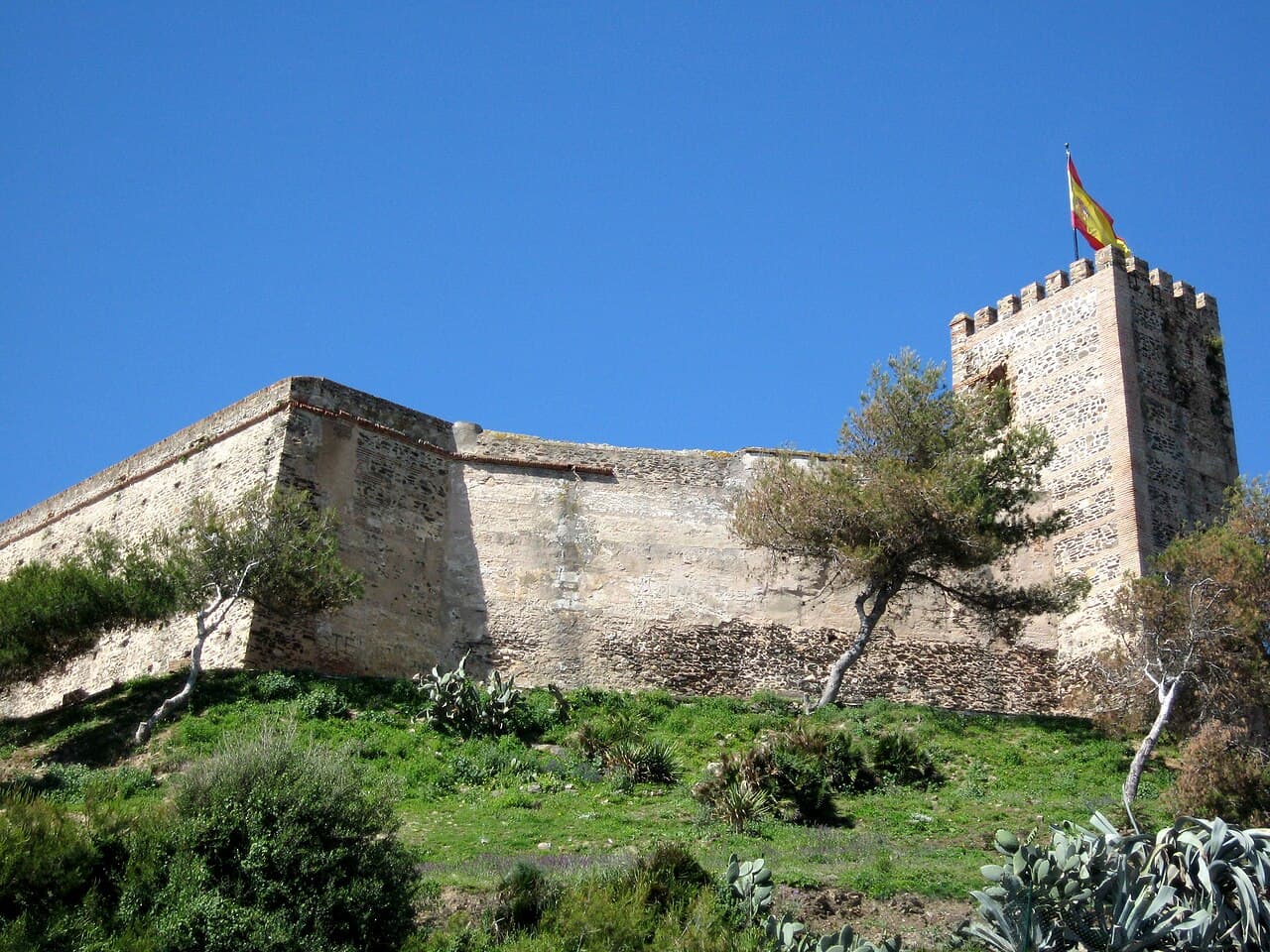
Sohail Castle is characterized by its irregular octagonal plan, with eight curtain walls and six surviving towers. The walls are notably thick and topped with an adarve (wall walkway) that connects the towers, allowing defenders to patrol the ramparts. Access to the battlements is provided by narrow spiral staircases within the towers, facilitating defense while maintaining structural integrity.
The main entrance is through a gate facing northwest, approached by a ramp fortified with a barbican—a secondary defensive structure designed to slow attackers. The gate tower features a distinctive horseshoe arch, a hallmark of Islamic architecture, and is equipped with arrow slits for archers. A modern service gate has been added along the southwest wall, also incorporating defensive arrow slits.
The construction materials reflect the castle's layered history. The walls combine stone masonry with courses of brick, a technique inherited from Roman builders to enhance strength. Additionally, tapial (rammed earth) and carefully cut ashlar blocks are used in certain sections, demonstrating a mix of building traditions over centuries.
Interior structures and water supply
While the original internal buildings have not survived intact due to centuries of conflict and reconstruction, fragments of partition walls provide clues about the castle's internal layout. A notable feature is the covered well within the enclosure, which supplied water from the nearby Fuengirola River. This reliable water source was essential for sustaining the garrison during sieges and prolonged military campaigns.
Cultural heritage and modern restoration
20th-century restoration efforts
After a long period of neglect, restoration efforts began in 1969 under the ownership of Leopoldo Werne de Bolin. Between 1990 and 1997, the Escuela-Taller Castillo Sohail undertook a major rehabilitation project that stabilized and repaired the ruins, preserving the castle's structural integrity and historical character.
Current use and public access
Today, Sohail Castle is a well-known cultural venue and tourist attraction in Fuengirola. The castle hosts concerts, festivals, and other public events, integrating the historic fortress into the modern urban fabric. The surrounding park and urban infrastructure, including the nearby A-7 highway, frame the castle, highlighting its transition from a medieval military fortress to a cherished heritage site.
Archaeological significance
The site also features excavated stone ruins at the western base of the hill, dating back to at least 300 BC, predating the Roman Republic's occupation. These remains attest to the area's continuous human presence and strategic importance over millennia, enriching the historical narrative of Sohail Castle.
Artillery and defensive adaptations
Archaeological discoveries in 1914 uncovered several artillery pieces within the castle, including cannons mounted on the northeastern walls. These artifacts highlight the castle's adaptation to the advent of gunpowder weaponry in the 16th century, marking a significant evolution in its defensive capabilities. The positioning of these cannons facing the sea underscores the fortress's role in coastal defense against naval threats.
Strategic location and military role
Perched on a hill overlooking the mouth of the Fuengirola River, Sohail Castle commanded a crucial junction between the Mediterranean coast and inland routes. Its control over the corridor connecting Málaga and Marbella made it a pivotal military asset for various rulers, from the Phoenicians and Romans to Muslim and Christian forces. This enduring strategic value shaped the castle's architectural development and historical significance throughout the centuries.
Frequently asked questions (FAQ)
- How do I get to Sohail Castle in Fuengirola?
- Sohail Castle is located on a hill in Fuengirola, easily accessible by car or public transport. It is well signposted and near the town center, making it convenient for visitors.
- What is the best time to visit Sohail Castle?
- The castle is open daily from 10:00 to 18:00. Spring and autumn offer pleasant weather and fewer crowds, ideal for exploring the ruins and enjoying the views.
- Is there an entrance fee to visit Sohail Castle?
- Admission to Sohail Castle is free, allowing visitors to explore the historic site and attend cultural events without charge.
- Can I attend events or concerts at Sohail Castle?
- Yes, Sohail Castle hosts regular concerts, festivals, and cultural events throughout the year, making it a vibrant community venue.
- What architectural styles are visible at Sohail Castle?
- The castle exhibits a mix of architectural styles, including Islamic military architecture from the Almoravid period and later Christian modifications with artillery adaptations.
- Are the castle ruins accessible for people with mobility issues?
- Due to the castle's hilltop location and uneven terrain, access can be challenging for visitors with mobility issues. Some areas may not be wheelchair accessible.
Photo gallery

Information
Opening hours
10:00-18:00, daily
Ticket prices
Free
Current owner
Town of Fuengirola
Website
Visit websiteSources & official resources
Verify the information above using these authoritative references.
Loading map...
Visitor reviews
No reviews yet. Been here? Write the first review and help other travelers!
Write the first reviewVisited this castle? Share your experience
Your review helps other travelers and adds first-hand knowledge to our encyclopedia.