Snodhill Castle
Snodhill Castle stands as a significant example of Norman military architecture in England, located near the village of Dorstone in Herefordshire. Constructed initially in the 11th century, this hill castle was strategically positioned along the volatile border with Wales, known historically as the Welsh Marches. Its primary role was to serve as a defensive stronghold controlling the frontier against Welsh incursions, reflecting the turbulent political landscape of medieval Britain.
The earliest documentary evidence of Snodhill Castle dates from 1142, yet archaeological investigations suggest that its origins may reach back to around 1067, shortly after the Norman Conquest of England. The initial stone construction is widely attributed to William FitzOsbern, a trusted companion of William the Conqueror, making Snodhill among the earliest Norman castles in England to feature substantial stonework rather than timber. An alternative theory credits Roger de Chandos with founding the castle post-1127; however, physical evidence supports the earlier date. The land was initially granted to Hugh L’Asne before 1071, and by 1101, through marriage, it passed to Robert de Chandos I, initiating the long-standing association of the Chandos family with the site.
Medieval history and ownership
Throughout the 12th and 13th centuries, the Chandos family maintained and reinforced Snodhill Castle, adapting its fortifications to meet evolving military needs. A notable enhancement occurred in 1401 when John Chandos strengthened the defenses in response to the Welsh uprising led by Owain Glyndŵr. Following John Chandos's death without heirs in 1428, the castle transferred to the Beauchamp family, then briefly to Richard Neville, and later to Richard of York, who would become King Richard III. During this period, Snodhill transitioned from a private lordship to royal possession, reflecting its strategic importance.
By the mid-16th century, the castle was described by the antiquarian John Leland as partly ruined but still in occasional use. Queen Elizabeth I granted the property to Robert Dudley, Earl of Leicester. The castle suffered damage during the English Civil Wars in the 17th century, including siege and partial dismantling. Subsequently, ownership passed through local families such as the Prossers and Powells before the estate was sold in the 20th century.
Architectural features and layout
Motte and stone keep
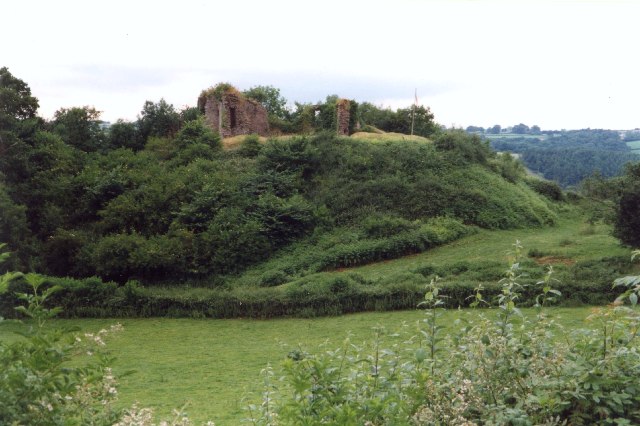
Snodhill Castle exemplifies the motte-and-bailey design, situated atop a steep hill formed between two watercourses: the River Dore and Snodhill Stream. The motte is an artificial earth mound rising between 7.5 and 14 meters above the surrounding terrain, measuring approximately 44 meters across at its widest. This elevated position provided a commanding vantage point for surveillance and defense.
At the summit of the motte are the ruins of a polygonal stone keep dating from circa 1160. The keep's base was originally thirteen-sided, but structural collapses and subsequent rebuilding have resulted in an irregular ten-sided upper structure. This polygonal design was advanced for its time, enhancing defensive capabilities. On the western side, the keep features a large drum-shaped tower on the southwest corner, with archaeological evidence suggesting a similar tower may have existed on the northwest side. Between these towers stood an arched gateway with an intact arch head and a groove for a portcullis, a heavy sliding gate used for defense. These gateway defenses likely date from the late 14th or early 15th century when the castle's fortifications were heightened.
Inner bailey and curtain walls
To the west of the motte lies the inner bailey, a courtyard enclosed by steep earthworks and terraces. Portions of the original stone curtain wall survive, along with remnants of a chapel tower on the southern side. Excavations have uncovered a large tower and traces of substantial buildings within the bailey, indicating a complex internal layout. A distinctive cross-wall divides the inner bailey, and a fortified postern gate in the northeast corner suggests multiple controlled access points, supplementing the main gate near the southwestern corner.
Outer baileys and additional defenses
Archaeological evidence hints at the existence of outer baileys to the east and west of the motte, which, if confirmed, would make Snodhill one of the largest early Norman castles in England. These additional enclosures would have expanded the defensive perimeter and accommodated auxiliary buildings and activities related to the castle's operation.
Religious significance: the royal free chapel
A unique feature of Snodhill Castle was its Royal Free Chapel, a rare example of a chapel within a lordship castle directly linked to the monarchy. Active from at least the 13th through the 16th centuries, this chapel had chaplains appointed by the monarch, underscoring the castle's status and royal connections. The chapel's remains were rediscovered in 2022 within the southeastern corner of the main bailey. Plans are underway to stabilize and restore this religious site, which offers valuable insights into the spiritual life and royal patronage associated with Snodhill.
Later history and conservation efforts
Approximately 200 meters west of the castle are the ruins of Snodhill Court, a 17th-century stone manor house constructed using salvaged stonework and carved corbels from the castle ruins. Excavations in 2021 uncovered matching carved fragments both at the manor and the castle site, illustrating the reuse of materials during this period.
In the 20th and 21st centuries, Snodhill Castle's historical importance has been increasingly recognized. It was designated an ancient monument in 1933 and later listed on England’s Heritage at Risk Register. Since 2016, the Snodhill Castle Preservation Trust has overseen ongoing archaeological excavations and conservation work aimed at preserving this remarkable medieval fortress for future generations.
Today, Snodhill Castle remains a compelling site for historians, archaeologists, and visitors interested in Norman military architecture, medieval frontier history, and castle conservation. Its combination of motte-and-bailey layout, early stone keep construction, and unique royal chapel make it a distinctive landmark in the Welsh Marches region.
Frequently asked questions (FAQ)
- How do I get to Snodhill Castle?
- Snodhill Castle is located near the village of Dorstone in Herefordshire, England. It is accessible by local roads, and visitors can reach the site by car or on foot from Dorstone village.
- What is the historical significance of Snodhill Castle?
- Snodhill Castle was a key Norman fortress on the English-Welsh border, built in the 11th century to control the frontier and defend against Welsh incursions. It has connections to notable medieval families like the Chandos and royal figures such as Richard III.
- Can I visit the interior of Snodhill Castle?
- As a ruin, Snodhill Castle's interior is accessible to visitors, but some areas may be unstable or under conservation. Visitors should follow safety guidelines and respect ongoing preservation efforts.
- When is the best time to visit Snodhill Castle?
- The castle can be visited year-round, but spring and summer offer the best weather and longer daylight hours for exploring the site and enjoying the surrounding countryside.
- Is there an entry fee for Snodhill Castle?
- Entry to Snodhill Castle is generally free, but donations to the Snodhill Castle Preservation Trust are welcomed to support ongoing conservation work.
- Are there guided tours available at Snodhill Castle?
- Guided tours are occasionally offered by the Snodhill Castle Preservation Trust during special events or open days. Check their website for current information on tours and events.
Information
Website
Visit websiteSources & official resources
Verify the information above using these authoritative references.
Loading map...
Visitor reviews
No reviews yet. Been here? Write the first review and help other travelers!
Write the first reviewVisited this castle? Share your experience
Your review helps other travelers and adds first-hand knowledge to our encyclopedia.