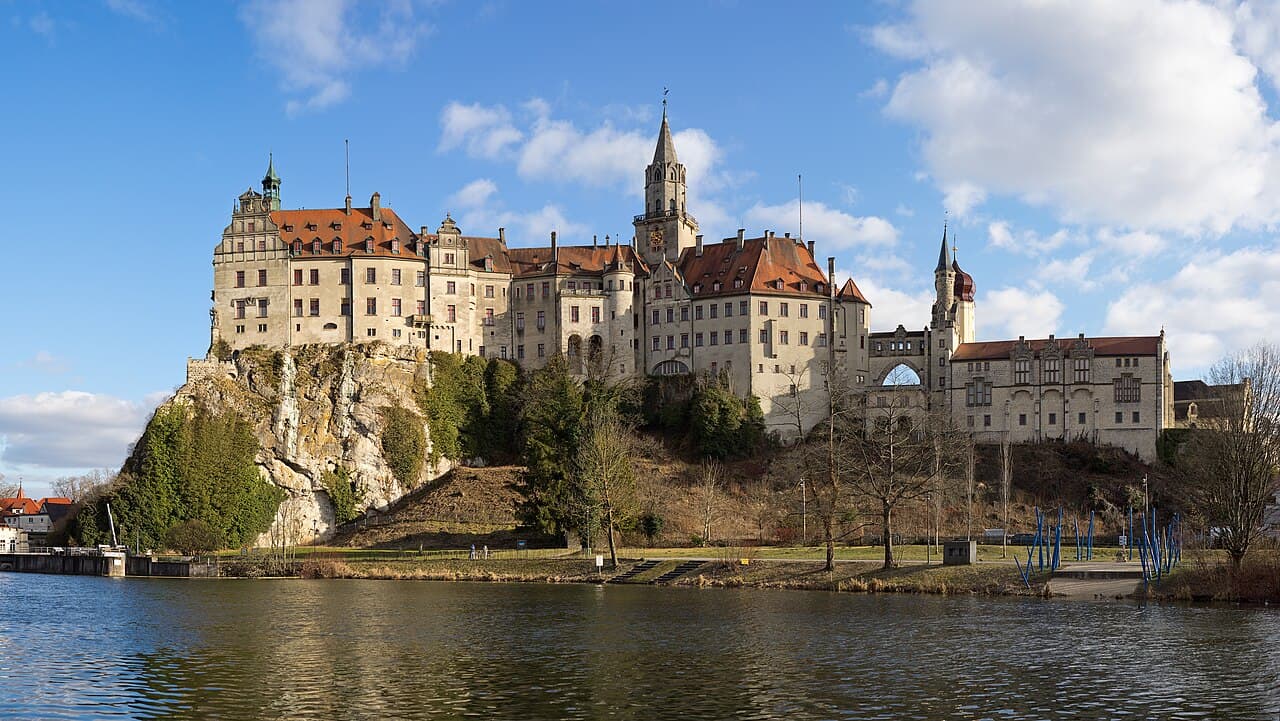
Sigmaringen Castle
Sigmaringen Castle stands as a commanding historic fortress in the town of Sigmaringen, located in the scenic Swabian Alb region of Baden-Württemberg, Germany. This hill castle dramatically overlooks the Danube River, perched atop a limestone rock approximately 35 meters above the river level, offering a naturally defensible position. With origins dating back to the 11th century, Sigmaringen Castle has served as a princely residence and seat of government for the Princes of Hohenzollern-Sigmaringen, a cadet branch of the influential Hohenzollern dynasty, which produced German emperors and Prussian kings.
The castle’s earliest documented mention occurs in 1077, during the conflict involving Rudolf of Rheinfelden and King Henry IV. Originally a medieval fortress, the castle evolved through multiple construction phases, reflecting architectural styles from the Staufer period around 1200, through the Renaissance, to extensive 19th-century historicist renovations following a devastating fire in 1893. Today, Sigmaringen Castle is a well-preserved monument showcasing a blend of medieval defensive structures and later stylistic adaptations, including neo-Gothic elements.
Early history and medieval foundations
The site of Sigmaringen Castle was first referenced in the chronicles of the Petershausen monastery in 1077. The original fortress was constructed on a defensible rock outcrop, with the oldest surviving elements dating to the Staufer period around 1200. The castle was built using the distinctive buckel stone masonry technique, characterized by roughly squared stones with rounded faces, a hallmark of Romanesque architecture in the region.
The medieval core included a massive bergfried (keep) approximately 25 to 26 meters tall, with thick walls tapering from about 3 meters at the base. This tower served as the last line of defense and was accessed through a doorway elevated about eight meters above ground level to deter attackers. The castle’s main gate featured a rounded arch framed by finely carved voussoirs and capitals decorated with soldier figures, emphasizing both defensive and aesthetic considerations.
Throughout the 12th and 13th centuries, the castle was associated with noble families such as the Sigmaringen-Spitzenberg and Helfenstein counts. The Helfensteins undertook significant rebuilding around 1200, incorporating Romanesque elements and strengthening the fortress’s defensive capabilities. Ownership shifted through various hands, including the Montfort family and the House of Habsburg, before the Werdenberg family took possession in 1399, marking a new phase of architectural expansion.
Renaissance transformation and architectural expansion
The 15th and 16th centuries saw Sigmaringen Castle transformed from a purely military fortress into a more comfortable residence. The Werdenberg family initiated expansions to the north-east and west, adding long angular buildings and round towers that enhanced both the castle's defensive features and its residential appeal. A surviving lintel engraved with the year 1498 on the Swedish Tower commemorates this period.
Between 1627 and 1630, under the supervision of master builder Hans Alberthal of Dillingen, the castle underwent a significant Renaissance-style transformation. This period marked the conversion of the medieval fortress into a Renaissance château under Count Charles II of Hohenzollern-Sigmaringen. The buildings were unified under a single roof, with the addition of elegant architectural details and improved living quarters. Later, master builder Michael Beer of Au further integrated the structures around 1650.
Impact of conflict and reconstruction
The castle endured damage during the Thirty Years' War, notably when Swedish troops occupied it in 1632. The eastern wing was burned but subsequently rebuilt between 1658 and 1659. Fires also struck the castle in 1539 and most devastatingly in 1893, the latter destroying much of the eastern wing and necessitating extensive reconstruction.
19th-century renovations and historicist style
In the 19th century, Sigmaringen Castle was extensively modernized under the direction of royal master builder Josef Laur and later architects Johannes de Pay and Emanuel von Seidl. The renovations embraced the historicist architectural style, incorporating neo-Gothic elements and eclectic ornamentation. The Portuguese Gallery, completed in 1902, is a notable feature of this period, enclosing the inner courtyard with distinctive shell-style decorations.
The keep’s original onion dome was replaced in 1877 by a pointed helmet-shaped roof, which was again replaced in 1901 by an octagonal neo-Gothic pointed roof made of tuff stone, giving the tower its current silhouette. These changes reflect the 19th-century romantic fascination with medieval forms and the castle’s role as a princely residence and cultural symbol.
The castle’s role in modern history
Sigmaringen Castle served as the principal residence of the Hohenzollern-Sigmaringen family from 1576 until the mid-19th century. During the reign of Prince Karl Anton (1848-1885), the castle was transformed into a vibrant cultural hub, featuring new interior spaces such as a weapons gallery, art gallery, and salons inspired by French design. The ancestral hall, established in 1736 and renovated in 1879, highlights the castle’s role as a family seat.
In the final years of World War II, the castle became the seat of the Vichy French government in exile from 1944 to 1945. Key figures such as Philippe Pétain and Pierre Laval resided there while the Hohenzollern family was forcibly relocated by the Gestapo. After the war, the castle was returned to the Hohenzollern descendants in 1951 and remains privately owned.
Architectural features and collections
Sigmaringen Castle’s architecture is a layered palimpsest reflecting centuries of adaptations. The medieval bergfried with its thick buckel stone walls remains a dominant feature. The castle complex includes an inner courtyard, multiple gates, and curtain walls that have been integrated into later buildings.
The Wilhelmsbau, originally a granary from the early 19th century, now houses the Fürstliche Hohenzollernsche Hofbibliothek, a princely library with approximately 200,000 volumes focusing on literature, art, history, heraldry, and genealogy. The Marstall building, formerly stables, contains the family’s historic carriage collection.
The castle also holds one of Europe’s largest private arms collections, with around 3,000 items displayed in the Hall of Weapons. The Galeriebau exhibits medieval torture instruments, while archaeological finds from the Stone Age to the Merovingian period are preserved, enriching the castle’s cultural and historical significance.
Visitor experience and access
Sigmaringen Castle is open to visitors year-round, with guided tours offering access to its richly decorated interiors, extensive collections, and historic rooms. The castle’s location in the Swabian Alb makes it a prominent landmark and a key cultural attraction in Baden-Württemberg. Visitors can explore the castle’s architectural evolution, from its medieval foundations to its 19th-century historicist grandeur.
Frequently asked questions (FAQ)
- When was Sigmaringen Castle originally built?
- Sigmaringen Castle was first mentioned in 1077, with its oldest surviving structures dating from around 1200 during the Staufer period.
- What architectural styles are present at Sigmaringen Castle?
- The castle features a blend of Romanesque medieval elements, Renaissance renovations, and 19th-century historicist and neo-Gothic styles.
- Is Sigmaringen Castle open to the public?
- Yes, the castle is open year-round with guided tours available to explore its interiors, collections, and historic rooms.
- What significant historical events took place at Sigmaringen Castle?
- The castle was involved in regional conflicts in the 11th century, was occupied during the Thirty Years' War, and served as the Vichy French government seat in exile during World War II.
- What collections can be seen at Sigmaringen Castle?
- Visitors can view one of Europe's largest private arms collections, medieval torture instruments, archaeological finds, and a princely library with approximately 200,000 volumes.
Photo gallery

Information
Website
Visit websiteSources & official resources
Verify the information above using these authoritative references.
Loading map...
Visitor reviews
No reviews yet. Been here? Write the first review and help other travelers!
Write the first reviewVisited this castle? Share your experience
Your review helps other travelers and adds first-hand knowledge to our encyclopedia.



