Siesikai Castle
Siesikai Castle stands as a remarkable example of a Renaissance hill castle in Lithuania, built in the early 16th century by the nobleman Gabrielius Daumantas-Siesickis. Situated near Siesikai Lake in the Ukmergė district, this castle was originally conceived as a fortified noble residence combining both defensive and residential functions. The castle’s architecture reflects the Renaissance style prevalent in the region during the early 1500s, characterized by its masonry construction and symmetrical layout.
Historical background and ownership lineage
The castle’s origins date back to around 1517, when Gabrielius Daumantas-Siesickis established the estate. The Daumantas family, also known as Siesicki, took their name from the estate itself, linking their identity closely to the castle and the surrounding lands. Throughout the 16th and 17th centuries, Siesikai Castle served not only as a noble residence but also as a local stronghold, fortified with towers and moats connected to the nearby lake for enhanced defense.
In 1704, the castle endured a significant attack during the Swedish invasion, resulting in fire damage that affected the structure. Later, in 1713, following the death of Mykolas Daumantas-Siesickis, the estate passed through marriage to Duke Mykolas Antanas Radvila, who acquired it as part of a dowry from Marijona Siesickaitė, a member of the Daumantas family.
The ownership changed hands again in 1745, when Konstantinas Daugėla took possession. The Daugėla family maintained control of the estate until 1940, overseeing significant developments and renovations, including a major neoclassical reconstruction in the early 19th century.
Architectural evolution and restoration
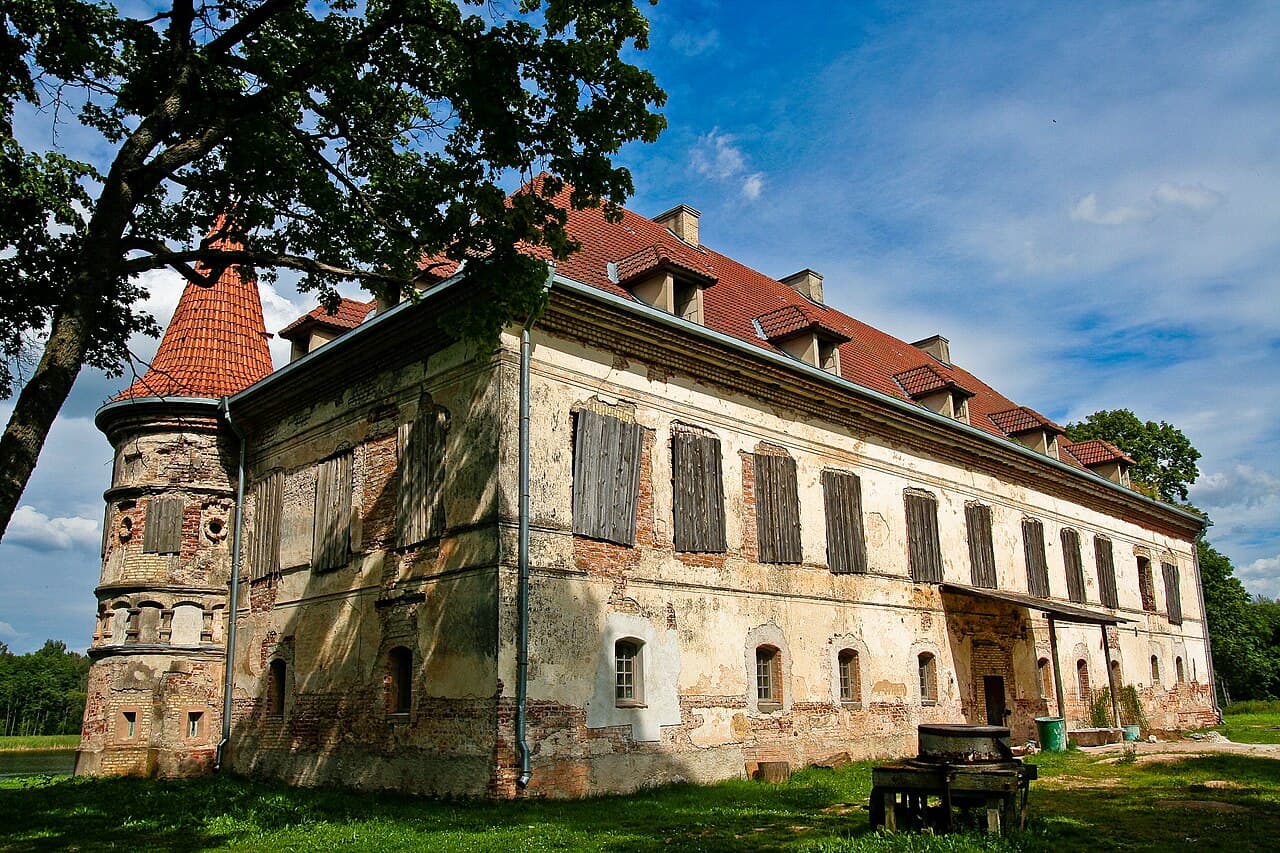
Siesikai Castle was originally constructed as a two-story rectangular stone palace with four corner towers, though only two towers remain today: one cylindrical and one rectangular. The castle features a four-sided hipped roof covered with tiles, a design typical for efficient water drainage and protection against the elements.
Between 1820 and 1845, under the direction of Dominykas Daugėla, the castle underwent extensive renovations that introduced neoclassical architectural elements. These modifications included the removal of one of the original cylindrical towers and the addition of auxiliary buildings such as a stable, granary, and the distinctive "Academy" building constructed in 1904. The Academy served as a school and lodging for children, teachers, and guests associated with the Daugėla family.
The castle was surrounded by substantial defenses, including moats on three sides linked to Siesikai Lake, integrating natural water sources into its fortifications. The estate grounds once encompassed a large park of about 10 hectares in the 17th and 18th centuries, later reduced to approximately 3 hectares along the lakeshore. The park included functional estate buildings such as a distillery, barn, birdhouse, and servants’ quarters, forming a comprehensive noble estate complex.
Cultural significance and interior treasures
The interior of Siesikai Castle was notable for its rich collection of artifacts, reflecting the cultural heritage of the Lithuanian nobility. The castle housed artworks depicting Lithuanian pagan gods such as Perkūnas (god of thunder), Patrimpas (associated with spring waters), and Pikulas (linked to the underworld), alongside sculptures of sacred animals. These pagan elements were preserved within a temple on the estate grounds until the outbreak of the First World War.
The Daugėla family’s library was extensive, containing approximately 5,000 volumes by 1914, alongside valuable collections of manuscripts, coins, porcelain, silver items, archaeological finds, and weaponry. This cultural richness underscored the castle’s role not only as a defensive residence but also as a center of heritage and learning.
Impact of wars and modern usage
The First World War inflicted severe losses on the castle’s archives and art collections, many of which were destroyed or dispersed. After 1940, valuables were looted or relocated, further diminishing the estate’s original treasures. During the Soviet era, the castle was repurposed for various public functions, including operating as a seven-year school (1946–1952), collective farm offices, a cinema, and housing for farm workers. These adaptations contributed to the castle’s physical decline, leading to abandonment after 1972.
Restoration efforts and current status
Since 1990, restoration initiatives have focused on preserving and reviving the castle’s Renaissance character. Architect Gražina Kirdeikienė has played a pivotal role in studying and restoring the site, aiming to reconstruct the original layout and architectural features. Restoration has included work on the first floor, the distillery building, and the surrounding parkland.
In 2018, stewardship of the estate was transferred to the Ukmergė district municipality, which entrusted the Ukmergė Regional Museum with its care in 2019. Plans are underway to establish a museum branch within the castle, enhancing public access and educational opportunities.
Architectural remains and landscape features
Today, Siesikai Castle retains two of its original towers: a cylindrical corner tower and a rectangular tower. The moats remain a defining feature, connected to the lake and emphasizing the castle’s strategic use of natural defenses. The neoclassical auxiliary buildings, including the "Academy," stable, and granary, contribute to the estate’s architectural diversity.
The castle grounds continue to reflect the historical parkland layout, though diminished in size, and include remnants of estate buildings that illustrate the daily life and operations of a noble household. The presence of seven cannons near the main building as late as 1939 highlights the castle’s enduring military heritage.
Frequently asked questions (FAQ)
- How do I visit Siesikai Castle?
- Siesikai Castle is located in the Ukmergė district of Lithuania near Siesikai Lake. Visitors should check with the Ukmergė Regional Museum for current opening hours and any guided tours available. The castle grounds and parkland are accessible for exploration, offering a glimpse into Lithuanian Renaissance architecture.
- What is the historical significance of Siesikai Castle?
- Siesikai Castle is a notable example of a Renaissance noble residence in Lithuania, built in the early 16th century by the Daumantas-Siesickis family. It played a key role in regional defense and cultural heritage, housing important collections of artifacts and pagan religious symbols until the early 20th century.
- When was Siesikai Castle built and who built it?
- The castle was constructed around 1517 by Gabrielius Daumantas-Siesickis, a member of the Lithuanian nobility. It reflects Renaissance architectural style and was designed as a fortified residential estate near Siesikai Lake.
- Can I see the original towers of Siesikai Castle?
- Yes, two of the original four towers remain standing today: one cylindrical and one rectangular. These towers are key features of the castle’s Renaissance defensive design and can be viewed by visitors exploring the site.
- Why is Siesikai Castle important architecturally?
- Siesikai Castle exemplifies Renaissance architecture in Lithuania, combining defensive features like moats and towers with residential elegance. Its later neoclassical renovations add to its architectural significance, illustrating the evolution of noble estates over centuries.
Photo gallery

Information
Sources & official resources
Verify the information above using these authoritative references.
Loading map...
Visitor reviews
No reviews yet. Been here? Write the first review and help other travelers!
Write the first reviewVisited this castle? Share your experience
Your review helps other travelers and adds first-hand knowledge to our encyclopedia.