Shlisselburg Fortress
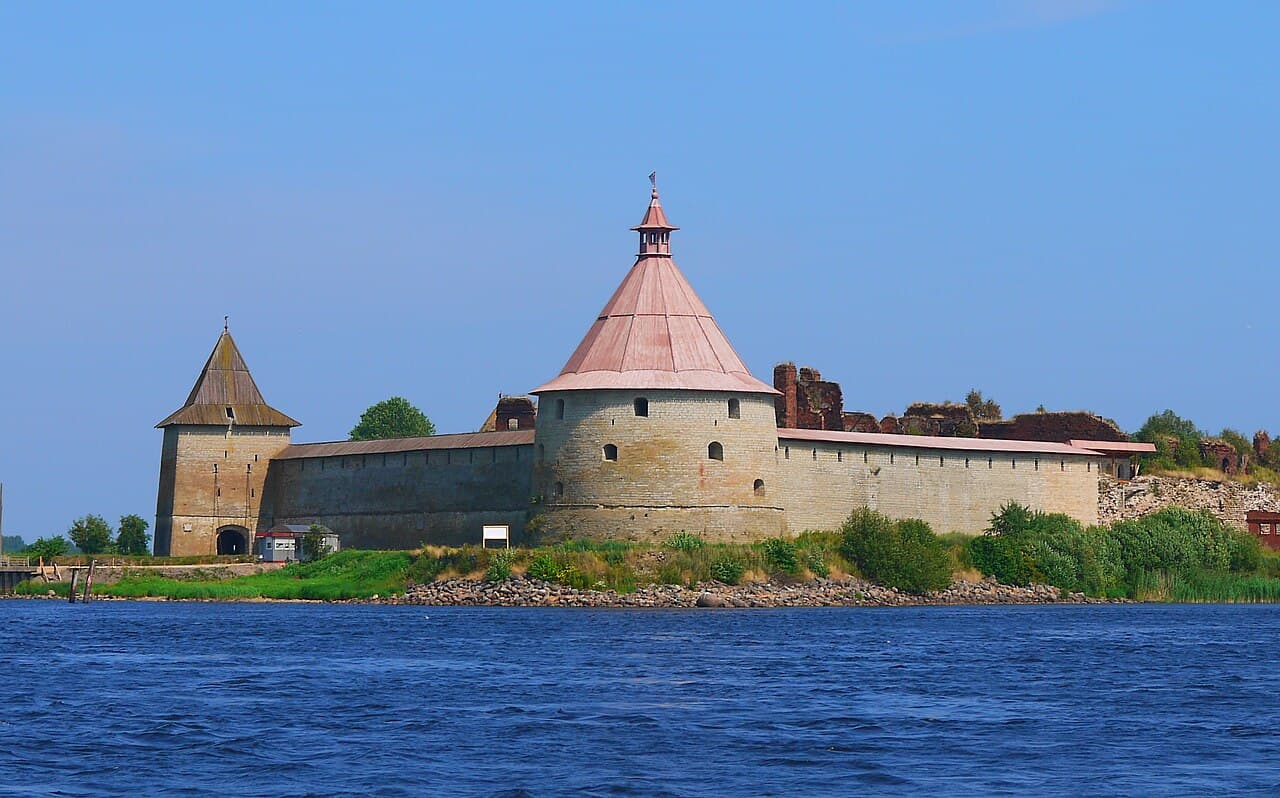
Shlisselburg Fortress, originally known as Schlüsselburg or Nöteborg, is a historically significant bastioned fortress located at the head of the Neva River on Lake Ladoga in northwest Russia. Its strategic position guarding the access to the Baltic Sea made it a focal point of military and political conflicts from the High Medieval period through modern times. Today, the fortress and its surrounding city center are recognized as UNESCO World Heritage Sites, preserving centuries of turbulent history.
Early history and medieval origins
The first fortification on the site was erected by the Swedes in 1299, marking the beginning of a contested border region between Sweden and the Novgorod Republic. The fortress was initially called Schlüsselburg, meaning "key fortress" in German, indicative of its controlling position over the water routes. However, the Swedes lost control of the fortress to the Novgorodians in 1301.
In 1323, following the Treaty of Nöteborg, the Novgorod Republic, under the leadership of Grand Prince Yury of Moscow acting as Prince of Novgorod, constructed a wooden fortress named Oreshek on the island. This fortress guarded the northern approaches to Novgorod and was crucial in controlling access to the Baltic Sea. The 1323 treaty was significant as the first formal agreement delineating the border between Eastern and Western Christianity in the region, running through present-day Finland. A modern stone monument commemorates this treaty near the Church of St. John within the fortress grounds.
Conflicts and reconstruction in the 14th century
During the crusades in the Baltic region, King Magnus Eriksson of Sweden briefly captured the fortress between 1348 and 1352. The Novgorodians regained control in 1351, finding the fortress largely ruined. In response, Archbishop Vasilii Kalika of Novgorod initiated a significant reconstruction, rebuilding the fortress in stone in 1352. This reconstruction marked the transition from wooden fortifications to robust stone walls, enhancing the fortress's defensive capabilities. Excavations in 1969 uncovered remnants of these 14th-century walls, which remain visible near the Church of St. John.
Shifting control and strategic importance
Throughout the following centuries, the fortress changed hands multiple times, reflecting the ongoing struggle for regional dominance. In 1611, during the Ingrian War, Swedish forces captured the fortress, renaming it Nöteborg and establishing it as the center of the north-Ingrian Nöteborg county within the Swedish Empire.
The fortress's strategic value was reaffirmed during the Great Northern War when Russian forces under Peter the Great recaptured it in 1702 after a costly amphibious assault. Despite heavy Russian casualties, the victory was pivotal, and the fortress was renamed Shlisselburg, a Russian transcription of Schlüsselburg. Peter the Great regarded the fortress as the "key to Ingria," underscoring its importance in controlling access to the Baltic Sea and the Neva River.
Imperial era and use as a political prison
During the period of Imperial Russia, Shlisselburg Fortress was repurposed as a notorious political prison. It housed several prominent prisoners, including Wilhelm Küchelbecker, Mikhail Bakunin, and Walerian Łukasiński, who was imprisoned there for 38 years. The fortress is also known as the site where Ivan VI of Russia was murdered in 1764 and where Aleksandr Ulyanov, Lenin's brother, was executed.
Out of the original ten defensive towers, six remain today—five constructed by the Russians and one from the Swedish period. The fortress's church ruins have been transformed into a memorial dedicated to its defenders, preserving the memory of those who fought and suffered within its walls.
20th century to present day: war damage and cultural significance
During World War II, Shlisselburg Fortress endured heavy damage as it was a strategic point in the Siege of Leningrad. Despite the destruction, the fortress remains a symbol of resilience and historical continuity.
Today, the fortress hosts an annual rock concert since 2003, blending cultural events with its historical ambiance. It also contains a museum dedicated to the political prisoners of the Russian Empire, alongside a small collection of World War II artillery pieces, offering visitors insights into its multifaceted past.
Architectural features and layout
Shlisselburg Fortress exemplifies bastioned fortress design, characterized by angular bastions projecting from the curtain walls, allowing defenders to cover adjacent walls with gunfire. The fortress's stone walls and towers reflect the evolution of military architecture from medieval stone masonry to adaptations for artillery defense.
The surviving towers vary in origin, with the Swedish-built tower representing the earlier medieval phase, and the Russian towers showcasing later fortification styles. The fortress's location on Orekhovy Island in Lake Ladoga provided natural defense advantages, supplemented by moats and ramparts.
Visitor information and cultural heritage
Visitors to Shlisselburg Fortress can explore the extensive ruins, the memorial church, and the museum exhibits that narrate the fortress's complex history. Its designation as part of the Historic Centre of Saint Petersburg and Related Groups of Monuments underscores its cultural and historical value.
The fortress's combination of military, political, and cultural history makes it a unique site for understanding the dynamics of Russian and Baltic regional history over several centuries.
Frequently asked questions (FAQ)
- How do I get to Shlisselburg Fortress?
- Shlisselburg Fortress is located on Orekhovy Island near the city of Shlisselburg in Leningrad Oblast, Russia. Visitors can reach it by boat from the mainland or by road to the city followed by a short ferry ride to the island.
- What is the historical significance of Shlisselburg Fortress?
- Shlisselburg Fortress played a crucial role in controlling access to the Baltic Sea and the Neva River, serving as a strategic military and political site from the 13th century through Imperial Russia. It was also used as a political prison for notable figures.
- When was the fortress rebuilt in stone?
- The fortress was rebuilt in stone in 1352 under Archbishop Vasilii Kalika of Novgorod, marking a transition from wooden to stone fortifications to improve defense capabilities.
- Can I visit the museum inside the fortress?
- Yes, the fortress houses a museum dedicated to political prisoners of the Russian Empire and displays World War II artillery. It is open to visitors during regular opening hours.
- What are the visiting hours and ticket prices?
- Visiting hours and ticket prices may vary seasonally. It is recommended to check with the official site or local tourist information for current details before planning your visit.
Photo gallery

Information
Current owner
State museum
Loading map...
Visitor reviews
No reviews yet. Been here? Write the first review and help other travelers!
Write the first reviewVisited this castle? Share your experience
Your review helps other travelers and adds first-hand knowledge to our encyclopedia.