Saint Michael's Castle
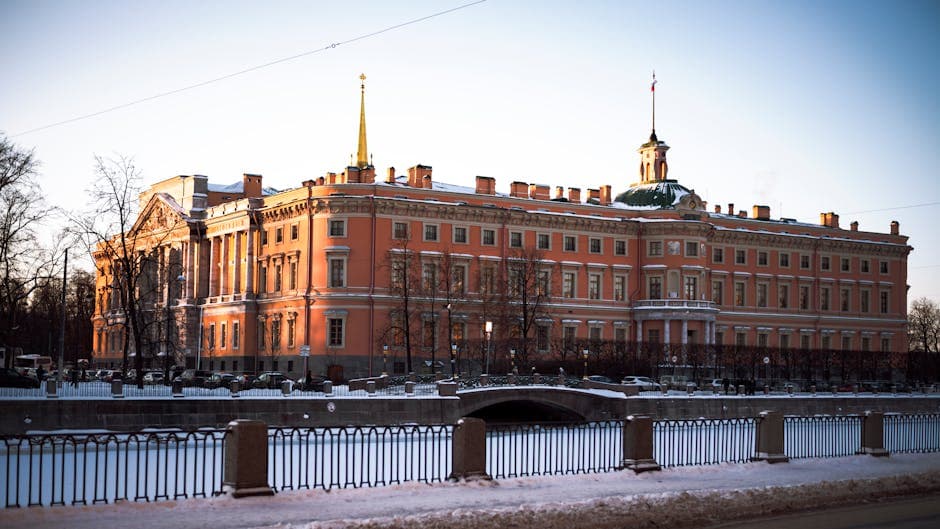
Saint Michael's Castle, also known as Mikhailovsky Castle, stands as a unique architectural monument in the heart of Saint Petersburg, Russia. Constructed between 1797 and 1801 by order of Emperor Paul I, this former royal residence reflects the emperor's personal tastes, fears, and aspirations. Unlike traditional palaces, the castle was designed as a fortified residence, embodying a blend of French Classicism, Italian Renaissance, and Gothic architectural styles. Its location south of the Summer Garden and its transformation into an artificial island surrounded by the Moika and Fontanka rivers, along with two canals, emphasize its fortress-like character.
The historical context and imperial vision
The site of Saint Michael's Castle holds deep historical significance. Originally, it was the location of Peter the Great's Summer Palace, one of the earliest royal residences in Saint Petersburg, built in 1711. This wooden palace was replaced during Empress Elizabeth Petrovna's reign, and it was in this earlier palace that Paul I was born in 1754 and where his mother was proclaimed empress in 1762. Paul I's decision to build a new residence on this site was influenced by his desire for security and his fascination with medieval chivalry, as well as his distrust of the Winter Palace, where he felt vulnerable to assassination plots.
Paul personally conceived the idea of the castle as early as 1784, making initial sketches. After ascending to the throne in 1796, he commissioned the construction, initially entrusting architect Vasily Bazhenov, who was soon replaced by the Italian architect Vincenzo Brenna. Brenna oversaw both the construction and the lavish interior decoration, working with a large workforce of up to 6,000 laborers to complete the project rapidly. The castle was solemnly consecrated on November 8, 1800, the feast day of Archangel Michael, to whom the castle's chapel is dedicated. This dedication is linked to a legend that Paul experienced a vision of Archangel Michael inspiring the castle's construction, symbolizing protection and divine favor. The castle's design also reflects Paul's role as Grand Master of the Knights of Malta, incorporating chivalric symbolism throughout.
Architectural design and fortress features
Saint Michael's Castle's architecture is notable for its eclectic mix of styles and its fortress-like layout. The building is square with rounded corners and encloses a small octagonal courtyard at its center. This courtyard serves as a ceremonial space and is a distinctive geometric feature. The castle was surrounded by water on all sides, created by the Moika River, the Fontanka River, and two artificial canals: the Church Canal and the Resurrection Canal. These waterways formed an artificial island accessible only by drawbridges, enhancing the castle's defensive character.
The castle's defensive features include bastions and artillery placements, unusual for a royal residence, reflecting Paul's military interests and his fear of assassination. The chapel's gilded spire, topped with a Maltese cross, symbolizes Paul's connection to the Knights of Malta. The southern façade, facing the main approach, is grand and imposing, featuring a high podium with a portico supported by pairs of Ionic red marble columns. Sculpted pediments and attic zones include statues of apostles Peter and Paul by Paolo Triscorni. Flanking obelisks bear Roman military armor motifs and Paul's monograms, while a relief by P. Staggi depicts "History inscribing the glory of Russia."
The northern façade overlooks the Summer Garden and features a wide staircase leading to a Tuscan marble colonnade loggia, adorned with statues of Hercules and Flora from the Farnese collection. The western façade, known as the church façade, is richly decorated with stucco cornices and allegorical sculptures representing Faith and Hope. White Carrara marble medallions of the four Evangelists, originally set in the third-floor windows, are now displayed inside the chapel.
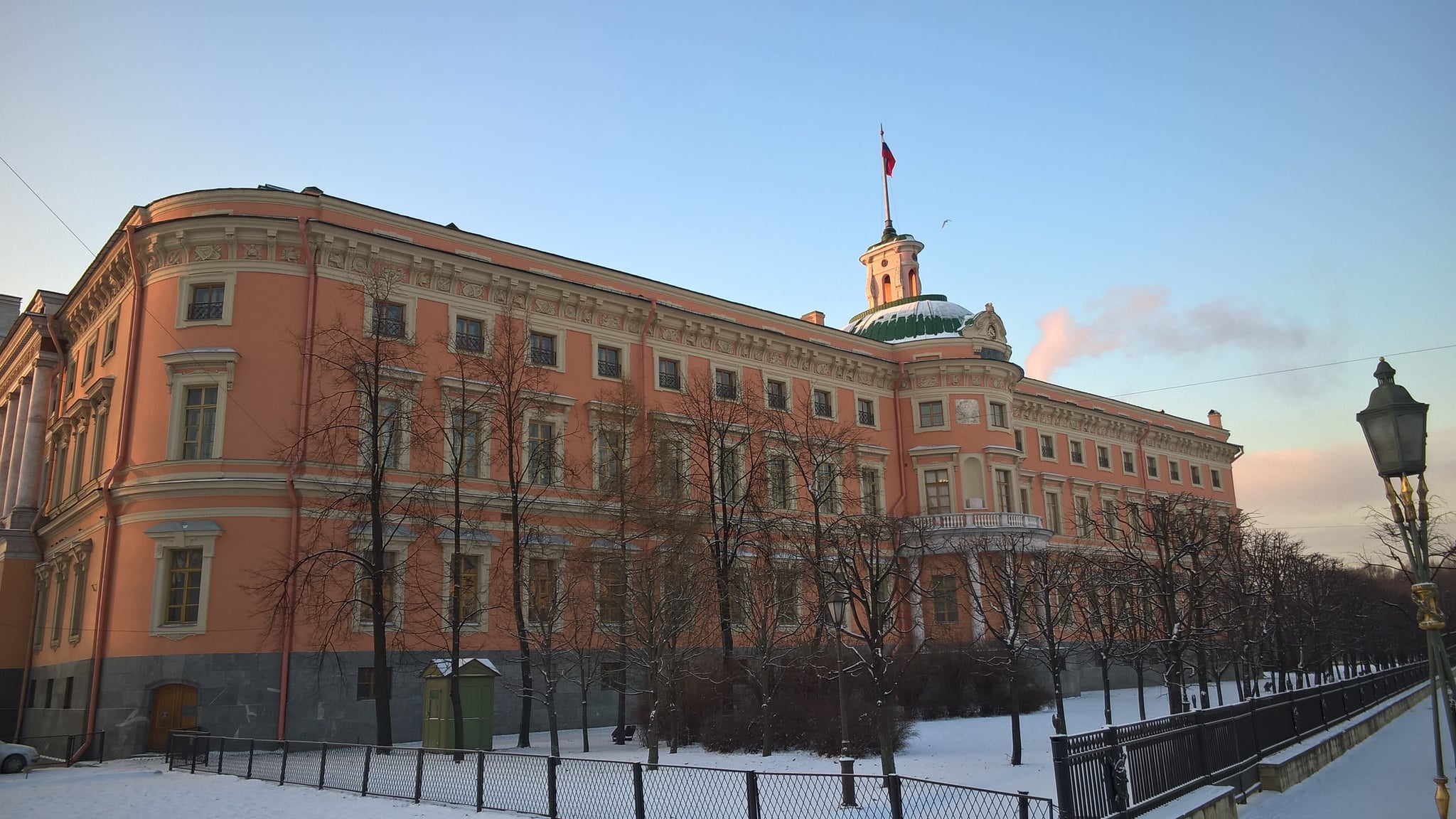
Photo by Villeke1 • CC0
Interior decoration and notable rooms
The castle's interiors are lavishly decorated with various marbles, gilded bronze fittings, and paintings by prominent artists such as Karl Scotti, Antonio Vigi, Franz Smuglewicz, and Johann Mettenleiter. Christian and Maltese symbols are prominent, especially in the chapel and ceremonial halls, reinforcing the castle's spiritual and chivalric themes.
Key rooms include the Resurrection Hall, which served as a formal reception area and where Paul I's body lay in state after his assassination. The Large Throne Hall hosted official ceremonies and was later adapted as a library and archive. The Oval Hall features an elliptical dome painted with Olympian gods by Antonio Vigi, supported by Ionic half-columns decorated with caryatids.
The Georgievsky Hall, or Marble Gallery, displays multicolored marble walls and three white marble fireplaces inlaid with lapis lazuli and jasper. Its gilded bronze details and antique sculptures reflect later 19th and 20th-century modifications, with restoration efforts in the 1950s and early 21st century.
The Small Throne Hall, also called the Maltese Throne, is a circular chamber with a vaulted ceiling painted by Carlo Scotti. Its crimson velvet walls embroidered with gold thread and colossal atlantes supporting the ceiling create a regal atmosphere. Lighting is provided by a large silver chandelier and ornate wall sconces.
The dining hall of Empress Maria Feodorovna opens onto a terrace overlooking the Summer Garden and hosted family meals and concerts. Adjacent rooms include a throne room with crimson velvet décor and a ceiling painting of the "Judgment of Paris" by Jacob Mettenleiter, restored in the early 2000s, and an opulent bedroom with artificial marble, gilded mirrors, crystal chandeliers, and a canopy bed adorned with ostrich feathers.
Engineering and preservation
The castle's foundations are a remarkable example of engineering, resting on a rubble masonry slab 2.1 to 3.9 meters thick, supported by a field of wooden piles driven 6.4 to 10.7 meters into the marshy ground. Two rows of conifer trunks form a timber grillage beneath the slab, providing stability. Maintaining the surrounding water levels is critical to preserving these wooden supports and preventing structural deterioration.
Originally, the castle complex included additional structures such as the Resurrection Canal (partially restored today), the Three-Part Bridge at the main entrance, the Hornwork fortification with a monument to Peter the Great (now relocated to Peter the Great Square), Maple Street, and two guard pavilions. Monuments on the site include the 1800 bronze statue of Peter I with bas-reliefs of the battles of Poltava and Gangut, and a 2003 monument to Paul I by sculptor V. Gorevoy.
The castle's original exterior color was a distinctive pinkish-orange-yellow, revealed beneath later brick-red paint during restoration. Legend attributes this hue to Paul I's affection for Anna Lopukhina, his favorite, whose glove supposedly inspired the color choice.
Later history and current use
After Paul I's assassination in March 1801, the imperial family abandoned Saint Michael's Castle, returning to the Winter Palace. In 1819, the castle became home to the Main Engineering School, earning the nickname "Engineers' Castle." Throughout the 19th and early 20th centuries, it housed various military and technical educational institutions, including the Nikolaev Engineering Academy. Notably, the famed Russian writer Fyodor Dostoyevsky studied there as a cadet between 1838 and 1843.
During World War II, the castle suffered damage from bombings and was repurposed as a hospital. Post-war, it served as headquarters and offices for scientific and technical organizations during the Soviet era.
From 1991, the castle was gradually incorporated into the State Russian Museum complex, with full museum administration established by 1994, except for the naval library. Restoration efforts were intensified ahead of Saint Petersburg's 300th anniversary, culminating in the castle's reopening as a museum in 2003. Today, it houses the Portrait Gallery of the Russian Museum, featuring official portraits of Russian emperors, empresses, dignitaries, and celebrities from the late 17th to early 20th centuries.
The chapel dedicated to Archangel Michael was closed in 1918 during political upheaval and repurposed for storage and offices. Restoration began in the late 20th century, and it reopened as a museum space in 1991, with limited religious services resuming from 1993. The chapel was formally reconsecrated in 2019, reinstating its spiritual function alongside its cultural role.
Legends and cultural significance
Saint Michael's Castle is enveloped in local legends and folklore. One enduring tale recounts Emperor Paul I's visionary encounter with Archangel Michael, which inspired the castle's construction. Another legend speaks of the emperor's ghost haunting the castle grounds, a spectral reminder of the tragic assassination that ended his reign. These stories contribute to the castle's mystique and cultural resonance in Saint Petersburg.
Architecturally, the castle is often described as "costume architecture," a term reflecting its eclectic stylistic fusion and the personal tastes of Paul I. It stands as a testament to a turbulent period in Russian history, combining royal ambition, military symbolism, and artistic refinement in a singular, evocative monument.
Frequently asked questions (FAQ)
- What is the historical significance of Saint Michael's Castle?
- Saint Michael's Castle, built in the late 18th century, is a remarkable example of neoclassical architecture and holds great historical significance as it was commissioned by Emperor Paul I. It served as a royal residence and is known for its tragic association with the emperor's assassination, which took place shortly after its completion.
- When is the best time to visit Saint Michael's Castle?
- The best time to visit Saint Michael's Castle is during the late spring and summer months, from May to September, when the weather is typically mild and conducive for exploring the outdoor gardens and surrounding areas. Additionally, this period often features special events and exhibitions that enhance the visitor experience.
- What are the opening hours of Saint Michael's Castle?
- Saint Michael's Castle is generally open to visitors from 10 AM to 6 PM, with the last admission at 5 PM. However, it is advisable to check the official website for any changes to the schedule or special holiday hours.
- Can I access Saint Michael's Castle with a wheelchair?
- Yes, Saint Michael's Castle is equipped with facilities to accommodate visitors with mobility challenges. Ramps and accessible paths are available, ensuring that everyone can enjoy the castle's rich history and stunning architecture.
- What are the ticket prices for visiting Saint Michael's Castle?
- Ticket prices for Saint Michael's Castle vary depending on age and status, with discounts available for students and seniors. As of the latest updates, general admission typically ranges from 300 to 500 rubles, but it's best to verify current prices on the official site before your visit.
- Are there any nearby attractions to visit after exploring the castle?
- Yes, after visiting Saint Michael's Castle, you can explore several nearby attractions such as the Summer Garden, the Russian Museum, and the Church of the Savior on Spilled Blood. Each of these sites offers a unique glimpse into the cultural and historical richness of Saint Petersburg.
- How do I get to Saint Michael's Castle?
- Saint Michael's Castle is easily accessible by public transportation, with several bus and metro stops located nearby. Visitors can take the metro to the Nevsky Prospekt station and then enjoy a short walk to the castle, which is centrally located in the city.
- Is it possible to take guided tours of Saint Michael's Castle?
- Yes, guided tours of Saint Michael's Castle are available and offer an enriching experience as knowledgeable guides share insights into the castle's history, architecture, and significance. Tours can be arranged in multiple languages and are recommended for those who wish to deepen their understanding of this historic site.
Photo gallery

Photo by Vitali Adutskevich


Information
Loading map...
Visitor reviews
No reviews yet. Been here? Write the first review and help other travelers!
Write the first reviewVisited this castle? Share your experience
Your review helps other travelers and adds first-hand knowledge to our encyclopedia.