Sheriff Hutton Castle
Sheriff Hutton Castle stands as a significant medieval fortress located in the village of Sheriff Hutton, North Yorkshire, England. This castle, with its origins rooted in the early English Middle Ages, offers a vivid glimpse into the architectural and historical evolution of English noble residences and military fortifications. Nestled within the historic royal Forest of Galtres, the site has witnessed centuries of strategic importance, noble ownership, and political intrigue, particularly during the turbulent period of the Wars of the Roses.
Early origins and medieval foundations
The earliest fortification at Sheriff Hutton was a motte and bailey castle established during the reign of King Stephen, approximately between 1135 and 1154. This initial structure was commissioned by Bertram de Bulmer, who held the office of Sheriff of York. The motte and bailey design, typical of early medieval military architecture, consisted of a raised earthwork (the motte) topped with a wooden or stone keep, accompanied by an enclosed courtyard (the bailey) protected by palisades and ditches. This form of castle was favored for its rapid construction and defensive capabilities in a period marked by frequent local conflicts and shifting allegiances.
The neville family's transformative influence
By the late 14th century, Sheriff Hutton Castle underwent a major transformation under the auspices of John, Lord Neville. Around 1380, John Neville replaced the earlier timber fortifications with a substantial stone quadrangular castle, featuring four rectangular towers at each corner enclosing a central courtyard. This design was emblematic of the period's shift towards more durable and imposing stone castles that combined residential comfort with defensive strength.
In 1377, John Neville secured royal permission to hold a weekly market and an annual fair at Sheriff Hutton, enhancing the castle's status as a local economic and social hub. The granting of a license to crenellate by King Richard II in 1382 further authorized the addition of battlements, which not only improved the castle's defenses but also served as a symbol of noble prestige and royal favor.
Architectural features of the quadrangular castle
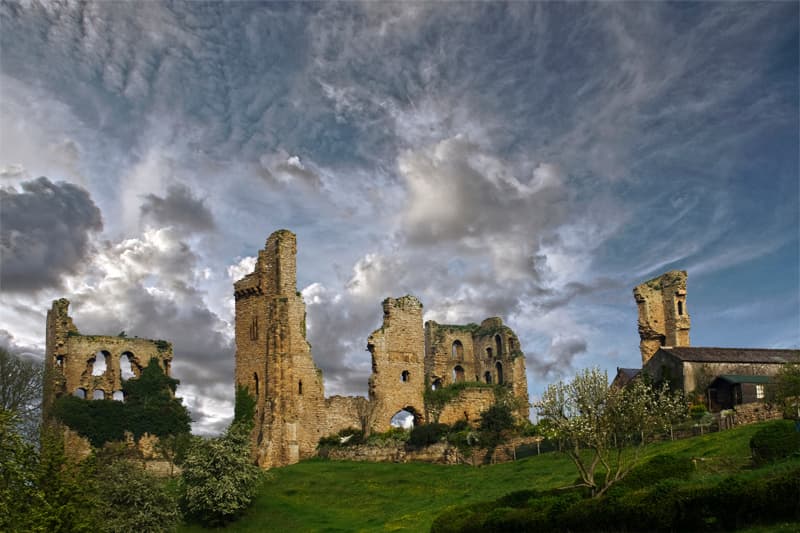
The castle's quadrangular layout is defined by straight curtain walls on the north and west sides, while the south and east walls feature distinctive obtuse, outward-pointing angles at their midpoints. Each corner is anchored by a rectangular tower, although today only fragments of these towers remain to their original height. The walls and towers were constructed primarily of rubble mudstone, faced with finely dressed sandstone from nearby Terrington, demonstrating the use of local materials and skilled masonry techniques.
The main entrance to the castle was through a fortified gatehouse located in the east wall, designed to control access and provide a strong defensive position. The castle originally included two additional enclosed wards beyond the inner courtyard: a middle ward and an outer ward, which offered extra layers of defense and space for domestic and administrative functions. These outer wards have since been lost beneath a modern farmyard adjacent to the surviving ruins.
Historical significance and noble ownership
Throughout its history, Sheriff Hutton Castle was closely associated with some of the most powerful noble families in northern England. After the Nevilles, ownership passed to notable figures such as Ralph Neville, 1st Earl of Westmorland, and Richard Neville, 5th Earl of Salisbury. The castle gained particular prominence under Richard Neville, 16th Earl of Warwick, famously known as "Warwick the Kingmaker," who played a pivotal role in the Wars of the Roses, a series of dynastic conflicts that shaped late medieval England.
Following Warwick's death at the Battle of Barnet in 1471, Sheriff Hutton Castle came into the possession of Richard, Duke of Gloucester, later crowned King Richard III. Due to its strategic location near York, the castle served as a residence and administrative center for Richard in his capacity as Lord of the North.
The council of the north and royal residence
In 1484, King Richard III established a royal household at Sheriff Hutton Castle for his niece, Elizabeth of York, and other noble captives, underscoring the castle's role as a secure noble residence. Around the same time, he founded the Council of the North, a regional governing body that administered northern England with headquarters at Sheriff Hutton and Sandal Castle. This council continued to function for approximately 150 years, highlighting the castle's enduring administrative importance.
During the lead-up to the Battle of Bosworth in 1485, Richard III used Sheriff Hutton Castle as a refuge for Elizabeth of York and other high-status prisoners. After Richard's defeat and death at Bosworth, the castle passed to the new Tudor monarch, Henry VII.
Later history and decline
In the late 15th and early 16th centuries, Sheriff Hutton Castle was occupied by the influential Howard family. Thomas Howard, 2nd Duke of Norfolk, served as constable and undertook repairs in 1537, although a 1525 survey had already noted the need for maintenance. The castle also housed Henry Fitzroy, Henry VIII's illegitimate son, reflecting its continued use as a noble residence.
However, the castle's significance diminished after the Council of the North moved its headquarters to York in the mid-16th century. Despite repair efforts by Henry Hastings, 3rd Earl of Huntingdon, in 1572, by 1618 the castle was officially described as ruinous. The Ingram family acquired the property in 1622 and repurposed much of the stone for local building projects, accelerating the castle's decay.
By the early 20th century, the site functioned as a farmyard, and the castle remained in private hands. Recognition of its historical and architectural value led to its designation as a scheduled ancient monument in the 1950s. Subsequent preservation efforts by English Heritage have helped stabilize the ruins, safeguarding them for future generations.
Architectural remains and heritage status
Today, Sheriff Hutton Castle survives as a large stone fortress characterized by its quadrangular plan with four corner towers and enclosing curtain walls. While the curtain walls and ranges of buildings that once connected the towers have largely disappeared, the remaining fragments reveal the castle's original grandeur and defensive sophistication.
The castle's construction materials, including rubble mudstone and locally sourced sandstone, highlight regional building practices of the late medieval period. The site is officially recognized as a Grade II* listed building, underscoring its special architectural and historic interest. Preservation work by English Heritage has ensured the stability of the surviving structures, which continue to attract interest from historians, archaeologists, and visitors fascinated by England's medieval past.
Photo gallery

Information
Website
Visit websiteSources & official resources
Verify the information above using these authoritative references.
Loading map...
Visitor reviews
No reviews yet. Been here? Write the first review and help other travelers!
Write the first reviewVisited this castle? Share your experience
Your review helps other travelers and adds first-hand knowledge to our encyclopedia.