Crayke Castle
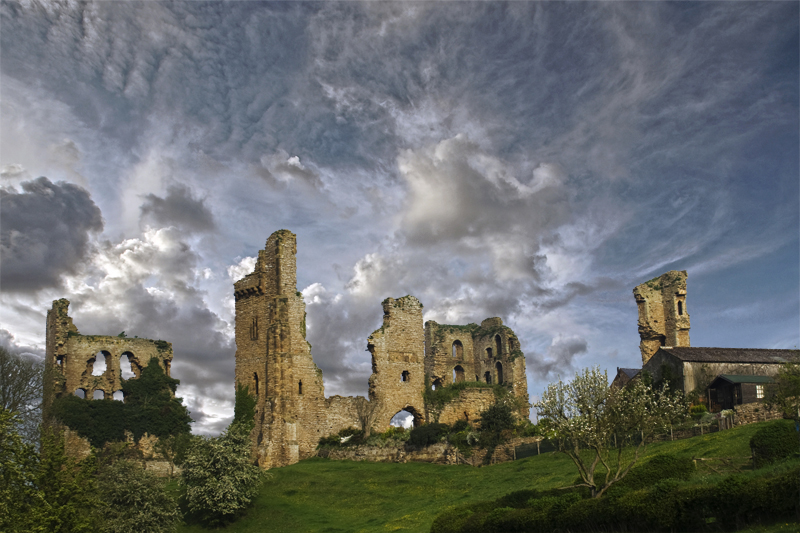
Crayke Castle stands prominently in the village of Crayke, North Yorkshire, England, occupying the highest point in the parish. This Norman hill castle was originally established shortly after the Norman Conquest, serving both strategic and residential purposes. Its location atop a natural elevation provided commanding views of the surrounding landscape, an essential feature for medieval fortifications.
Early history and ecclesiastical origins
The castle's origins are closely tied to the Norman conquest of England in the late 11th century. Documentary evidence indicates that a fortification existed on this site soon after 1066, with early links to Bishop Hugh Pudsey (Hugh de Puiset), a powerful 12th-century Bishop of Durham who played a significant role in the region's ecclesiastical and political affairs. The land had been under the ownership of the See of Durham since Saxon times, reflecting a long-standing religious association.
Archaeological investigations have revealed traces of a motte and bailey castle beneath the later stone structures. This early Norman fortification style featured a raised earthwork (motte) topped with a wooden or stone keep, accompanied by an enclosed courtyard (bailey). Such a design was typical for Norman castles established to consolidate control over newly conquered territories.
15th-century reconstruction and architectural features
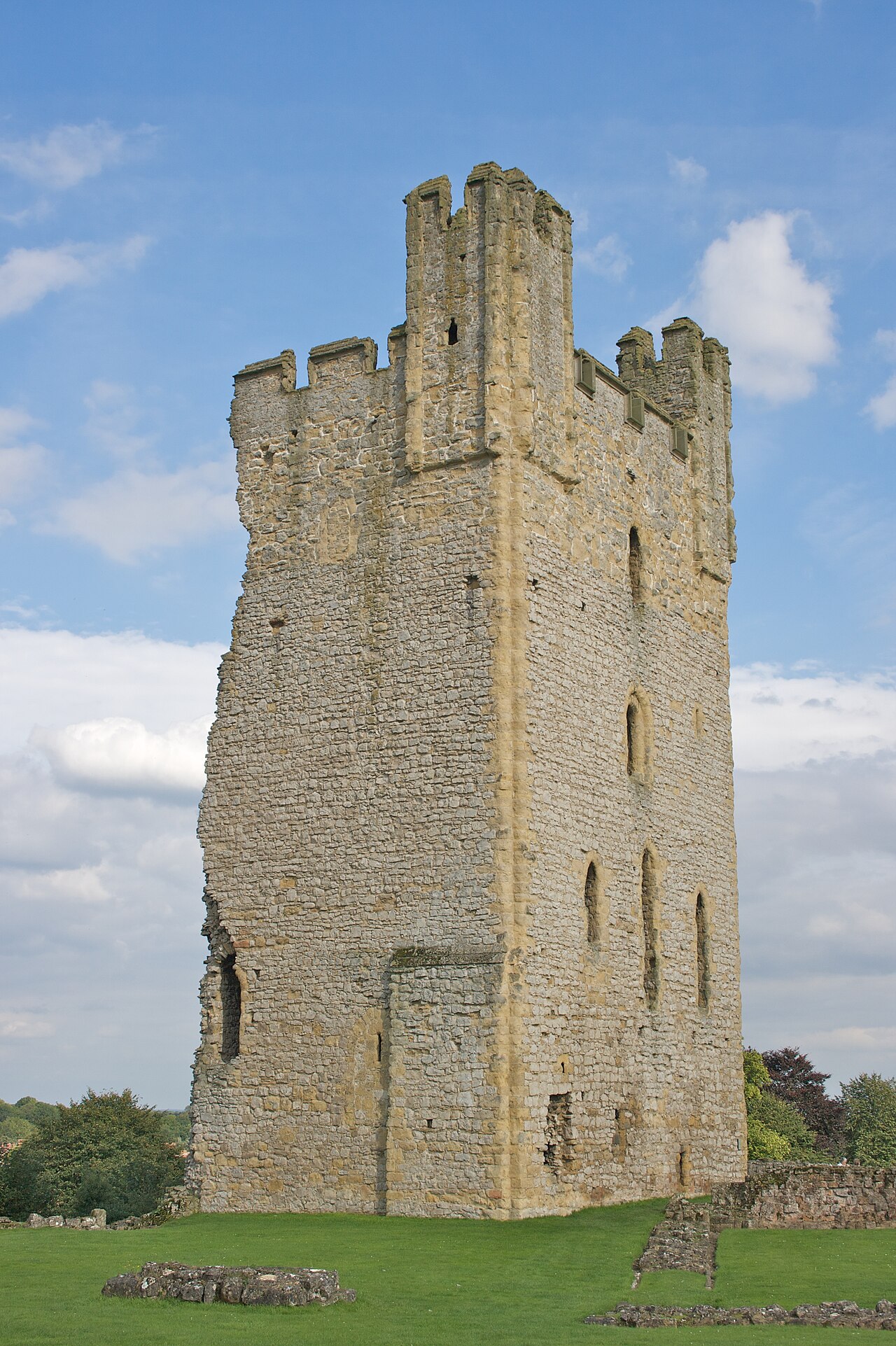
Around 1450, the castle underwent significant rebuilding under Robert Neville, Bishop of Durham. This period marked the construction of the main surviving structures, including a four-storey rectangular tower house made of stone, which forms the centerpiece of the castle today. The tower measures approximately 70 feet 9 inches in length and 28 feet 4 inches in width, with each floor externally marked by projecting stone bands. The narrow, square-headed windows reflect the defensive architectural style of the late medieval period.
The tower is crowned with a crenellated parapet, providing battlements for defense. Originally, the main entrance was accessed via an external staircase on the northeast side leading to the first floor, a typical feature in tower houses to enhance security. This staircase has since been removed, and the entrance relocated to ground level on the south side.
Attached to the rear of the tower is a vaulted undercroft, part of a kitchen extension dating from the 19th century. Behind this lies the foundations of the former great hall, a central space used for gatherings and administration during the medieval period. These remains offer valuable insight into the domestic arrangements of the castle's inhabitants.
The new tower and defensive layout
To the northeast of the main tower stands the "New Tower," originally a three-storey structure from the 15th century, now surviving as a two-storey ruin. This tower has an L-shaped footprint, measuring about 49 feet in length and width. Its lower floor is built into the hillside, allowing the upper floor to open directly onto the summit, providing strategic defensive advantages and commanding views.
The surviving walls of the New Tower stand approximately 20 feet high, retaining a sense of the tower's original scale despite the absence of a roof. This structure, alongside the main tower, illustrates the castle's phased development and defensive design.
Medieval estate and deer park
During the medieval period, Crayke Castle was surrounded by a deer park, a feature that lasted until the reign of James I in the early 17th century. Deer parks were common among noble estates, serving both as hunting grounds and symbols of status. The presence of the park suggests the castle functioned not only as a military stronghold but also as a residence with recreational and economic purposes.
Impact of the english civil war and later ownership
The castle's strategic importance made it a target during the English Civil War. In 1647, the House of Commons ordered Crayke Castle to be dismantled to prevent its use as a military garrison. Parliamentary forces slighted the castle in 1648 during the siege of York, deliberately damaging it to reduce its defensive capabilities.
Later in 1648, ownership passed to Sir William Allanson, a former Mayor and Member of Parliament for York. His son, Charles Allanson, undertook restorations that largely shaped the castle's current form. By around 1667, the castle reverted to the See of Durham and was leased as a farmhouse for several decades, reflecting a shift away from military use.
In 1827, Bishop William van Mildert obtained parliamentary approval to sell the property, ending nearly a thousand years of ecclesiastical ownership. The castle was surveyed in the 19th century by Canon Raine for the Victorian Associated Architectural Societies, highlighting its recognized heritage value.
20th-century use and preservation
During World War II, Crayke Castle was repurposed as a barracks for the Women’s Land Army, demonstrating its continued adaptation to contemporary needs. The castle was formally listed as a Grade I historic building in 1952, acknowledging its architectural and historical significance.
In recent years, the castle was owned by Kevin Hollinrake, Member of Parliament for Thirsk and Malton since 2015, reflecting its status as a private residence with a rich historical legacy.
Archaeological findings and site layout
Excavations in 2005 uncovered evidence of a former monastic complex alongside the castle remains, indicating a layered history of religious and military use. The discovery of a gatehouse further emphasizes the site's fortified nature.
The castle occupies approximately six acres and includes two main 15th-century buildings. The primary tower house is well preserved, while the New Tower remains a ruin. The presence of a vaulted undercroft and foundations of the great hall provide insights into medieval domestic life and castle function.
Architectural significance
Crayke Castle exemplifies features typical of late medieval tower houses in northern England, combining defensive elements such as battlements and narrow windows with residential spaces. The castle’s evolution from a motte and bailey to a stone tower house reflects broader trends in castle architecture during the High to Late Medieval periods.
Frequently asked questions (FAQ)
- What is the historical significance of Crayke Castle?
- Crayke Castle is a remarkable example of medieval architecture and serves as a testament to the rich history of the region. Originally built in the 11th century, it played a crucial role in the defense of Northern England during conflicts, particularly the Wars of the Roses. Today, it stands as a cherished landmark that attracts history enthusiasts and tourists alike.
- When was Crayke Castle built?
- Crayke Castle was built in the early 11th century, making it one of the oldest castles in the United Kingdom. The castle has undergone various renovations and restorations over the centuries, reflecting the architectural styles and historical changes of each era.
- Can I visit Crayke Castle?
- Yes, Crayke Castle is open to visitors, allowing you to explore its historic grounds and enjoy the stunning views of the surrounding landscape. It is advisable to check the official website or local tourist information for specific visiting hours and any potential restrictions.
- What are the opening hours for Crayke Castle?
- Crayke Castle is typically open to visitors from 10 AM to 5 PM during the peak season, but hours may vary based on the time of year. It is recommended to confirm the current opening hours before planning your visit.
- Is Crayke Castle accessible for visitors with disabilities?
- Crayke Castle strives to be accessible to all visitors. However, due to its historic nature, some areas may have limitations. It is best to check in advance for specific accessibility options and facilities available on site.
- When is the best time to visit Crayke Castle?
- The best time to visit Crayke Castle is during the spring and summer months when the weather is pleasant and the gardens are in full bloom. This period also often features special events and guided tours that enhance the visitor experience.
- What are the ticket prices for Crayke Castle?
- Ticket prices for Crayke Castle vary based on age and type of visit, with discounts typically available for children, seniors, and groups. For the most accurate and up-to-date pricing information, it's advisable to visit the official website or contact the castle directly.
- Are there any nearby attractions to Crayke Castle?
- Yes, there are several nearby attractions that complement a visit to Crayke Castle, including the historic town of York, renowned for its architecture and cultural heritage. Additionally, the scenic North York Moors National Park is within a short drive, offering beautiful landscapes and hiking opportunities.
Information
Website
Visit websiteSources & official resources
Verify the information above using these authoritative references.
Loading map...
Visitor reviews
No reviews yet. Been here? Write the first review and help other travelers!
Write the first reviewVisited this castle? Share your experience
Your review helps other travelers and adds first-hand knowledge to our encyclopedia.