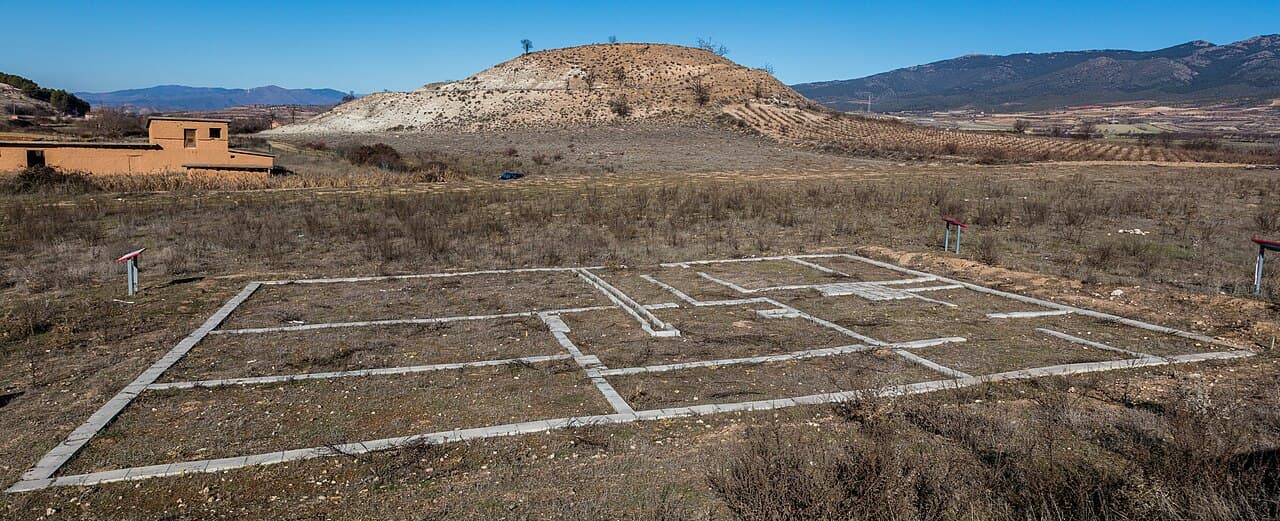
Segeda is an ancient archaeological site located between the modern towns of Belmonte de Gracián and Mara in the province of Zaragoza, Aragon, Spain. This site was originally a prominent Celtiberian town inhabited by the Belli tribe, who named it Sekeida or Sekeiza. The settlement is significant for its role during the Celtiberian Wars against Rome and its subsequent transformation under Roman influence.
Historical background and significance
The earliest known phase of Segeda corresponds to its existence as a Celtiberian oppidum, a fortified town typical of the Iron Age settlements in the Iberian Peninsula. The Belli people were one of the main Celtiberian tribes, and Segeda served as a political and military center for them. The settlement gained historical prominence during the mid-2nd century BC when it became a focal point in the conflict between the Celtiberians and the expanding Roman Republic.
According to Roman historical records, notably the Periochae of Livy, in 153 BC the Roman Senate altered the start of the consular year to January 1st specifically to enable the consul Quintus Fulvius Nobilior to launch a military campaign against Segeda. This strategic move underscores the importance of Segeda as a military target during the Celtiberian Wars.
The Roman assault led to the destruction of the original Celtiberian city. However, the inhabitants soon established a new settlement nearby, often referred to by archaeologists as Segeda II. This new town reflects the profound Roman influence in its urban planning, which contrasts with the organic layout typical of Celtiberian settlements.
Segeda II: Roman urban planning and architecture
Segeda II demonstrates a clear adoption of Roman town planning principles, notably the rectilinear street grid or orthogonal layout. This layout was a hallmark of Roman urbanism, designed for efficient organization, defense, and administration. The streets intersected at right angles, creating rectangular blocks or insulae, a pattern that facilitated movement and land division.
Archaeological excavations have revealed remains of fortification walls that likely protected the settlement, although these were adapted to the Roman military architectural standards rather than the earlier Celtiberian style. The presence of Roman-style public buildings and infrastructure such as water management systems is also suggested by the site’s layout and material culture.
The coinage discovered at Segeda II bears the same name as the original city, indicating continuity of identity despite cultural changes. This numismatic evidence also helps date the settlement and confirms its integration into the Roman economic sphere.
Decline and abandonment
Segeda II continued to exist into the period of the Roman Civil War in the 1st century BC. The turmoil of this era affected many Roman towns and settlements, and Segeda II was no exception. The site suffered damage and was ultimately ruined during these conflicts.
After 49 BC, Segeda II was permanently abandoned. The reasons likely include the political instability of the period, shifting trade routes, and the consolidation of Roman power in the region, which made smaller settlements less viable.
Modern archaeological investigations
Systematic archaeological excavations at Segeda began in 1998, bringing to light the extensive remains of both the original Celtiberian settlement and the later Roman town. These investigations have provided valuable insights into the Celtiberian culture, their resistance to Rome, and the process of Romanization in the Iberian Peninsula.
The site includes remnants of fortifications, street layouts, and artifacts such as pottery, tools, and coins, which collectively illustrate the transition from indigenous to Roman ways of life. Segeda is now recognized as an important cultural heritage site that sheds light on the complex interactions between native peoples and Roman conquerors.
Geographical and cultural context
Situated in the Ebro River basin, Segeda occupied a strategic position in northeastern Spain. The surrounding landscape features rolling hills and fertile plains, which supported agriculture and trade. Its location between modern Belmonte de Gracián and Mara places it within a region rich in archaeological sites linked to Celtiberian and Roman history.
Today, Segeda stands as an archaeological ruin open to researchers and visitors interested in ancient Iberian history. Its remains provide a tangible connection to the Iron Age and early Roman periods in Spain, offering a rare glimpse into the urban and military developments of the time.
Frequently asked questions (FAQ)
- How do I get to Segeda Castle?
- Segeda Castle is located in the beautiful region of Spain and can be accessed by car or public transportation. The nearest major city is Teruel, from which you can take a scenic drive or a local bus to reach the castle.
- What is the historical significance of Segeda Castle?
- Segeda Castle holds great historical importance as it was a strategic fortification during the medieval period. It played a key role in various battles and was a symbol of power and defense for the region.
- When was Segeda Castle built?
- Segeda Castle was constructed in the 11th century, showcasing the architectural styles of the time. Its construction reflects the need for defense mechanisms in the midst of territorial conflicts.
- Can I take guided tours of Segeda Castle?
- Yes, guided tours are available for visitors who want to learn more about the castle's history and architecture. These tours are led by knowledgeable guides who provide in-depth insights and stories about the site.
- Is Segeda Castle accessible for visitors with disabilities?
- The castle does have some accessibility features, but due to its historical nature, certain areas may be challenging to navigate. It is recommended to check with the visitor center for specific accessibility options before your visit.
- What is the best time to visit Segeda Castle?
- The best time to visit Segeda Castle is during the spring and fall when the weather is mild and pleasant. This allows for a comfortable experience while exploring the castle and its surroundings.
- Are there any nearby attractions to visit?
- Yes, there are several nearby attractions, including stunning natural parks and historical sites. Visitors can enjoy hiking trails, local museums, and other castles in the region that enhance the overall experience.
- What are the ticket prices for Segeda Castle?
- Ticket prices for Segeda Castle are quite reasonable, with discounts available for students and seniors. It's best to check the official website for the most current pricing and any special offers that may be available during your visit.
- What are the opening hours of Segeda Castle?
- Segeda Castle is typically open to visitors from 10 AM to 6 PM, with extended hours during the peak tourist season. However, it's advisable to verify the hours before your visit as they may vary based on the season or special events.
Photo gallery

Information
Loading map...
Visitor reviews
No reviews yet. Been here? Write the first review and help other travelers!
Write the first reviewVisited this castle? Share your experience
Your review helps other travelers and adds first-hand knowledge to our encyclopedia.


