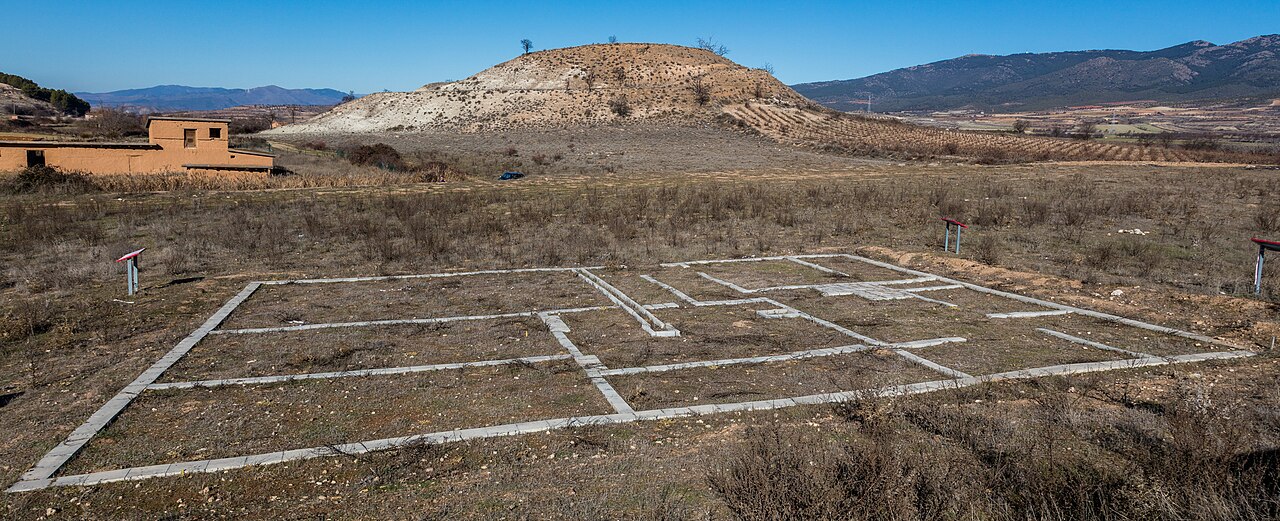
Castillo de Langa
The Castillo de Langa stands as a significant example of medieval military architecture in the region of Aragón, Spain. This hill castle occupies a commanding position atop a broad rocky plateau, overseeing the surrounding landscape and the nearby town of Langa del Castillo. Its strategic location reflects its primary function as a defensive stronghold during the turbulent Middle Ages, a period marked by frequent territorial disputes and shifting political alliances.
Constructed initially in the early 12th century, the castle first appears in historical records dating back to 1131. It was part of the jurisdiction of Calatayud and administratively belonged to the Comunidad de aldeas de Daroca, specifically within the district or sesma of Langa. This community was an association of villages that collectively managed local governance and defense, with the castle serving as both a military bulwark and a center for administrative activities.
Historical context and military significance
Throughout the Middle Ages, Castillo de Langa played a vital role in regional defense, especially during the 14th century, when tensions between the kingdoms of Aragón and Castile escalated. The castle's importance peaked during the War of the Two Peters (1356–1375), a prolonged conflict that saw numerous sieges and military campaigns in the borderlands.
In 1357, King Pedro IV of Aragón ordered the expansion and strengthening of the fortress in anticipation of Castilian attacks. That same year, Bernat de Cabrera, the governor of Aragón and a trusted advisor to the king, inspected the castle's fortifications. This inspection likely coincided with significant construction efforts that enhanced the castle's defenses, incorporating architectural features typical of Gothic military design prevalent in the mid-14th century.
The castle also served as a political venue; in 1367, it hosted a key assembly of the Comunidad de aldeas de Daroca. Attended by prominent officials such as the Baile General of Aragón and the treasurer, this meeting was crucial for organizing financial and military resources to sustain the ongoing war effort against Castile.
Following the conclusion of the War of the Two Peters, the castle's military role diminished gradually, reflecting the shifting political landscape and the consolidation of royal power in Aragón. Over subsequent centuries, the fortress fell into disuse and partial ruin, although its remains continued to bear witness to its historical significance.
Architectural features and construction details
Layout and defensive structures
The Castillo de Langa covers an extensive area of approximately 120 meters long by 60 meters wide, enclosed originally by a curtain wall that formed a continuous defensive perimeter. This wall, typical of medieval fortifications, was designed to protect the interior spaces and withstand sieges. Today, only fragments of the curtain wall survive, standing at much reduced heights but still illustrating the castle's former scale and defensive strategy.
Towers and keep
Within the enclosure, five towers remain partially standing, including the main keep (torre del homenaje). This central tower, with a square footprint measuring roughly six meters on each side, was constructed using finely cut ashlar masonry. Its robust design and elevated position made it the last line of defense and a symbol of lordly power. The keep features narrow arrow slits that allowed defenders to repel attackers while minimizing exposure.
The keep retains its original entrance door, which led to an internal staircase providing access to upper floors. These upper chambers likely served as living quarters or strategic observation posts, emphasizing the dual military and residential function of the tower.
Another notable structure is the gate tower, built primarily with rubble masonry. Although heavily damaged and partially collapsed between 2001 and 2004, this tower once guarded the main entrance to the castle. It also featured arrow slits and defensive elements typical of Gothic fortifications, designed to control access and provide a strong defensive point.
Walls and additional structures
The remaining towers and curtain walls share the rubble masonry construction and include narrow arrow slits. These elements, now standing as low fragments, reveal the castle's layered defense system. Beneath the rocky plateau, archaeologists have uncovered vaulted cellars that were part of the castle's internal infrastructure. These underground chambers, protected by stone vaults, likely served as storage for provisions, arms, or other essential supplies during sieges.
Preservation and archaeological significance
Today, Castillo de Langa is recognized as an important cultural heritage site, though it is in a fragile state. The castle has been listed on Spain's Red List of endangered heritage sites, emphasizing its vulnerability and the urgent need for conservation efforts to prevent further deterioration.
Access to the site is challenging due to debris from the collapsed gate tower, which poses safety hazards and complicates preservation work. Archaeological investigations have been ongoing to document and stabilize the remains, providing valuable insights into medieval military architecture and the historical context of the Aragón-Castile border conflicts.
The castle's ruins offer a tangible connection to the region's medieval past and serve as a focal point for understanding the social, political, and military dynamics of 14th-century Spain. Efforts to conserve and study Castillo de Langa contribute to preserving this heritage for future generations and enhancing public appreciation of Spain's rich medieval history.
Frequently asked questions (FAQ)
- How do I get to Castillo de Langa?
- Castillo de Langa is located near the town of Langa del Castillo in Aragón, Spain. Visitors can reach the site by car or local transport, but access involves a hike up to the rocky plateau where the castle stands.
- What is the historical significance of Castillo de Langa?
- The castle played a crucial role in the 14th-century War of the Two Peters between Aragón and Castile, serving as a military fortress and administrative center.
- Is Castillo de Langa open to the public?
- The castle is accessible to visitors, but due to its fragile condition and collapsed structures, caution is advised. There are no formal visitor facilities, and access may be restricted during conservation work.
- When was Castillo de Langa built?
- The castle was first documented in 1131, with significant expansions in the mid-14th century, particularly in 1357 under King Pedro IV of Aragón.
- What architectural style characterizes Castillo de Langa?
- The castle's architecture reflects Gothic military design from the 14th century, featuring ashlar masonry, arrow slits, and defensive towers.
Information
Current owner
Municipality
Loading map...
Visitor reviews
No reviews yet. Been here? Write the first review and help other travelers!
Write the first reviewVisited this castle? Share your experience
Your review helps other travelers and adds first-hand knowledge to our encyclopedia.