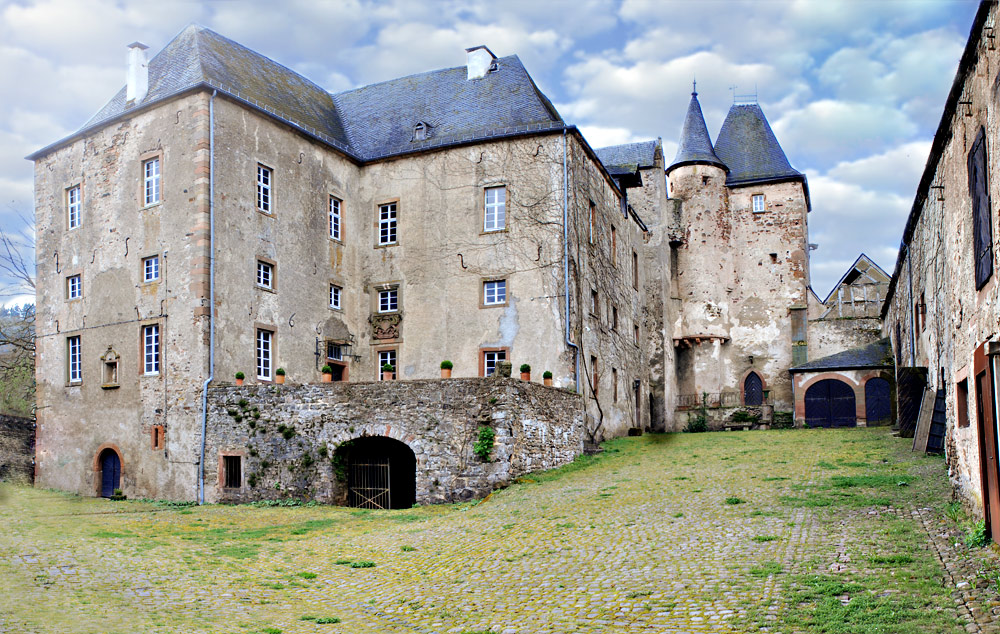
Schönecken Castle

Schönecken Castle: medieval hilltop fortress in Rhineland-Palatinate
Schönecken, Germany
High Medieval (11th–13th c.)
Partially Restored

Schönecken Castle, known locally as Burg Schönecken, is a prominent medieval hilltop fortress located above the village of Schönecken in the picturesque Rhineland-Palatinate region of Germany. Perched strategically on a mountain spur in the valley of the Nims River, the castle commands sweeping views over the surrounding landscape, underscoring its historical role in territorial control and defense.

The castle's origins trace back to the early 13th century, with construction dating to around 1230. It was built under the auspices of the Counts of Vianden, who acted as patrons of the nearby Prüm Abbey. The abbey had been granted the surrounding estate in 762 by Pepin the Short, King of the Franks, establishing a long-standing ecclesiastical presence in the region. Schönecken Castle was initially known by the Latin names Bella Costa or Clara Costa, meaning "beautiful coast" or "clear coast," reflecting its commanding hillside position.

Architectural design and defensive features

The castle occupies a substantial rectangular site measuring approximately 120 by 60 meters, making it one of the largest fortifications in the region during its time. It is classified as a hill castle, constructed on elevated terrain to maximize defensive advantages. The site is enclosed by a robust ring wall (enceinte) that served as the primary defensive barrier.

On the southern side, the castle is fortified by three projecting towers: two are round and date from the 13th or 14th century, while the central tower is rectangular and a later addition. These towers rise up to three stories high and were integrated into a multi-storey residential complex by the 16th century. The curtain walls connecting these towers also formed part of this residential adaptation, indicating the castle's evolution from a purely military fortress to a noble residence.

The eastern approach is protected by a wide neck ditch, a defensive trench carved into the landscape to impede enemy advances. Access to the castle was historically controlled by a drawbridge on the east side, enhancing its security. The castle's layout includes an inner and outer courtyard, which would have accommodated various functional buildings and facilitated defensive operations.

Historical significance and ownership

Schönecken Castle's history is deeply intertwined with the political and ecclesiastical dynamics of the region. After its construction around 1200, the castle served as a strategic stronghold to protect the southern border of the Prüm Abbey's territory and to oversee an important trade route from Bitburg to Prüm.

In 1247, the castle hosted notable historical figures such as Albertus Magnus, a Dominican friar and Catholic bishop renowned for his scholarship, and Konrad von Hochstaden, Archbishop of Cologne, highlighting its status as a center of both political and religious importance.

By 1264, the castle became the residence of Heinrich of Vianden, who adopted the title "Lord of Schönecken," signaling the establishment of a local lordship. The last lord of Schönecken died in 1370, after which the castle was acquired by the Archbishop and Elector of Trier, Kuno II von Falkenstein, in 1348. Under his ownership, the castle was enlarged and fortified further, serving as a military base during conflicts with the Prüm Abbey.

The castle's strategic importance continued through the centuries, including during the Thirty Years' War, when it was conquered by mercenaries in 1648. The castle suffered significant damage during the French occupation in 1802 when it was burned down, and the ruins were subsequently auctioned for demolition in 1804.

Restoration and current status

In 1848, the Kingdom of Prussia took ownership of the castle ruins and initiated restoration efforts beginning in 1906. These early efforts aimed to stabilize the remains and preserve the castle's historical fabric. In the 1920s, local authorities considered demolishing the ruins entirely, but these plans were thwarted by the intervention of a local student, preserving the site for future generations.

Further restoration work was carried out in the 1970s and 1980s, employing modern conservation techniques, including the use of sprayed concrete to reinforce vulnerable towers and walls. Despite ongoing weathering and structural challenges, the castle remains a significant cultural monument.

Today, Schönecken Castle is state property and the ruins are freely accessible to the public. The site serves as a popular picnic area and offers visitors a chance to explore a well-preserved example of a high medieval hill castle. While the ruins are somewhat sparse, their setting on a scenic hilltop overlooking the Nims valley makes Schönecken Castle a noteworthy destination for history enthusiasts and casual visitors alike.

Notable events and historical anecdotes

The castle's history includes episodes of violent conflict and political intrigue. In 1288, Gerhard of Schönecken was involved in a deadly dispute resulting in the killing of two monks from Prüm Abbey, reflecting the tense relations between local lords and ecclesiastical authorities. The 14th century was marked by feuds and battles involving the castle's lords, including the death of Hartard of Schönecken in 1352 during combat alongside Baldwin of Trier.

These events underscore the castle's role not only as a defensive stronghold but also as a focal point of regional power struggles during the medieval period.

Architectural evolution and residential adaptation

Originally constructed as a fortress to control the valley and protect the abbey's lands, Schönecken Castle underwent significant architectural transformations. By the 16th century, the castle's defensive towers and curtain walls were adapted into a multi-storey residential complex, reflecting broader trends in castle architecture where comfort and status became increasingly important alongside military function.

The integration of living quarters within the defensive structures illustrates the castle's dual role as both a military bastion and a noble residence. This evolution is documented in an 18th-century painting that depicts the castle's layout and residential features, providing valuable insight into its historical appearance.

Geographical context and strategic location

Schönecken Castle is situated on the lowest ridge of a hill within a valley bowl surrounded by higher hills, a location that provided natural protection. The valley of the Nims River was a vital corridor for trade and movement, making the castle's position crucial for controlling access and asserting territorial dominance.

The castle's location on a mountain spur allowed for extensive visibility and defense, while the surrounding higher hills offered additional security by limiting approaches. This strategic siting exemplifies medieval military architectural principles aimed at maximizing natural terrain advantages.

Frequently asked questions (FAQ)

How do I get to Schönecken Castle?
Schönecken Castle is located above the village of Schönecken in Rhineland-Palatinate, Germany. It is accessible by local roads and has parking nearby. Visitors can reach the castle on foot via a short uphill walk from the village center.
What are the opening hours of Schönecken Castle?
The castle ruins are freely accessible to the public at all times as the site is an open picnic area. There are no specific opening hours or entrance fees.
Is Schönecken Castle suitable for families and children?
Yes, the castle ruins and surrounding picnic areas provide a family-friendly environment. However, visitors should exercise caution on uneven terrain and near the ruins, especially with young children.
What is the historical significance of Schönecken Castle?
Schönecken Castle was a strategic hilltop fortress built in the early 13th century to protect the Prüm Abbey's southern border and control a key trade route. It played a role in regional conflicts and was a residence for local lords and later the Electorate of Trier.
Can I explore the castle ruins on my own?
Yes, visitors are free to explore the castle ruins independently. Some areas may be restricted due to safety concerns, but the main parts of the castle and grounds are open for self-guided tours.
Are there any guided tours available at Schönecken Castle?
Currently, there are no regular guided tours at Schönecken Castle, but local tourist offices may offer occasional tours or informational materials about the castle's history and architecture.

Information

Hill Castle

Current owner

State of Rhineland-Palatinate

Sources & official resources

Verify the information above using these authoritative references.

Loading map...

Visitor reviews

No reviews yet. Been here? Write the first review and help other travelers!

Write the first review

Visited this castle? Share your experience

Your review helps other travelers and adds first-hand knowledge to our encyclopedia.
Write a review

(5/5)

0/2000 characters

Your review will be visible after admin approval

Nearby castles

9.8 km
Bertrada Castle — Germany castle

Bertrada Castle

Mürlenbach, Germany

Bertrada Castle, also known as Bertradaburg or Burg Mürlenbach, is a prominent hill castle situated on a rock spur overlooking the village of Mürlenbach in the Rhineland-Palatinate region of Germany. This castle is steeped in history, with its origins tracing back to ancient times and evolving through the early medieval period into a significant fortification of the region. The site of Bertrada Castle is believed to have originally hosted a Roman castrum, a military fortification that guarded the important Roman road known as the Via Agrippa, which connected the cities of Trier and Cologne. Archaeological evidence supports the presence of earlier fortifications on this strategic location, highlighting its longstanding military importance. Local tradition holds that Bertrada, the mother of the famed Holy Roman Emperor Charlemagne, lived here, suggesting that Charlemagne's birth around 747 AD may have occurred at this site. This historical association lends the castle its name and enriches its cultural significance. Medieval origins and development The first recorded mention of an estate in Mürlenbach dates back to 1103, when the property was owned by the Prüm Abbey. The current castle structure likely began construction towards the end of the 13th century, under the auspices of Abbot Heinrich von Prüm. The earliest documented reference to Bertrada Castle itself appears in 1331. As a stronghold of the Prüm Abbey, the castle played a vital role in the defense and administration of the abbey's extensive territorial holdings. Fortifications and architectural features During the 16th century, the castle's defenses were significantly enhanced due to the aggressive territorial expansion of the Archdiocese of Trier. To protect the abbey's assets, two massive roundels with walls approximately 5 meters thick were added to the castle's fortifications. These additions exemplify the military architectural evolution of the castle, reflecting the heightened need for robust defense mechanisms during this turbulent period. Following the merger of the Archdiocese and the abbey in the late 16th century, the fortification efforts continued, although the castle eventually fell into disrepair shortly thereafter. The castle's most striking architectural feature is the imposing 30-meter-high double tower gatehouse, a tower house that dominates the surrounding landscape and offers commanding views of the countryside. This gateway tower is a key element of the castle's defensive system and remains a visible landmark today. Historical transitions and modern restoration In 1804, during the period of French occupation, Bertrada Castle was seized and declared national property. It was subsequently sold and repurposed as a residence. Later, the courtyard buildings were utilized as part of a brewery, reflecting the adaptive reuse of the castle's structures over time. Restoration and consolidation efforts began in the 1980s and continue to this day, with significant funding from federal and state sources. The 16th-century southwest roundel and the 13th-century shield wall have been renovated to preserve the castle's historical integrity. The double tower gatehouse was also rebuilt with state financing, ensuring the survival of this iconic feature for future generations. Current status and visitor information Today, Bertrada Castle remains privately owned and is accessible to visitors by appointment. The castle buildings within the courtyard have been converted into holiday apartments, which are undergoing renovation to enhance visitor accommodation. The castle also hosts the annual Mürlenbach Castle Festival (Mürlenbacher Burgfest), a cultural event that celebrates the site's rich heritage and attracts visitors from the region and beyond. Bertrada Castle stands as a testament to the layered history of the Rhineland-Palatinate region, combining elements from Roman military architecture through to early medieval and Renaissance fortifications. Its preservation and ongoing restoration highlight the importance of safeguarding historical monuments that embody centuries of cultural and architectural evolution.

Early Medieval (5th–10th c.)
Details
15.2 km

Malberg Castle

Malberg, Germany

Malberg Castle is a historic castle located in Malberg, Germany, with origins tracing back to a medieval fortress on the same site. The current structure was primarily constructed between 1591 and 1597 during the Renaissance period, replacing the earlier medieval fortifications. This castle embodies the transition from medieval defensive architecture to a more residential and representational style that was typical of the Renaissance era in Germany. Historical background and construction The castle was built on the foundations of a previous medieval stronghold, which served as a local defensive site. The Renaissance construction phase introduced more refined architectural elements focused on comfort and aesthetics, rather than purely military functions. The original builders aimed to create a residence that reflected the status and wealth of its owners while maintaining some defensive capabilities typical of the period. Architectural evolution and style Although the castle was constructed during the Renaissance, its present-day appearance is largely influenced by Baroque style renovations carried out in the early 18th century. These renovations introduced characteristic Baroque features such as elaborate facades, ornamental details, and a more symmetrical layout. The Baroque influence softened the castle's Renaissance austerity, adding grandeur and decorative richness to the structure. Structural features The castle complex includes a main residential building surrounded by defensive walls and ancillary buildings. Typical Renaissance elements include rectangular windows, gabled roofs, and a balanced, harmonious facade. The Baroque modifications added stucco decorations, pilasters, and expanded window openings to allow more light into the interiors. Significance and preservation Malberg Castle stands as an example of architectural evolution from medieval fortification to Renaissance residence and finally Baroque refinement. It reflects the changing needs and tastes of the German nobility over centuries. The castle is well preserved, maintaining much of its historical fabric and architectural integrity. Current status and use Today, Malberg Castle is recognized for its cultural and historical value. It remains a prominent landmark in the region, attracting visitors interested in Renaissance and Baroque architecture. The castle's preservation allows for educational and cultural activities, showcasing the architectural heritage of the area. The castle in its regional context Located in the western part of Germany, Malberg Castle is part of the Rhineland-Palatinate region, which is known for its rich concentration of castles and historic buildings. The castle's position within this landscape highlights the strategic and social importance of such estates during the Renaissance and Baroque periods.

Renaissance (15th–17th c.)
Details
15.9 km
Lissingen Castle — Germany castle

Lissingen Castle

Gerolstein, Germany

Lissingen Castle stands as a remarkable example of a well-preserved moated castle dating back to the 13th century. Situated on the banks of the River Kyll near Gerolstein in the Eifel region of Germany, it is distinguished by its unique status as a double castle, comprising the upper castle (Oberburg) and the lower castle (Niederburg), each with separate ownership since their division in 1559. This dual structure is a rare architectural and historical feature that reflects the complex feudal and familial arrangements of the time. Alongside Bürresheim Castle and Eltz Castle, Lissingen is one of the few castles in the Eifel that has never been destroyed, preserving an authentic glimpse into medieval and early modern castle life. Its origins trace back even further, with archaeological evidence suggesting the site was once a Roman settlement or military camp connected to the nearby Roman horse-changing station, Ausava, on the ancient route between Trier and Cologne. Historical origins and medieval development The earliest documentary mention of Lissingen Castle dates to 1212, when it was recorded as the possession of the knightly family von Liezingen, vassals to the powerful Prüm Abbey. The abbey controlled extensive estates in the region, including nearby villages such as Büdesheim and Sarresdorph. The castle's strategic location and fortifications were developed in response to the threat of Norman raids in the 9th century, evolving from defensive towers into a fortified complex with ring walls and moats to protect ecclesiastical lands. Throughout the High Middle Ages, Lissingen Castle grew in significance as a noble residence and administrative center. In 1514, the abbey granted the castle in fief to Gerlach Zandt von Merl, marking the beginning of the Zandt family's long association with the estate. The division of the castle in 1559 into upper and lower sections reflected the complexities of inheritance and estate management common in the period. Architectural evolution and renaissance transformation Between 1661 and 1663, the lower castle underwent a major reconstruction under Ferdinand Zandt von Merl, who transformed three medieval residential towers into an imposing Renaissance manor house. This renovation exemplified the shift from purely defensive architecture to more comfortable and representative noble residences, incorporating elegant sandstone fireplaces, vaulted cellars, and spacious reception rooms. The lower castle also featured a small chapel, documented in the early 18th century as the oratory of the von Zandt family, which was eventually deconsecrated in the early 20th century. The estate's agricultural functions expanded with the construction of a large tithe barn and stables, reflecting the castle's role as a manorial center. The castle mill and early industrial innovations An integral part of the lower castle complex is the castle mill, originally a standalone grain mill incorporated into the estate after the 1559 division. In the early 20th century, the mill was adapted to generate hydroelectric power, supplying electricity to the castle and surrounding village until 1936. The presence of the millstream and the Oosbach stream, which powered the mill and provided water for livestock and firefighting, highlights the castle's self-sufficient estate infrastructure. A notable feature added around 1920 is the Königswinter oven, a large wood-fired stone oven used for baking bread, which has been restored and remains operational today, contributing to the castle's cultural and culinary heritage. The upper castle and its renaissance-baroque character The upper castle is centered around a walled courtyard enclosed by a long Renaissance-Baroque manor house and a 14th-century gate tower that served as the original main entrance. The courtyard includes a barn, washhouse, and a Baroque administration building, demonstrating the estate's multifaceted functions. The chapel house within the upper castle initially served religious and burial purposes before being converted for residential use. Additional structures include a Renaissance gatehouse and an 18th-century farmer's cottage that combined living quarters with stables and barns, illustrating the integration of noble and agricultural life. Surrounding the upper castle is a park area that evolved from former kitchen gardens, enhancing the estate's aesthetic and leisure qualities. Historical significance and modern use Lissingen Castle's long history reflects the broader political and social changes in the region. After the French Revolution and the subsequent annexation of the left bank of the Rhine in 1794, the castle came under French administration. Following the Congress of Vienna in 1815, it became part of the Kingdom of Prussia. During World War II, the castle served as a billet for Wehrmacht regiments, a command post for the German General Staff, and later as a temporary prison for high-ranking military captives. Post-war, the estate returned to agricultural use under the ownership of the Greven family until economic challenges led to neglect and disrepair by the late 20th century. Restoration efforts beginning in the late 1980s have revitalized the lower castle, transforming it into a cultural venue with exhibitions of historic carriages, sleighs, and traditional crafts. The castle mill and bakery with the historic stone oven offer visitors a unique glimpse into the estate's working heritage. The upper castle remains a private residence with parts available as holiday apartments, maintaining the castle's living legacy. Architectural and cultural heritage protection The entire Lissingen Castle complex is protected as a cultural monument under the Hague Convention, recognizing its outstanding architectural and historical value. The preservation of its medieval fortifications, Renaissance and Baroque manor houses, and ancillary buildings provides an exceptional example of a double castle estate that has continuously evolved over centuries without destruction. Visitors to Lissingen Castle can explore its historic courtyards, admire the stone masonry and vaulted cellars, and experience the castle's rich history through exhibitions and cultural events. The combination of defensive structures, noble residences, agricultural buildings, and early industrial innovations like the hydroelectric mill offers a comprehensive insight into the life and development of a significant Eifel castle.

High Medieval (11th–13th c.)
Details