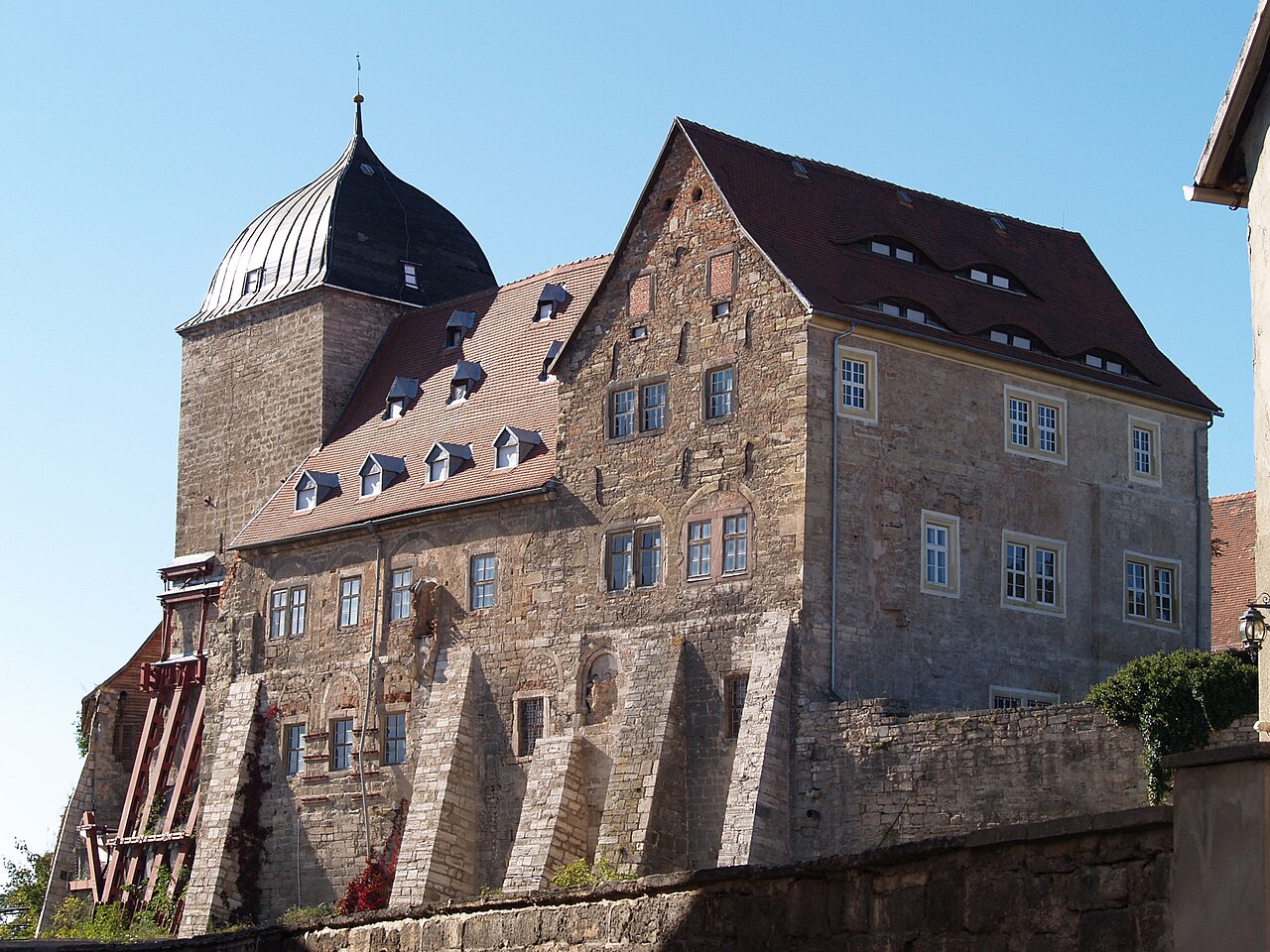
Schloßvippach Schloss
Schloßvippach Schloss stands as a remarkable example of a medieval water castle located in the municipality of Schloßvippach, Thuringia, Germany. Its origins trace back to around 1050, when the Frankish nobility established a fortified residence in the historic region known as the Frankish Ostergau. This early foundation set the stage for a castle that would witness centuries of political upheaval, architectural transformation, and regional conflict.
The castle’s early history is closely tied to the noble family known as the Herren von Vippach, documented from 1095. This family bore a distinctive coat of arms featuring a white and red checkerboard pattern, symbolizing their noble status and territorial influence. For several centuries, the Herren von Vippach controlled the castle and its surrounding lands, maintaining their autonomy until the mid-14th century.
Medieval origins and early history
Originally constructed as a water castle, Schloßvippach Schloss was strategically positioned on a castle island surrounded by a moat, which provided a natural defensive barrier. The irregular quadrangular layout was typical of such fortifications, with defensive walls and towers at each corner enhancing its protection. The castle’s central stronghold was a tall bergfried dating from the 14th century, serving both as a lookout and a last refuge during sieges.
The castle’s early prominence was disrupted during the Thuringian Count’s War in 1345, a conflict involving local nobles and the powerful Wettin dynasty. Schloßvippach Schloss was destroyed in this war, marking a turning point in its history. Two years later, in 1347, the Herren von Vippach lost their independence and became vassals under the Landgraves of Thuringia, reflecting the shifting political landscape of the region.
Fortification and transformation under erfurt
Following the sale of the castle in 1387 by Otto von Vippach to the city of Erfurt, Schloßvippach Schloss underwent significant reinforcement to protect Erfurt’s northeastern territories. The castle was transformed into a robust water castle featuring defensive walls, corner towers, and the imposing bergfried. In 1404, the construction of the Kemnate, a residential tower within the courtyard, provided a fortified living space that also served as a last defensive stronghold.
The castle earned the nickname "Löwen-Vippach" or "Lion Vippach" during this period, reflecting its formidable presence. By the late 15th century, the castle’s leadership transitioned from military commanders to administrative officials known as Amtmänner. Around 1500, a Renaissance-style gatehouse was added, marking a shift toward administrative functions and civil governance. Additional structures such as a brewhouse with a dedicated well underscored the castle’s role in production and self-sufficiency. By 1590, all buildings were topped with tiled roofs, indicating sustained investment in maintenance and comfort.
Decline and adaptation in the early modern era
In the early 17th century, Schloßvippach Schloss saw a decline in its military importance. Its fortifications were partially dismantled to make way for a manor house, reflecting a transition from a defensive stronghold to a residential and agricultural estate. During the Thirty Years’ War, the castle served as headquarters for Duke Friedrich of Altenburg in 1622. His troops looted nearby villages, and his departure in 1623 left the castle in ruins.
The ensuing decades were marked by plague outbreaks and repeated military occupations. By 1646, the castle was recorded as a ruin, and the surrounding area suffered further devastation when Swedish forces under General Wrangel ravaged the region in 1647. In 1664, the castle and village were incorporated into the Electorate of Mainz, with local inhabitants swearing allegiance in the castle courtyard.
18th to 20th century transformations and destruction
The 18th century brought further changes as the castle’s four corner towers were dismantled in 1700 to accommodate new administrative buildings and expand agricultural activities. In 1701, hereditary land rights were granted to local subjects by the Archbishop of Mainz, establishing a community that lasted until 1862. The castle complex took on a stable form during this period, with the Kemnate demolished in 1828.
Following the relocation of the tax office to Großrudestedt, the castle passed into private ownership by the Collenbusch family, who managed it as a farming estate until 1945, when Soviet authorities expropriated the property. After World War II, the castle served as accommodation for displaced persons from former eastern territories.
In 1948, the Soviet Military Administration authorized the demolition of the main building to reuse materials for rural housing. The demolition included the destruction of the bergfried by controlled explosion. Many construction materials were repurposed locally, and the castle’s historic library suffered significant losses. The moat was gradually filled with sediment, and the castle island became overgrown with vegetation, obscuring its original features.
21st century restoration and preservation efforts
Starting after the year 2000, extensive restoration efforts have sought to reverse decades of neglect and damage. Approximately 5,000 cubic meters of silt were removed to reopen the moat and restore its continuous water supply. The castle bridge was repaired and reinforced, and surviving wall fragments were stabilized to prevent further deterioration. These efforts have made the outlines of the castle’s defensive structures visible once again, allowing visitors to appreciate its historic layout.
Plans to reforest portions of the castle meadow aim to restore the landscape setting, enhancing the site’s cultural and heritage significance. Today, Schloßvippach Schloss offers a tangible connection to its layered past through its partially restored medieval and early modern features, serving as a valuable monument to the region’s history.
Frequently asked questions (FAQ)
- How do I visit Schloßvippach Schloss?
- Schloßvippach Schloss is located in the municipality of Schloßvippach, Thuringia. Visitors should check local tourism websites or contact the municipality for current visiting hours and access information, as the castle is privately owned and may have limited public access.
- What is the historical significance of Schloßvippach Schloss?
- Schloßvippach Schloss is historically significant as a medieval water castle originally built around 1050 by Frankish nobility. It played important roles during the Thuringian Count’s War, the Thirty Years’ War, and as an administrative center under the city of Erfurt.
- When was the castle’s bergfried built and what was its purpose?
- The castle’s bergfried dates from the 14th century and served as a tall fortified tower used for defense and observation, acting as the stronghold’s central structure and last refuge during attacks.
- Can I see the original defensive structures at Schloßvippach Schloss?
- While the castle’s original four corner towers and bergfried were demolished, restoration efforts have stabilized remaining walls and reopened the moat, allowing visitors to discern the outlines of the historic defensive layout.
- Why was the castle demolished in 1948?
- The main building was demolished under Soviet Military Administration orders to recycle building materials for rural housing development after World War II, resulting in the loss of key structures including the bergfried and the castle library.
Information
Current owner
Private owner
Loading map...
Visitor reviews
No reviews yet. Been here? Write the first review and help other travelers!
Write the first reviewVisited this castle? Share your experience
Your review helps other travelers and adds first-hand knowledge to our encyclopedia.