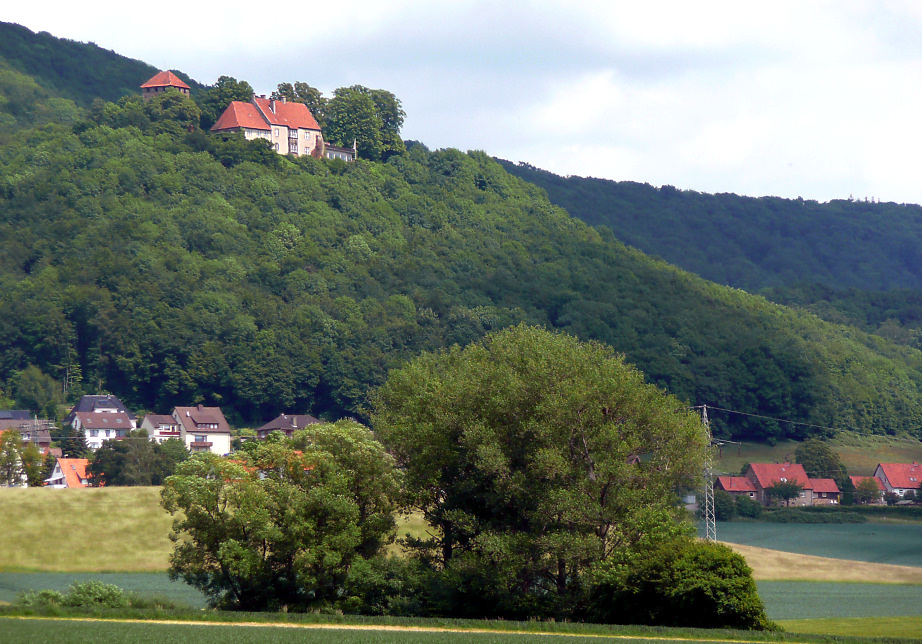
Schloss Rodenberg
Schloss Rodenberg stands as a remarkable example of a hill castle with a rich history dating back to the early 13th century. Located in the town of Rodenberg, Germany, this castle was originally constructed by the Lords of Schaumburg to secure and administer the surrounding territory. Its strategic position on an island formed by the Rodenberger Aue and a mill ditch provided a natural moat, enhancing its defensive capabilities.
Early history and medieval fortifications
The castle's earliest documented mention occurs in 1317, shortly followed by references to officials managing the site in 1320. Between 1330 and 1348, Count Adolf VII of Schaumburg undertook extensive renewal and fortification efforts, significantly strengthening the castle and its outer bailey. By 1348, Schloss Rodenberg served as Adolf VII’s residence, while the outer bailey functioned as the administrative seat for the Schaumburg bailiff from 1337.
During the late 15th century, Otto III of Schaumburg enhanced the castle's defenses by adding a distinctive tower rondel on the northeast corner and installing sluice gates to control water levels around the moat. Around 1510, Anton I of Schaumburg further expanded the fortifications by constructing a heavily fortified bastion integrated into the outer wall, reflecting advancements in military architecture to counter artillery threats.
Renaissance remodeling and military conflicts
The mid-16th century brought conflict when Brunswick forces besieged Schloss Rodenberg in 1553. Following this, Otto IV of Schaumburg completed repairs by 1556. Between 1560 and 1565, the castle's palas—the main residential building—was remodeled in the Weser Renaissance style under the guidance of architects Jakob Kölling and Heinrich Schrader. This remodeling introduced elegant Renaissance architectural elements, marking a transition from purely military functions to residential and administrative uses.
During the turbulent Thirty Years’ War in the early 17th century, Schloss Rodenberg changed hands multiple times. In 1638, imperial troops successfully defended the fortress. The death of the last Schaumburg ruler in 1647 transferred ownership to Hesse-Kassel, after which the castle’s political and military significance diminished as administrative functions moved to Rinteln.
Post-medieval transformations and decline
Landgrave Wilhelm VI initiated restoration efforts in 1661 and 1662, focusing on the castle buildings but ordering the removal of defensive structures such as wall towers in 1663. The outer bailey was converted from a military installation into a domain, reflecting the reduced strategic importance of the site.
By the late 18th century, only fragments of the original fortifications remained, including parts of the bastion, the northeastern tower rondel with sluice gates, and remnants of a southwestern tower rondel. The castle moat was filled in during the early 19th century but was restored again in 1940.
A devastating fire in 1859 destroyed much of the complex, leading to the demolition of all buildings except the Ständehaus—the former palas. This surviving structure was repurposed as a Catholic church from 1950 to 1975 before becoming a local history museum in 1981.
Archaeological discoveries and modern preservation
Between 2000 and 2004, archaeological excavations uncovered remains of key defensive features such as the bastion, tower rondel, and sluice gates. These were partially reconstructed and incorporated into an open-air museum opened in 2005. Further geophysical surveys in 2016 revealed foundations of additional castle-related buildings including stables, storage facilities, a carriage shed, and the castle well. These findings confirm that the earliest castle construction occupied the island where the Ständehaus stands today.
Architectural features and layout
Schloss Rodenberg was originally built as a water castle with a nearly closed four-wing layout anchored by the palas (now the Ständehaus) and a bergfried (keep), which no longer exists. The castle was surrounded by a defensive wall approximately 24 meters long at the base and about 4 meters high, with a water moat up to 30 meters wide running inside the wall.
The bastion constructed in the early 16th century is a stout, two-story structure measuring roughly 10 by 10 meters. Its lower floor housed a powder magazine within a vaulted casemate. Eight cannon firing ports and specialized narrow firing slits called "hosenscharte" provided artillery coverage, reflecting adaptations to gunpowder warfare.
The tower rondel on the northeast corner, dating from around 1480, has a diameter of nearly eight meters. Both the bastion and tower rondel have been partially reconstructed and are protected by roofs and fencing to preserve these important architectural relics.
Surrounding the castle was an outer ditch known as the Butengraben, up to 20 meters wide on three sides, fed by the Rodenberger Aue. Two sluice gates connected to the bastion and tower rondel allowed defenders to control water levels, enhancing the castle’s defensive water barrier.
The former outer bailey, located south of the main castle, has been completely leveled, but excavations in the 1960s and later geophysical surveys revealed foundations and subsurface remains of various buildings such as stables, granaries, a carriage house, and the castle well, indicating a complex and functional castle estate.
Current status and visitor experience
Today, visitors to Schloss Rodenberg can explore the open-air museum featuring the restored bastion, tower rondel, and remaining castle walls alongside the Ständehaus. Informational displays provide detailed context about the castle’s historical evolution, architectural features, and the lives of its former inhabitants.
The site offers a unique opportunity to witness the layered history of a medieval water castle that evolved through the High Medieval and Renaissance periods, reflecting changing military technologies and residential needs. The preservation efforts and archaeological findings make Schloss Rodenberg a significant cultural heritage site in Lower Saxony.
Frequently asked questions (FAQ)
- How do I get to Schloss Rodenberg?
- Schloss Rodenberg is easily accessible by public transportation, with the nearest train station located just a short distance away. You can also reach the castle by car, as there are parking facilities available nearby. Make sure to check local transit schedules for the most convenient routes.
- What is the historical significance of Schloss Rodenberg?
- Schloss Rodenberg dates back to the 14th century and has served various purposes throughout its history, including as a noble residence and a military stronghold. Its rich history reflects the architectural and cultural evolution of the region. The castle is a testament to the medieval heritage of Germany and offers insights into its feudal past.
- When was Schloss Rodenberg built?
- Construction of Schloss Rodenberg began in the early 14th century, specifically around 1320. Over the centuries, it has undergone several renovations and expansions, showcasing a variety of architectural styles. The castle's enduring presence makes it a fascinating subject for history enthusiasts.
- Can I take guided tours of Schloss Rodenberg?
- Yes, guided tours of Schloss Rodenberg are available, providing visitors with in-depth knowledge about the castle's history and architecture. Tours are offered in multiple languages, catering to a diverse audience. Be sure to check the schedule ahead of your visit to secure a spot.
- Why is Schloss Rodenberg a popular tourist destination?
- Schloss Rodenberg attracts visitors due to its stunning architecture and picturesque views of the surrounding landscape. The castle's historical significance and well-preserved structures offer a glimpse into Germany's medieval past. Additionally, the peaceful setting and charming grounds make it an ideal spot for leisurely exploration.
- Is it possible to host events at Schloss Rodenberg?
- Yes, Schloss Rodenberg offers facilities for hosting various events, including weddings, corporate gatherings, and private celebrations. The unique ambiance and historic setting provide a memorable backdrop for any occasion. It's advisable to contact the castle's event management team in advance to discuss options and availability.
- What are the opening hours for Schloss Rodenberg?
- Schloss Rodenberg typically opens to visitors from Tuesday to Sunday, with specific hours varying by season. During peak tourist season, the castle may extend its hours to accommodate more guests. It's recommended to check the official website for the most current information on opening times before your visit.
- What are the ticket prices for visiting Schloss Rodenberg?
- Ticket prices for Schloss Rodenberg are generally affordable, with discounts available for students and seniors. Children under a certain age may enter for free, making it a family-friendly destination. Be sure to check the official site for any special offers or group rates available during your visit.
- What are some nearby attractions to Schloss Rodenberg?
- In addition to Schloss Rodenberg, visitors can explore the charming town of Rodenberg, which features quaint shops and local eateries. Nearby, you can also enjoy scenic hiking trails and parks that showcase the natural beauty of the region. Other historical sites in the area may also be worth a visit to enhance your experience.
Information
Loading map...
Visitor reviews
No reviews yet. Been here? Write the first review and help other travelers!
Write the first reviewVisited this castle? Share your experience
Your review helps other travelers and adds first-hand knowledge to our encyclopedia.