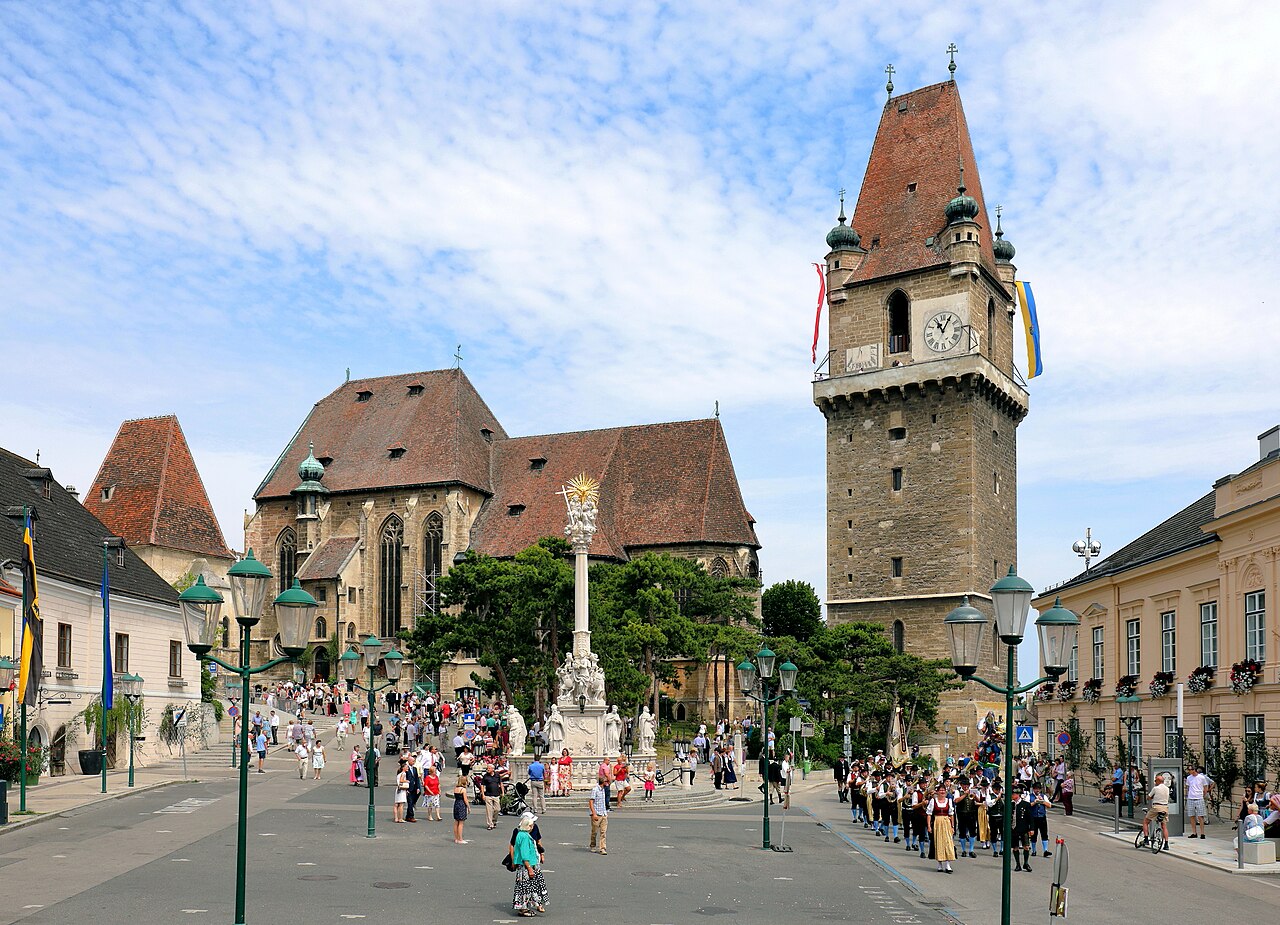
Schloss Purkersdorf
Schloss Purkersdorf is a notable hill castle located in the town of Purkersdorf, Austria. Its origins trace back to the early 11th century, when it was established as a fortified residence by Purchart de Louppah from nearby Gablitz. Initially conceived as a defensive stronghold, the castle played a significant role in the medieval landscape of Lower Austria, reflecting the region's strategic importance and evolving political dynamics.
The earliest documented mention of the castle dates to 1255, recorded as "castrum Purchartsdorf". At this time, the fortress was owned by Heinrich von Kreuzenstein, with the fief managed by the Lengenbach family. During the late 13th century, part of the fortress came under the control of the Teutonic Order, a prominent medieval religious and military order known for their role in crusades and territorial administration. By the early 14th century, the castle passed through marriage into the hands of the Habsburg family, one of Europe's most influential dynasties, marking a new chapter in its history.
Medieval origins and strategic importance
The castle's initial design reflected its defensive purpose, featuring a rectangular layout with four wings enclosing a central courtyard. Its location on a hill provided a commanding view of the surrounding forested area, enhancing its role as a military stronghold. Originally, the fortress was protected by a deep water-filled moat, accessible only via a drawbridge on the eastern side, which was a common defensive feature in medieval castles to deter attackers.
The eastern façade was fortified with robust corner defenses and a prominent square keep constructed from finely cut ashlar stone. This tall tower was the dominant feature of the castle, symbolizing both strength and authority. On the western side, the fortress was further protected by round bartizans—small overhanging turrets used for surveillance and defense. These architectural elements underscored the castle's military function during the medieval period.
Destruction and transformation during the ottoman sieges
Schloss Purkersdorf endured significant damage during the two major Ottoman sieges of Vienna. The first siege in 1529 resulted in heavy destruction, with the fortress largely destroyed by fire. Reconstruction efforts took place over two decades, from 1533 to 1553. During this period, the defensive moat was filled in, signaling a shift in military architecture and the castle's role.
The second siege in 1683 once again saw the fortress captured and damaged. Following this, Emperor Leopold I ordered a comprehensive restoration between 1684 and 1688, which transformed the castle from a fortified stronghold into a more palatial residence. This renovation removed the military towers and introduced a more residential architectural style, reflecting the changing needs and tastes of the period.
Later history and preservation efforts
In the early 19th century, a serious fire caused further damage to Schloss Purkersdorf. Although demolition was considered, restoration efforts prevailed, preserving the structure for future generations. In 1925, ownership transferred to the Austrian forestry authority, which undertook extensive conservation work completed by 1985.
Today, the castle serves a variety of civic functions, including housing the local district court, a medical facility, the city museum of Purkersdorf, and private residences. Its adaptive reuse demonstrates the castle's continued relevance and integration into modern community life.
Architectural features and layout
The castle's current form retains the rectangular plan with four three-story wings enclosing a central courtyard, giving it a solid, palace-like presence in the town center, just west of the main square and behind the parish church dedicated to St. Jakob the Elder. The original defensive moat has been removed, but the castle's robust stone construction and buttressed walls remain prominent.
The main entrance features a vaulted stone gateway with a barrel vault ceiling, constructed from large, visible stone blocks that are remnants of the original Romanesque keep. While the interior has undergone significant changes and no original decorations survive, the castle once contained prison cells that were removed during the last restoration.
The demolition of all original defensive towers, including the prominent square keep and western bartizans, marks a significant change from the castle's medieval military character to its later palatial and civic functions. Despite these changes, Schloss Purkersdorf remains a protected cultural monument, officially registered under number 3703, preserving a rich history of medieval fortification and subsequent residential adaptation.
Cultural significance and heritage status
Schloss Purkersdorf stands as a testament to the layered history of Lower Austria, reflecting shifts in military technology, architectural styles, and political power from the early medieval period through the post-medieval era. Its transformation from a fortress to a palatial residence mirrors broader European trends in castle evolution. The castle's preservation and adaptive reuse underscore its importance as a cultural and historical landmark within the region.
Frequently asked questions (FAQ)
- What is the historical significance of Schloss Purkersdorf?
- Schloss Purkersdorf dates back to the early 11th century and reflects important medieval defensive architecture and later adaptations by the Habsburgs. It played a role in the Ottoman sieges of Vienna and evolved from a fortress to a palatial residence.
- Can I visit Schloss Purkersdorf today?
- Yes, Schloss Purkersdorf is accessible to the public and serves various civic functions including a museum. Visitors can explore its historic architecture and learn about its rich history.
- What architectural styles are visible at Schloss Purkersdorf?
- The castle features primarily Romanesque architectural elements, especially in the vaulted stone gateway and ashlar stone construction. Later renovations introduced palatial features removing military towers.
- How was Schloss Purkersdorf affected by the Ottoman sieges?
- The castle was heavily damaged during the Ottoman sieges of 1529 and 1683, resulting in fires and destruction. It was rebuilt and transformed into a palatial residence under Emperor Leopold I after the second siege.
- Is Schloss Purkersdorf protected as a cultural monument?
- Yes, Schloss Purkersdorf is a protected cultural monument registered under number 3703, preserving its historical and architectural significance in Lower Austria.
Information
Current owner
Austrian forestry authority
Loading map...
Visitor reviews
No reviews yet. Been here? Write the first review and help other travelers!
Write the first reviewVisited this castle? Share your experience
Your review helps other travelers and adds first-hand knowledge to our encyclopedia.