Burg Perchtoldsdorf
Burg Perchtoldsdorf is a remarkable hill castle located in the heart of Perchtoldsdorf, Austria, perched on the northern slope of the Vienna Woods (Wienerwald). Its strategic position on a hillside was integral to its role as a defensive fortification guarding the eastern frontier of the Babenberg dynasty's territories during the early medieval period. The castle's origins trace back to the 10th century, making it one of the region's oldest surviving fortifications with a rich history spanning over a millennium.
Originally constructed as a modest stronghold, the castle began as a stone tower accompanied by wooden buildings, all enclosed by a palisade and moat. This early design was typical of frontier castles intended to repel invasions, particularly from the Hungarians who frequently raided the Babenberg lands. The castle's early defensive features reflect the military architecture of the early medieval era, emphasizing rapid construction and practical fortification.
Early construction and medieval development
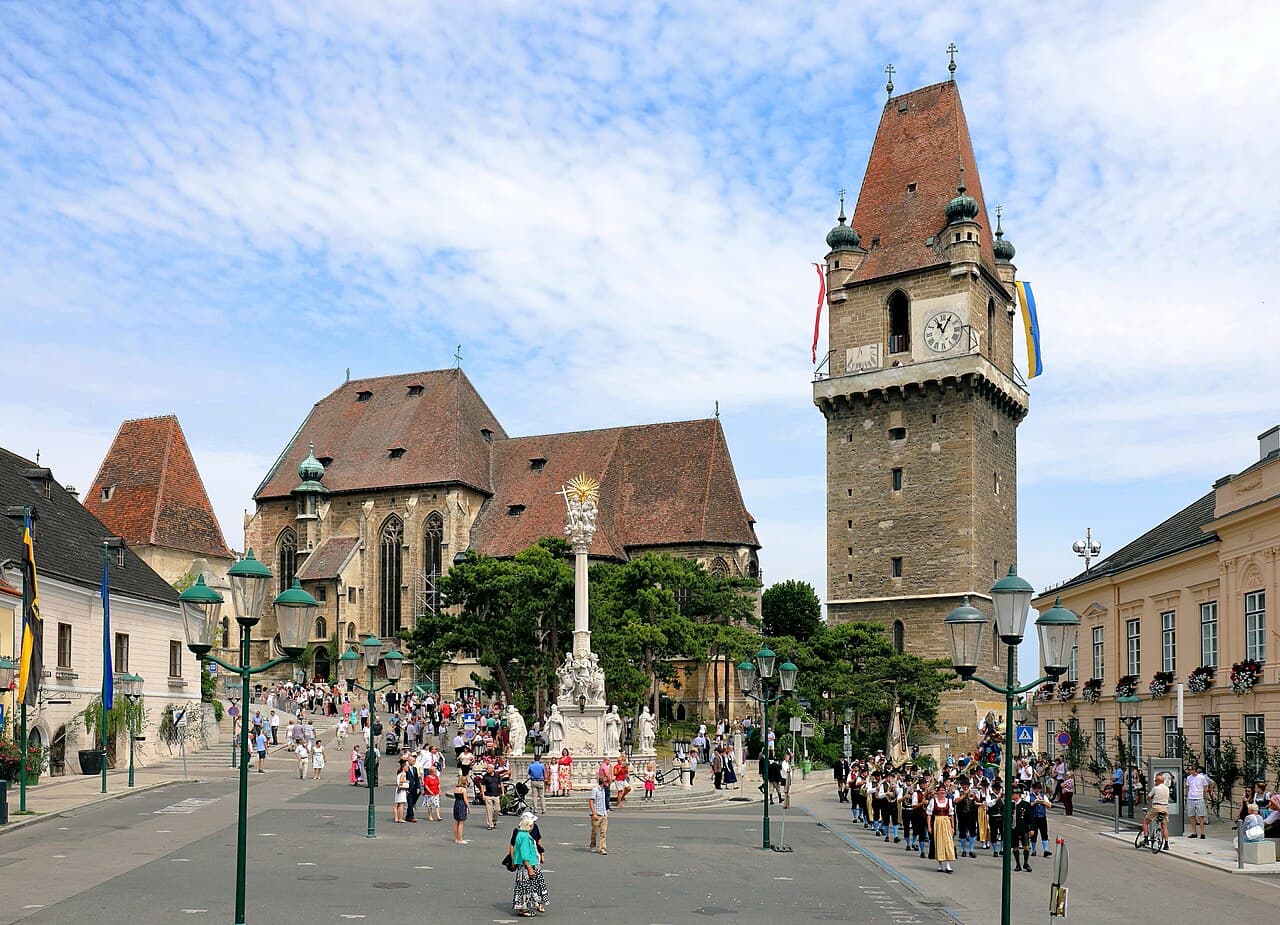
The first documented lord associated with the castle was Heinricus de Pertoldesdorf, mentioned in a deed from 1138, during the height of Babenberg rule. By the early 12th century, the wooden structures were replaced with durable brickwork, and a fortified stone wall was erected, transforming the castle into a more permanent and formidable fortress. A notable feature from this period is the southern tower (bergfried), which served as the main defensive stronghold and still stands today as a prominent landmark.
The castle chapel, originally located on the second floor of the southern tower, gained religious significance when it was elevated to a parish church in 1217 by the Bishop of Passau. This dual military and religious function highlights the castle's importance as both a defensive bastion and a community center.
Ownership changes and conflicts
In 1232, Otto I of Perchtoldsdorf transferred the castle to Melk Abbey as a freehold, retaining it as a fief. However, his participation in a noble revolt against Duke Frederick the Warlike led to the castle's destruction by ducal forces, leaving only foundations and parts of the south wall intact. Otto I subsequently relocated to Kammerstein castle, which he had constructed as a new residence.
A separate town castle was built near the market square's southeast corner to serve administrative purposes. Otto II, who fought alongside Rudolf of Habsburg at the battles of Dürnkrut and Jedenspeigen, rebuilt the ancestral castle, likely completing the reconstruction around 1270. This restoration reaffirmed the family's presence and influence in the region.
Otto III's involvement in another noble uprising resulted in the destruction of all three castles—ancestral, town, and Kammerstein—by Duke Albert I around 1290. Otto III probably died in captivity following this conflict. After the extinction of the Perchtoldsdorf family line with Heinrich IV, the castle reverted to Melk Abbey, which granted it as a fief to the Dukes of Austria.
Gothic transformation and ducal residence
Under ducal ownership, Burg Perchtoldsdorf underwent a significant transformation in the Gothic architectural style. This phase included the construction of a well within the castle grounds to ensure a reliable water supply during sieges and the addition of a ducal chapel annexed to the parish church, reserved exclusively for the ducal family. The castle also served as a residence for widowed duchesses such as Elisabeth of Virneburg and Beatrix of Zollern, the latter of whom founded a hospital and hospital church in Perchtoldsdorf, which still stands today.
Conflicts and sieges in the late medieval period
The castle and town were caught in the turbulent conflicts of the 15th century, notably the rivalry between Emperor Frederick III and Archduke Albert VI. In 1446, the town suffered significant damage during an invasion by the Hungarian regent John Hunyadi. The castle changed hands multiple times, including occupation by mercenaries loyal to King Matthias Corvinus from 1477 until about 1490.
The siege of Vienna by Ottoman forces in 1529 was a critical moment for Burg Perchtoldsdorf. The castle's fortifications, including the tower house (Wehrturm) standing 60 meters tall, allowed it to withstand the siege successfully, even as the surrounding market town was devastated. Defensive upgrades during this period included replacing windows with narrow shooting slits and constructing an outer ring wall to enhance protection against artillery and infantry assaults.
Early modern period and restoration efforts
The castle again provided refuge in 1605 during the approach of Prince Stephen Bocskai and his hajduks. However, it was burned during the second Ottoman siege of Vienna in 1683, leading to significant damage.
By the late 18th century, the castle had fallen into disrepair. The demolition of the inner castle wall in 1794 and the filling in of the moat altered the original defensive layout. Plans to demolish the castle entirely for farmland were proposed but never realized.
In 1871, the southern tower was restored by Joseph Hyrtl, who converted it into a workspace. Following his death, the tower served as a museum for several years. The castle armory was renovated in 1928 and later adapted as a scout clubhouse after a regional exhibition. Emergency roofing was installed over the palace hall in 1958 to protect the structure from further decay.
Modern renovations and cultural use
From 1964, the former residential wing of the castle was transformed into a cultural center. Since 1976, the Burghof courtyard has hosted annual summer theater performances, becoming a vibrant cultural venue in Perchtoldsdorf.
Between 2008 and 2010, extensive renovations introduced a modern underground event hall and foyer constructed with glass and steel. These upgrades improved accessibility with barrier-free access and an elevator, and a reinforced concrete passage was built to connect the historic castle to the new festival hall. While these changes altered some original features, such as sealing the historic courtyard exit and disabling the armory gate, they balanced the needs of modern use with historic preservation.
Architectural features and remains
Burg Perchtoldsdorf is characterized as a tower castle situated on a hillside, featuring a prominent bergfried or southern tower, which served as the main defensive and residential structure. The castle's layout originally included a bailey enclosed by a stone wall, a moat, and wooden buildings that were later replaced by stone constructions.
The castle chapel, initially part of the southern tower, evolved into a parish church, reflecting the castle's dual military and religious functions. The addition of a ducal chapel during the Gothic period further emphasized its status as a noble residence.
Defensive enhancements in the 16th century, including the outer ring wall and shooting slits, demonstrate adaptation to changing military technologies and threats, particularly from Ottoman forces.
Today, the castle remains partially preserved with significant restoration work ensuring its survival as a historic monument and cultural hub. Its blend of early medieval origins, Gothic architecture, and modern adaptations make Burg Perchtoldsdorf a unique example of Austria's layered medieval heritage.
Frequently asked questions (FAQ)
- How do I get to Burg Perchtoldsdorf?
- Burg Perchtoldsdorf is located in the center of Perchtoldsdorf, easily accessible by public transport and car from Vienna. The castle sits on a hillside near the Vienna Woods, with clear signage from the town center.
- What are the opening hours for visiting Burg Perchtoldsdorf?
- The castle is open daily from 9:00 to 18:00. Visitors can explore the courtyard, attend cultural events, and enjoy the historic architecture during these hours.
- Is there an entrance fee to visit Burg Perchtoldsdorf?
- Admission to Burg Perchtoldsdorf is free of charge, making it an accessible destination for all visitors interested in medieval history and architecture.
- What architectural styles are visible at Burg Perchtoldsdorf?
- The castle features a blend of early medieval defensive structures and Gothic architectural elements, including the bergfried tower, stone walls, and the ducal chapel.
- Can I attend events or performances at Burg Perchtoldsdorf?
- Yes, since 1976 the Burghof courtyard hosts annual summer theater performances, and the castle serves as a cultural center with various events throughout the year.
Photo gallery

Information
Opening hours
9:00-18:00, daily
Ticket prices
Free
Current owner
Municipality
Website
Visit websiteSources & official resources
Verify the information above using these authoritative references.
Loading map...
Visitor reviews
No reviews yet. Been here? Write the first review and help other travelers!
Write the first reviewVisited this castle? Share your experience
Your review helps other travelers and adds first-hand knowledge to our encyclopedia.