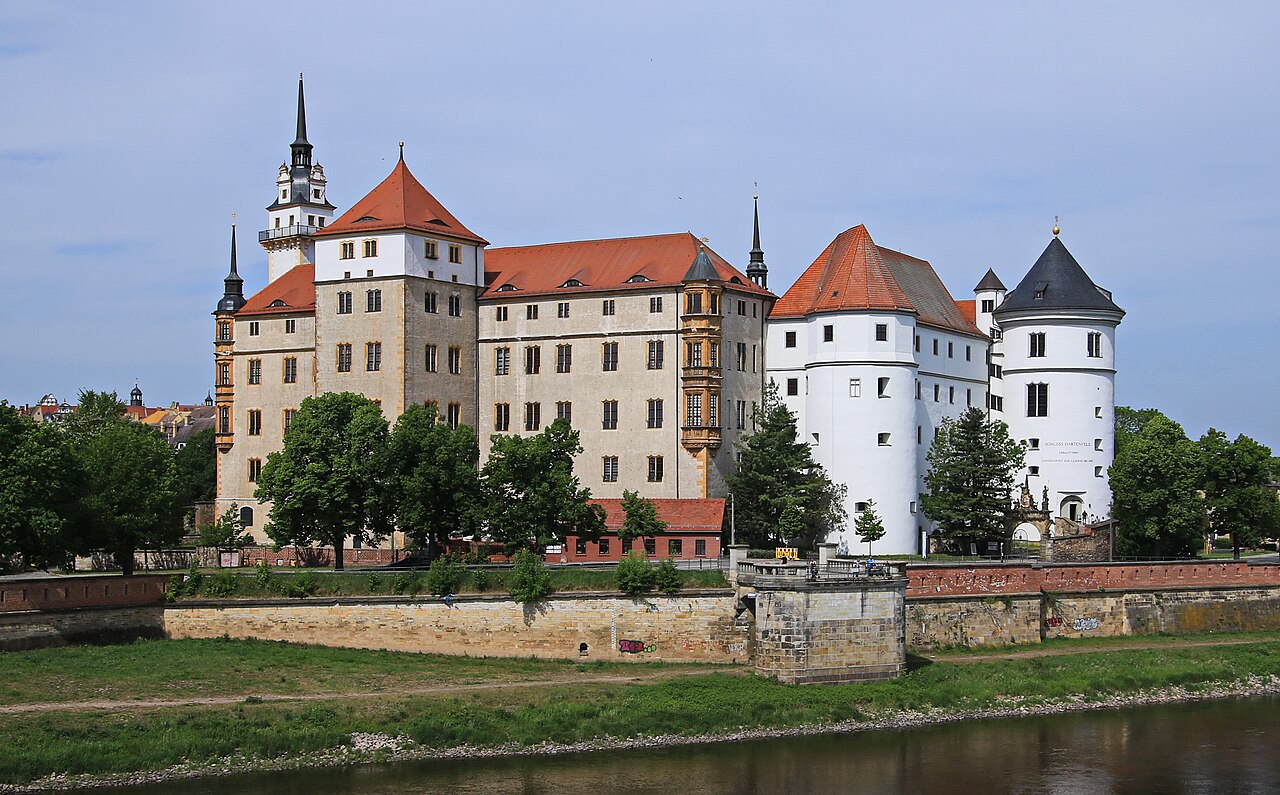
Schloss Pretzsch
Schloss Pretzsch stands as a significant Renaissance hill castle located in the municipality of Bad Schmiedeberg, in the region of Saxony-Anhalt, Germany. The castle's origins trace back to the medieval period, with the earliest recorded fortification dating from 981 AD. Over the centuries, Schloss Pretzsch has witnessed numerous architectural transformations and has played diverse roles, reflecting the shifting political, social, and cultural landscapes of the region.
Medieval origins and early history
The site of Schloss Pretzsch was initially occupied by a castle documented in the late 10th century, marking it as an important regional stronghold. By 1325, the castle was recognized as a fiefdom under Magnus von Rehfeld-Löser, indicating its integration into the feudal system. In 1380, a new castle was constructed on the site, although no visible remains of this medieval structure survive today. This early phase established the strategic and noble significance of the location, which would continue to evolve through subsequent centuries.
Renaissance transformation and architectural development
Between 1571 and 1574, the medieval fortifications were replaced by a two-winged palace built in the Saxon Renaissance style under the direction of Hans Löser. This marked a major architectural shift from a purely defensive structure to a more residential and representative palace, reflecting Renaissance ideals of symmetry, proportion, and ornamentation. The castle’s plastered brick construction exemplifies the regional adaptation of Renaissance architecture, combining functionality with aesthetic refinement.
Baroque modifications and expansions
In the late 17th and early 18th centuries, Schloss Pretzsch underwent significant Baroque alterations, particularly around 1700. These included the addition of an expanded attic and interior enhancements that introduced the ornate and dynamic elements characteristic of Baroque architecture. The castle’s two wings, each rising three stories, are arranged around the former moat system, preserving the memory of its defensive origins.
Distinctive architectural features
The western side of the castle features a notable two-story gatehouse with a two-part portal supported by diamond-cut pedestals and Doric columns, a classical Greek architectural element emphasizing strength and simplicity. The portal is richly decorated with carvings of winged putti and multiple coats of arms, including those of Hans Löser and Agnes von Bünau, as well as the alliance coat of arms of Wolf Christoph von Arnim and Catharina Dorothea von Hoym, dated 1647. Between the north and east wings stands a square stair tower, marked by a construction inscription above its entrance, symbolizing the castle’s layered history.
Historical significance and notable residents
Remarkably, Schloss Pretzsch survived the Thirty Years’ War without major damage, a testament to its robust construction and possibly its strategic diplomacy. In 1647, the estate passed to Wolf Christoph von Arnim. Later, in 1689, it was exchanged by Elector Johann Georg III for other knightly estates. From 1694 to 1696, the castle was home to Eleonore von Sachsen-Eisenach, widow of Johann Georg IV, who resided there with her children.
In 1697, the castle was granted by August the Strong to his wife, Christiane Eberhardine, as a widow’s residence. She used Schloss Pretzsch as a place of quiet retreat, dedicating herself to the support of the Lutheran faith and various charitable causes until her death in 1727. During her residency, the castle saw numerous construction projects that enhanced both its structure and interiors, blending Renaissance and Baroque styles.
Later uses and adaptations
From 1783, Schloss Pretzsch served administrative functions as a residence and office for forest officials. Between 1829 and 1923, it was repurposed as a girls’ orphanage affiliated with the Great Military Orphanage in Potsdam, reflecting its evolving social role. Subsequently, the castle was used as a factory producing organs and harmoniums, demonstrating adaptive reuse of the historic structure.
In the 20th century, the castle functioned as a guesthouse for visitors to local spa facilities. During World War II, it was adapted for various roles including a border police training school, a hospital, and a resettlement facility. Since 1947, Schloss Pretzsch has operated as a children’s home, continuing its tradition of serving community needs.
Architectural remnants and interior features
The castle is surrounded by the remains of water-filled moats, indicative of its original defensive purpose. The existing building is primarily a plastered brick structure reflecting the Saxon Renaissance architectural style, with significant Baroque modifications dating from around 1700. The two wings of the castle, each three stories high, enclose the former moat area.
Inside, much of the original Renaissance and Baroque interior detailing has been lost or altered, particularly due to its long use as an orphanage. However, some original elements survive, including decorated consoles from 1574, stucco ceilings from the early 18th century, and several studded doors. Additionally, three wooden ceiling panels with intricate arabesque designs dating from 1574 are preserved in a local museum, alongside cast-iron stove plates—one depicting the city of Dresden and another displayed in the Luther House of Wittenberg—offering insights into the artistic and functional décor of the period.
Gardens and landscape design
The castle’s surrounding park was initially laid out around 1702, likely designed by the renowned Baroque architect Matthäus Daniel Pöppelmann. Originally conceived as a Baroque pleasure garden characterized by symmetry and ornamental structures, the grounds were later transformed into orchards and kitchen gardens after 1727. Some remnants of the original garden architecture remain, including single-story masonry buildings connected by pavilions that served as garden houses and an orangery for cultivating citrus trees.
From the original statuary, only one sandstone sculpture survives: a putto playing a flute dressed in a jester’s costume. The former garden entrances are marked by sandstone portals located near the town and at the river landing site on the Elbe. In 1798, the formal Baroque garden was remodeled into a landscape garden, reflecting the changing tastes in garden design during the late 18th century.
Visiting Schloss Pretzsch today
Today, Schloss Pretzsch remains a well-preserved example of a Renaissance hill castle with significant Baroque architectural influences. While some interior features have been lost or altered, the castle’s exterior and surrounding landscape continue to evoke its historical grandeur. Visitors can appreciate the intricate details of the gatehouse portal, the preserved elements of the Renaissance and Baroque interiors, and the historic park grounds that tell the story of changing architectural and horticultural styles over centuries.
Frequently asked questions (FAQ)
- How do I get to Schloss Pretzsch?
- Schloss Pretzsch is located in Bad Schmiedeberg, Germany, and is easily accessible by car or public transport. If you're traveling by train, the nearest station is about 10 km away, and local buses can take you directly to the castle.
- What is the historical significance of Schloss Pretzsch?
- Schloss Pretzsch is a stunning example of Renaissance architecture and has a rich history dating back to the 16th century. It served as a residence for various noble families and played a significant role in the region's political and cultural development.
- When was Schloss Pretzsch built?
- The construction of Schloss Pretzsch began in 1560 and was completed in the early 17th century. Over the years, it has undergone several renovations, reflecting the architectural styles of different periods.
- Can I visit Schloss Pretzsch year-round?
- Yes, Schloss Pretzsch is open for visitors throughout the year, though opening hours may vary by season. It's advisable to check the official website for specific hours and any seasonal events that may enhance your visit.
- Why is Schloss Pretzsch considered an architectural gem?
- Schloss Pretzsch combines elements of Renaissance and Baroque architecture, making it a unique example of its kind. Its intricate facades, beautiful gardens, and well-preserved interiors showcase the craftsmanship of the era.
- Is it possible to take guided tours of Schloss Pretzsch?
- Yes, guided tours are available and provide in-depth insights into the castle's history and architecture. These tours often include access to areas not open to the general public and are a great way to enhance your experience.
- What are the ticket prices for visiting Schloss Pretzsch?
- Ticket prices for Schloss Pretzsch are generally affordable, with discounts available for students and seniors. Check the castle's official website for the most current pricing and any special family or group rates.
- What is the best time to visit Schloss Pretzsch?
- The best time to visit Schloss Pretzsch is during the spring and summer months when the gardens are in full bloom and outdoor activities are available. Additionally, the castle hosts various cultural events during these seasons, making it a vibrant time to explore.
- Are there any nearby attractions to Schloss Pretzsch?
- Yes, there are several attractions near Schloss Pretzsch, including the picturesque Elbe River and the scenic town of Bad Schmiedeberg. Visitors can enjoy hiking, cycling, and exploring local history in the surrounding area.
Information
Website
Visit websiteSources & official resources
Verify the information above using these authoritative references.
Loading map...
Visitor reviews
No reviews yet. Been here? Write the first review and help other travelers!
Write the first reviewVisited this castle? Share your experience
Your review helps other travelers and adds first-hand knowledge to our encyclopedia.