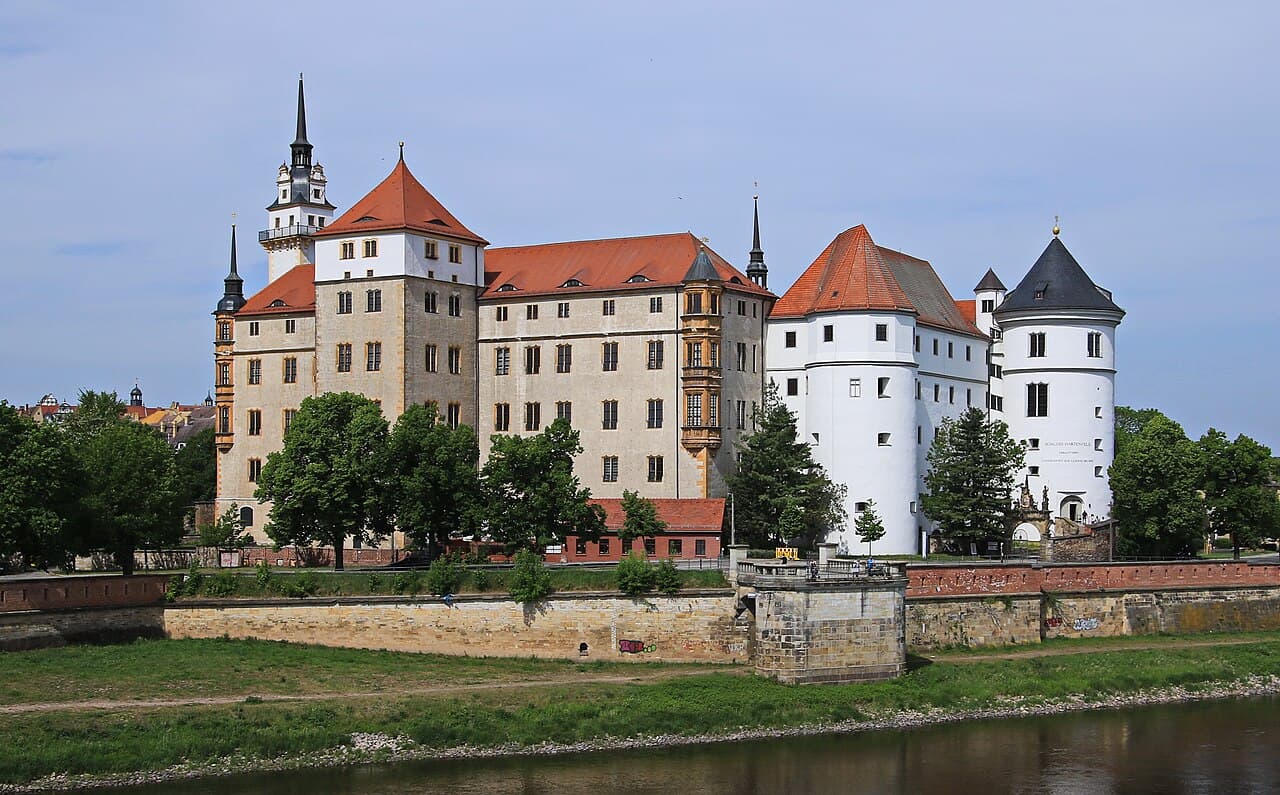
Hartenfels Castle
Hartenfels Castle stands prominently in the historic town of Torgau, Germany, as a remarkable example of early Renaissance architecture and a symbol of Saxon electoral power. This hill castle has served as a political and administrative center since the mid-10th century, evolving through centuries of architectural development and historical significance. The castle is especially renowned for its castle chapel, the first sacral building constructed exclusively for Protestant worship, consecrated by Martin Luther in 1544, marking a pivotal moment in the Reformation and the religious history of Saxony.
The origins and historical evolution of Hartenfels Castle
The site of Hartenfels Castle was originally a Slavic fortification located on the banks of the Elbe River. By the mid-10th century, it was developed into a castle, establishing its strategic importance in the region. The castle's significance grew notably after 1485 when Torgau came under the control of the Ernestine Electorate of Saxony. This transition marked the beginning of Torgau's rise as a political center, with the castle serving as the residence of the Saxon electors.
During the late 15th and early 16th centuries, Hartenfels Castle underwent significant architectural transformations, gradually evolving into an early modern castle. The period coincided with the rise of the Protestant Reformation, which deeply influenced the castle's role and design. From 1525 onward, Torgau became a hub of Protestant thought and governance, closely associated with the teachings of Martin Luther. The castle hosted numerous reformers and scholars from the University of Wittenberg, who advised the elector on theological, religious, and administrative matters.
Martin Luther himself visited Torgau approximately 60 times, highlighting the castle's central role in the Reformation. The castle chapel, designed with Protestant worship in mind, symbolized the elector's commitment to Lutheran doctrine and his leadership within the Protestant alliance. This religious and political significance was underscored by the chapel's consecration by Luther in 1544, an event carefully orchestrated as a public declaration of faith and power.
The castle sustained damage during the Thirty Years' War but has been the subject of multiple restoration efforts, particularly since the 1990s. Notable recent restorations include the Große Wendelstein (large stone spiral staircase) and the gallery of coats of arms. Restoration of the electoral chambers adjacent to the chapel has been ongoing, with plans to open these historically significant rooms to the public.
Architectural features and layout
Hartenfels Castle is characterized by its complex layout, consisting of five unequal wings arranged around a large irregular rectangular courtyard. Four wings form the main enclosure, while the fifth, an 18th-century addition, crosses the moat extending towards the city. The castle's high, primarily three-storey buildings are complemented by eight towers, numerous gables, and bay windows, creating a dynamic yet monumental silhouette.
The Große Wendelstein and other architectural highlights
The castle's most celebrated architectural feature is the Große Wendelstein, a magnificent stone spiral staircase located in the main wing. This staircase is a masterpiece of Renaissance stonework, notable for its scale and intricate design. Another highlight is the Beautiful Bay Window in the former living quarters of the electors, exemplifying the ornamental style of the period.
The Hausmannsturm tower is another prominent element, providing both defensive function and a commanding view over the town and the Elbe. The castle's entrance is marked by a representative late Renaissance gate, flanked by a slender bell tower, welcoming visitors from the city side.
Castle chapel: a landmark of Protestant architecture
The castle chapel at Hartenfels is a pioneering example of Protestant sacred architecture. Constructed as a hall church with two-story lofts surrounding the main space, it features a ribbed vault adorned with net and star patterns. This design was revolutionary for its time, emphasizing the centrality of preaching in Protestant worship by positioning the pulpit prominently on the northern long side, visible from all angles.
The chapel's architectural and symbolic design reflected the religious and political aspirations of Elector John Frederick, who sought to manifest his dedication to Lutheran teachings and his leadership in the Protestant alliance. The consecration by Martin Luther in 1544 was a defining moment, reinforcing the chapel's role as a spiritual and political statement.
Hartenfels Castle in the context of Saxon and Reformation history
Beyond its architectural significance, Hartenfels Castle played a crucial role in the religious and political transformations of Saxony during the 16th century. As the residence of the Saxon electors, it was a center where religious reform and state governance intersected. The castle's association with prominent reformers and its function as a venue for theological consultation underscore its importance in the broader narrative of the Protestant Reformation.
The castle's history is intertwined with the turbulent events of the Thirty Years' War, during which it suffered damage but remained a symbol of Saxon resilience. Subsequent restoration efforts have preserved its historical fabric and enhanced its role as a cultural landmark.
Visiting Hartenfels Castle today
Today, Hartenfels Castle stands as a well-preserved monument open to the public, offering visitors a glimpse into the rich history of Saxony and the Reformation. The ongoing restoration of the electoral chambers promises to expand the visitor experience, providing deeper insight into the castle's political and religious significance.
The castle's architectural grandeur, combined with its historical importance, makes it a key destination for those interested in Renaissance architecture, Protestant history, and German cultural heritage. Visitors can explore the courtyard, towers, chapel, and restored interiors, gaining a comprehensive understanding of the castle's multifaceted legacy.
Frequently asked questions (FAQ)
- When was Hartenfels Castle originally built?
- Hartenfels Castle was originally developed into a castle in the mid-10th century on the site of a former Slavic fortification.
- What makes the castle chapel at Hartenfels unique?
- The castle chapel was the first sacral building constructed exclusively for Protestant worship, consecrated by Martin Luther in 1544, emphasizing the central role of preaching.
- Can visitors access the electoral chambers?
- The electoral chambers are currently undergoing restoration, with plans to open them to the public as part of a permanent exhibition.
- What architectural styles are represented in Hartenfels Castle?
- Hartenfels Castle primarily features early Renaissance architecture with elements reflecting its medieval origins.
- Are there any notable architectural features in the castle?
- Notable features include the Große Wendelstein stone spiral staircase, the Beautiful Bay Window, the Hausmannsturm tower, and the late Renaissance gate with bell tower.
Photo gallery

Information
Opening hours
10:00-17:00, daily
Ticket prices
€8 adult, €4 child
Current owner
State museum
Loading map...
Visitor reviews
No reviews yet. Been here? Write the first review and help other travelers!
Write the first reviewVisited this castle? Share your experience
Your review helps other travelers and adds first-hand knowledge to our encyclopedia.



